


Summer Outlook: Developing El Niño Set to Impact Drought, Wildfires Nationwide
As this year’s meteorological summer swings in, many folks wonder what might be in store when it comes to temperature trends and extremes, drought conditions, and wildfire risks.
In order to bring a bit more clarity to the season, WeatherBug, in collaboration with meteorologists from AEM, has released its Summer 2026 Outlook for wildfires and drought.
Even long-range weather models have a steep dropoff in their accuracy and precision after just one week, so our meteorologists studied current environments, analog summers, climate models, and various climate-related indices to create a clearer picture of what is to come.
To begin with, the meteorologists mainly studied three climate indices that will affect summer.
Firstly, a particularly strong El Niño event is projected this summer, characterized by sea surface temperatures up to 1.5 to 2.0 degrees Celsius above average along the Equator in the eastern and central tropical Pacific Ocean.
AEM meteorologist Kyle Leahy, who is well-versed in teleconnections such as El Niño, can add a bit of context to these numbers.
“El Niño summers, especially strong ones, are usually temperate to even a bit cooler than normal for most of the central U.S. and Midwest. They can be on the hotter side in the West. In terms of precipitation, they're usually wet over the Rockies and Southwest, as well as the Midwest and the interior Northeast.”
Secondly, the Pacific Decadal Oscillation tracks ocean temperatures off the U.S. West Coast, which is cooler than average but to a lesser extent than in 2025. These cooler waters would only serve to decrease evaporation into the atmosphere, limiting precipitation across the Mountain West and Pacific Northwest and opposing El Niño’s far-reaching, but less directly correlated, effects.
Lastly, the North Atlantic Ocean remains warmer than average, which increases available moisture and heat content that Atlantic storms feed on. In contrast, another one of El Niño’s common summer symptoms includes stronger environmental winds in the Gulf and western tropical Atlantic, winds that can suppress hurricane development and counter the Atlantic’s extra thermal energy.
Using these observations and projections, alongside other factors like recent jet stream behavior, meteorologists can identify similar summers of years past, also called analog summers. By comparing these analogs, precipitation and temperature patterns can be identified, which often hint at what lies ahead, honing predictions even further with long-range climate models and government resources from both the Climate Prediction Center and Environment Canada.
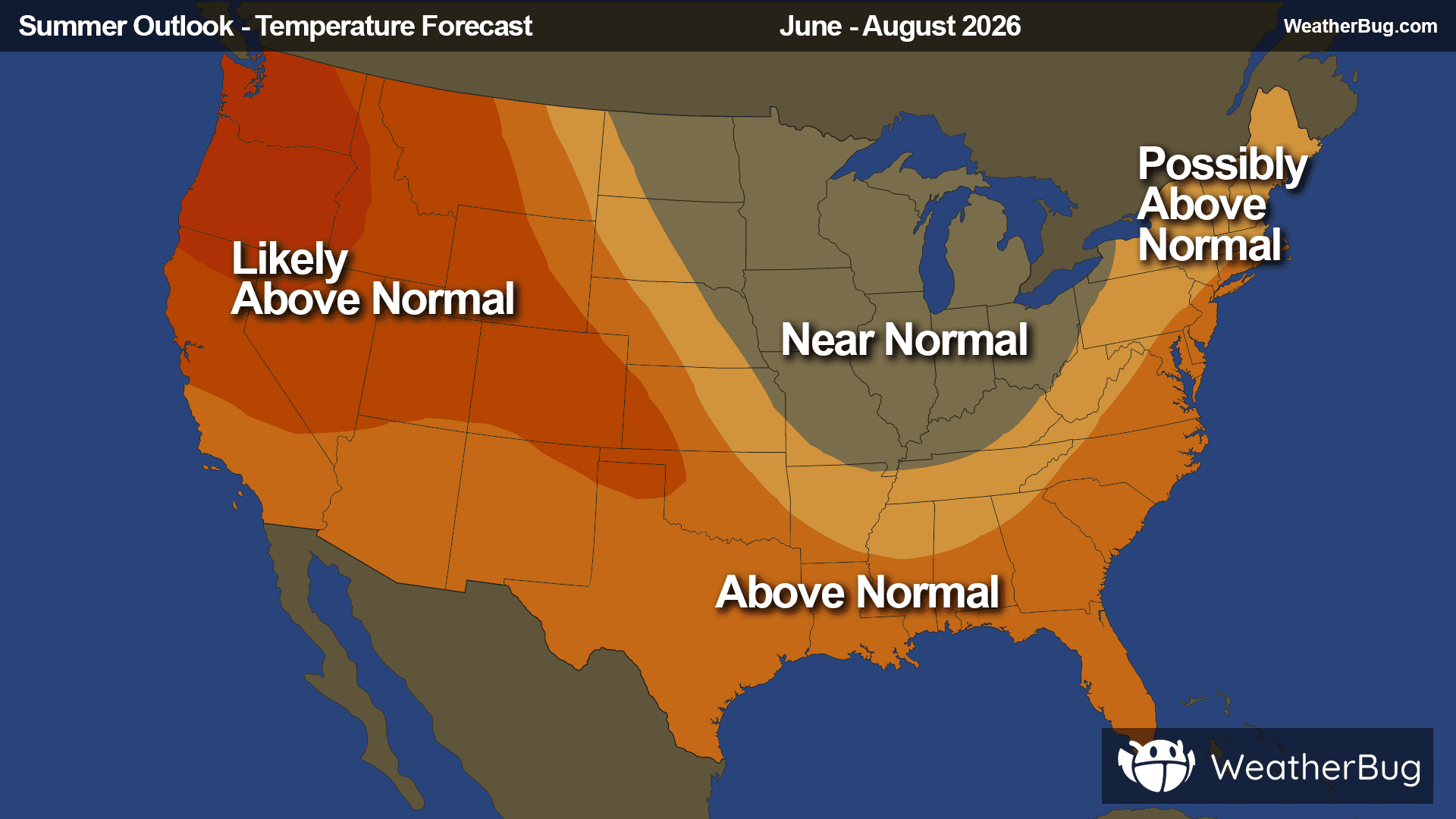
When it comes to temperatures, analogs and models for 2026 suggest that regions like the Northeast, Atlantic Canada, the West Coast, British Columbia, the Northwest, and the Mountain West are expecting above-average temperatures this summer, with the Deep South joining in the warm anomaly late this summer. By contrast, the Midwest is likely to observe cooler-than-average temperatures, which would lessen water losses via evaporation, while the Canadian Prairie leans toward normal.
As for precipitation, much of the East Coast and Appalachia will likely have above-average rainfall, and there is expected to be a more active monsoon season in New Mexico and western Texas. On the contrary, the Gulf states, the lower Great Lakes, the central Plains, and the northern Rockies and Cascades are all looking at below-average rainfall.
Entering this summer, there is also a need to evaluate current conditions across the U.S. and Canada.
Long-term severe to exceptional drought has marred a vast expanse, including the Southeast, the Mid-South, the central and southern Plains, and, particularly, a majority of the Mountain West. With expansive drought in the Southeast, crops such as peanuts and cotton have seen the greatest impacts on their expected yield and quality.
Across the various coastal and inland ranges of the western U.S., an especially warm and dry winter left what is considered to be one of the lowest snowpacks in the last 40 years, and water from melting snow usually constitutes half of this region’s reservoir water. Effects are already being observed, and snowmelt rates for what is left continue to exceed expectations.
For example, Lake Powell, a major reservoir and hydroelectricity generator on the Utah-Arizona border, is at a staggeringly small 24% of its water capacity. Furthermore, due to accelerating snowmelt, the snow-water equivalent of the snowpack that feeds into Lake Powell is just 23% of normal, meaning that any snowpack is much more compact, dirt-dense, and water-scarce than usual for this time of year.
Fortunately, a drought based within the Intermountain West and the Rockies, as opposed to the Great Plains and the timber-filled Canadian Interior, does have a benefit, just way downstream.
“Canada’s wildfire season is off to a slow start this year, with activity below average and largely centered farther west,” says AEM meteorologist Josh Kinsky, who has been studying the drought and wildfire consitions of the Canadian interior.
“As a result, significant smoke impacts in the Northeast, like those seen in June 2023, are unlikely. At most, there is a low risk of brief air quality issues if weather patterns align and allow smoke to funnel into the region.”
Lastly, weaker yet present drought conditions exist in the Pacific Northwest and sprinkled across northern Canada, as well as from the U.S. Northeast up to Canada’s Gulf of St. Lawrence. There have been noted decreases in the Columbia River’s hydroelectric output as a direct result of lighter snowpack.
Now, combining this information about current conditions, climate models, and analog summers, drought and wildfire predictions can be made for the upcoming dog days.
Moving from west to east, the Pacific Northwest, British Columbia, and the northern Rockies are likely to slowly degrade into drought through this summer, with wildfire potential increasing as well and peaking in the late summer and early autumn. These regions are particularly vulnerable to a strained electric load, thanks to the underperforming hydroelectric yields.
The Mountain West, already saddled with drought and minimal snowpack, will continue to dry out this summer, with prime wildfire conditions shifting northward each month as is typical. Luckily, a stronger North American monsoon than usual will push into the Four Corners region as summer progresses, weakening drought impacts and bolstering soil moisture in much of the Southwest.
Similarly to the Mountain West, the High Plains and Canadian Interior are expecting drought degradation this summer. However, with wildfire season keeping to the spring and fall months in the High Plains, significant wildfire potential is not anticipated, although the opposite is expected for the Canadian Prairie in the early Summer.
The western Gulf can expect early summer drought improvements, bringing a temporary boon to drought-riddled territory. However, the latter half of summer looks to leave deteriorating drought conditions and an increasing wildfire risk. Florida and the eastern Gulf are instead anticipating the converse, with a drier start, a wetter end, and decreasing wildfire risks through the dog days.
Lastly, drought improvements are probable for the Canadian Maritime and U.S. Northeast, leading to a dent, but not a full erasure, of current moderate to severe drought areas across the North Atlantic coast.
The 2026 Summer Outlook team included meteorologists Kyle Leahy, Josh Kinsky, and Keegan Miller, along with senior meteorologists James Aman and Rob Reale.