---
title: Heat Related Illness | WeatherBug | WeatherBug
description: When your body heats too quickly, it may have trouble cooling itself properly, leading to a heat illness.
canonical: https://www.weatherbug.com/news/Heat-Related-Illness
og:title: Heat Related Illness | WeatherBug | WeatherBug
og:description: When your body heats too quickly, it may have trouble cooling itself properly, leading to a heat illness.
og:url: https://www.weatherbug.com/news/Heat-Related-Illness
og:site_name: WeatherBug
og:locale: en_US
og:image: https://cms-assets-con.cdn.weatherbug.net/assets/contentitems/a4/a415de8e-f12d-4688-8221-507d5fb19a49/52e0ce98-d40a-4283-82d1-d0fe816ebf4b/760ee519-809b-4ddf-b55e-c445741bd095.jpg
og:image:width: 800
og:image:height: 600
og:image:alt: Story Image courtesy of NWS
og:type: article
article:published_time: 2025-06-12T08:59:28Z
article:modified_time: 2025-06-12T08:59:28Z
article:author: By WeatherBug's Ali Husain
article:tag: featured
article:tag: heat
article:tag: illness
article:tag: map
article:tag: maps
article:tag: safety
article:tag: summer
article:tag: weather
twitter:card: summary_large_image
twitter:title: Heat Related Illness | WeatherBug
twitter:description: When your body heats too quickly, it may have trouble cooling itself properly, leading to a heat illness.
twitter:image: https://cms-assets-con.cdn.weatherbug.net/assets/contentitems/a4/a415de8e-f12d-4688-8221-507d5fb19a49/52e0ce98-d40a-4283-82d1-d0fe816ebf4b/760ee519-809b-4ddf-b55e-c445741bd095.jpg
---
[](/)
[Back to forecast](/)
# Heat Related Illness
June 12, 2025 at 04:59 AM EDT
By WeatherBug's Ali Husain
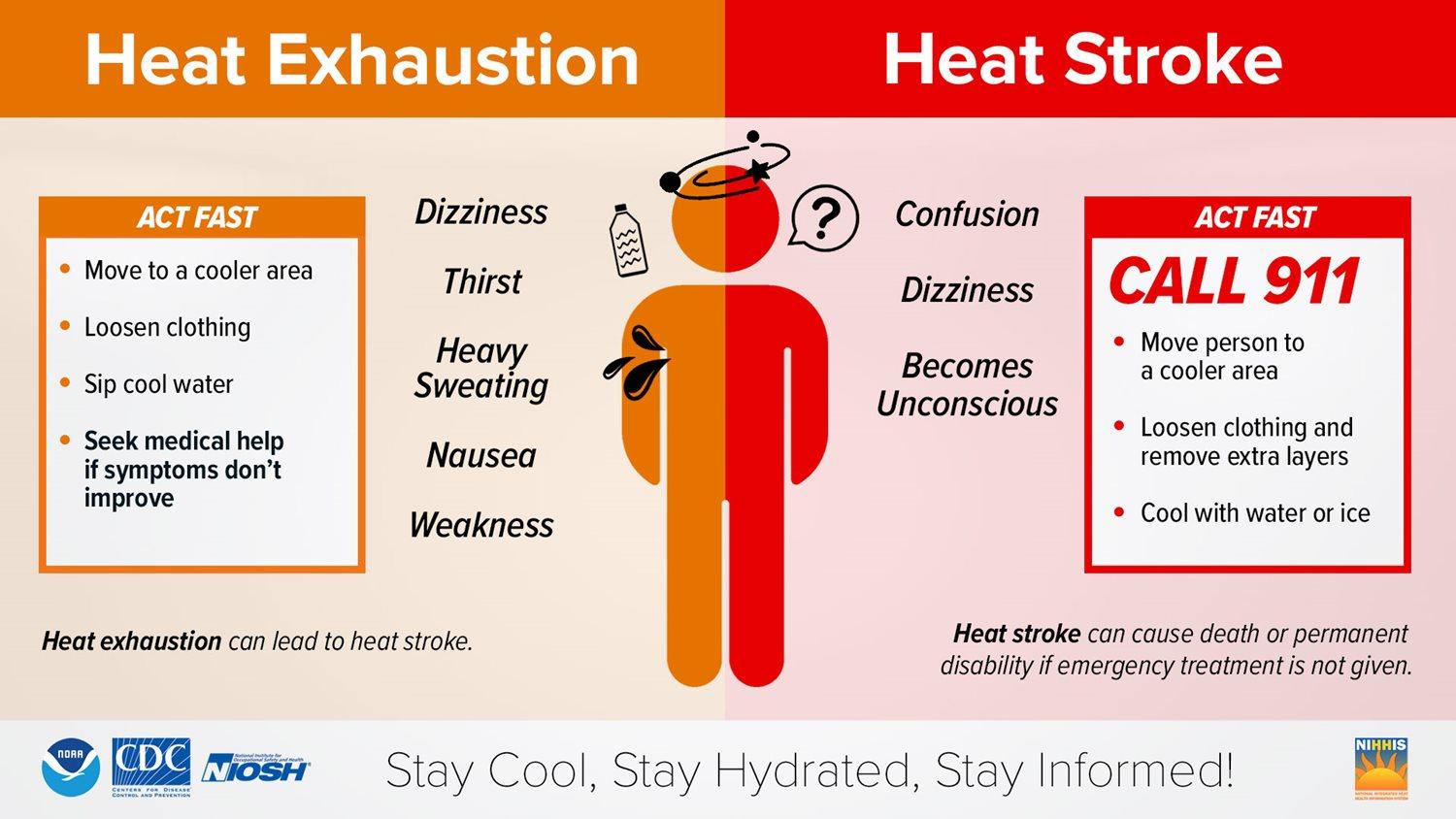
When your body heats too quickly, it may have trouble cooling itself properly, leading to a heat-related illness.
Sweating is your body’s way of cooling itself. Sweat is released from sweat glands to the surface of your skin, and as your body heat evaporates the sweat it cools itself down in the process. However, sweat contains water, of course, and electrolytes such as sodium, calcium, potassium and magnesium—essential minerals that are vital for many of your body’s key functions.
The dehydration of your body and the loss of crucial electrolytes can have serious consequences. **Heat cramps** may be the first expression of heat illness, and are characterized by painful muscle spasms, usually in the abdomen and legs. To treat heat cramps, apply firm pressure on the cramping muscles, or massage gently to relieve the pain. Give the person sips of water unless the person begins to feel nauseous, then stop giving water. Seek immediate medical attention if cramps last longer than one (1) hour.
Heat cramps may be the first signs of **heat exhaustion**. Someone experiencing heat exhaustion will be sweating heavily and will be weak or tired. They will appear pale with skin that is cool and clammy to the touch, and will have a fast, weak pulse while experiencing heat cramps. They may also experience dizziness or nausea, headaches, and fainting. Move the person immediately to a cooler environment, preferably an air conditioned room. Loosen their clothing, and apply wet, loose cloths or sit in a cool bath. Offer sips of water, and if the person vomits more than once or symptoms last more than an hour, seek immediate medical attention.
The final stage of worsening heat illness is a **heat stroke**. A person experiencing heat stroke will have confusion, nausea and dizziness. Their body temperature will usually be above 103 F, and the skin will be hot, red, and dry or damp with a rapid or strong pulse. They will also experience a throbbing headache that will lead to fainting and loss of consciousness. Call 911 or get the victim to the hospital immediately, as a heat stroke is a severe medical emergency as any delay could be fatal. If possible, reduce body temperature with cool cloths or baths, and lower the temperature of the surroundings as much as possible. Use a fan if the heat index is below the upper 90s, as a fan can make you hotter at higher temperatures. Do **NOT** give fluids.
Heat illnesses can sometimes have serious and fatal effects. Take precautions when you can to minimize the risks of overheating.
_Source:_ NWS
\-----
_Story Image via NWS_
We use technologies, such as cookies, to analyze your use (i.e., pages visited), to customize content, for our internal analytics purposes and for security and other purposes. By continuing to use this website, you agree to this usage. Please review our [privacy policy](/legal/privacy) for more details as well as for information on how to contact us to object to these activities. [Ad Choices](/legal/privacy#digitaladvertisingandyourchoices)
```json
{"@context":"https://schema.org","@type":"NewsArticle","mainEntityOfPage":{"@type":"WebPage","@id":"https://www.weatherbug.com/news/Heat-Related-Illness"},"headline":"Heat Related Illness","description":"When your body heats too quickly, it may have trouble cooling itself properly, leading to a heat illness.","image":["https://cms-assets-con.cdn.weatherbug.net/assets/contentitems/a4/a415de8e-f12d-4688-8221-507d5fb19a49/52e0ce98-d40a-4283-82d1-d0fe816ebf4b/760ee519-809b-4ddf-b55e-c445741bd095.jpg"],"datePublished":"2025-06-12T08:59:28Z","dateModified":"2025-06-12T08:59:28Z","dateCreated":"2025-06-12T08:59:28Z","articleSection":"Weather News","keywords":"featured,heat,illness,map,maps,safety,summer,weather","articleBody":"When your body heats too quickly, it may have trouble cooling itself properly, leading to a heat-related illness.
\r\n
\r\nSweating is your body’s way of cooling itself. Sweat is released from sweat glands to the surface of your skin, and as your body heat evaporates the sweat it cools itself down in the process. However, sweat contains water, of course, and electrolytes such as sodium, calcium, potassium and magnesium—essential minerals that are vital for many of your body’s key functions.
\r\n
\r\nThe dehydration of your body and the loss of crucial electrolytes can have serious consequences. Heat cramps may be the first expression of heat illness, and are characterized by painful muscle spasms, usually in the abdomen and legs. To treat heat cramps, apply firm pressure on the cramping muscles, or massage gently to relieve the pain. Give the person sips of water unless the person begins to feel nauseous, then stop giving water. Seek immediate medical attention if cramps last longer than one (1) hour.
\r\n
\r\nHeat cramps may be the first signs of heat exhaustion. Someone experiencing heat exhaustion will be sweating heavily and will be weak or tired. They will appear pale with skin that is cool and clammy to the touch, and will have a fast, weak pulse while experiencing heat cramps. They may also experience dizziness or nausea, headaches, and fainting. Move the person immediately to a cooler environment, preferably an air conditioned room. Loosen their clothing, and apply wet, loose cloths or sit in a cool bath. Offer sips of water, and if the person vomits more than once or symptoms last more than an hour, seek immediate medical attention.
\r\n
\r\nThe final stage of worsening heat illness is a heat stroke. A person experiencing heat stroke will have confusion, nausea and dizziness. Their body temperature will usually be above 103 F, and the skin will be hot, red, and dry or damp with a rapid or strong pulse. They will also experience a throbbing headache that will lead to fainting and loss of consciousness. Call 911 or get the victim to the hospital immediately, as a heat stroke is a severe medical emergency as any delay could be fatal. If possible, reduce body temperature with cool cloths or baths, and lower the temperature of the surroundings as much as possible. Use a fan if the heat index is below the upper 90s, as a fan can make you hotter at higher temperatures. Do NOT give fluids.
\r\n
\r\nHeat illnesses can sometimes have serious and fatal effects. Take precautions when you can to minimize the risks of overheating.
\r\n
\r\nSource: NWS
\r\n-----
\r\nStory Image via NWS","author":{"@type":"Person","name":"By WeatherBug's Ali Husain","url":"https://www.weatherbug.com"},"publisher":{"@type":"Organization","name":"WeatherBug","logo":{"@type":"ImageObject","url":"https://www.weatherbug.com/images/sharing/f1ff28ba-6f06-4745-a782-011a20397e16.png"}}}
{"@context":"https://schema.org","@type":"WebSite","mainEntityOfPage":{"@type":"WebPage","@id":"https://www.weatherbug.com/news/Heat-Related-Illness","relatedLink":"https://www.weatherbug.com/news/Heat-Related-Illness"},"name":"WeatherBug","url":"https://www.weatherbug.com/news/Heat-Related-Illness","headline":"Heat Related Illness","description":"When your body heats too quickly, it may have trouble cooling itself properly, leading to a heat illness.","dateModified":"2025-06-12T08:59:28Z","publisher":{"@type":"Organization","name":"WeatherBug","url":"https://www.weatherbug.com","sameAs":["https://www.facebook.com/WeatherBug","https://instagram.com/WeatherBug","https://www.linkedin.com/company/weatherbug","https://www.pinterest.com/weatherbug","https://twitter.com/WeatherBug","https://www.youtube.com/user/WeatherBugVideo"],"logo":{"@type":"ImageObject","url":"https://www.weatherbug.com/images/logos/weatherbug_logo_620x447.png"}},"author":{"@type":"Organization","name":"WeatherBug","url":"https://www.weatherbug.com","sameAs":["https://www.facebook.com/WeatherBug","https://instagram.com/WeatherBug","https://www.linkedin.com/company/weatherbug","https://www.pinterest.com/weatherbug","https://twitter.com/WeatherBug","https://www.youtube.com/user/WeatherBugVideo"],"logo":{"@type":"ImageObject","url":"https://www.weatherbug.com/images/logos/weatherbug_logo_620x447.png"}}}
{"@context":"https://schema.org","@type":"Organization","name":"WeatherBug","logo":"https://www.weatherbug.com/images/logos/weatherbug_logo_620x447.png","url":"https://www.weatherbug.com","sameAs":["https://www.facebook.com/WeatherBug","https://instagram.com/WeatherBug","https://www.linkedin.com/company/weatherbug","https://www.pinterest.com/weatherbug","https://twitter.com/WeatherBug","https://www.youtube.com/user/WeatherBugVideo"]}
```