---
title: September Hurricane Climatology | WeatherBug | WeatherBug
description: September is typically the busiest month for Atlantic Basin tropical activity.
canonical: https://www.weatherbug.com/news/September-Hurricane-Climatology
og:title: September Hurricane Climatology | WeatherBug | WeatherBug
og:description: September is typically the busiest month for Atlantic Basin tropical activity.
og:url: https://www.weatherbug.com/news/September-Hurricane-Climatology
og:site_name: WeatherBug
og:locale: en_US
og:image: https://cms-assets-con.cdn.weatherbug.net/assets/contentitems/fa/facadb87-7e23-4f4b-a329-cfef0c9b3996/52e0ce98-d40a-4283-82d1-d0fe816ebf4b/d761e042-de64-4812-9721-7c597a2be49a.jpg
og:image:width: 800
og:image:height: 600
og:image:alt: General September Storm Tracks
og:type: article
article:published_time: 2025-09-01T09:14:19Z
article:modified_time: 2025-09-01T09:14:19Z
article:author: Updated By WeatherBug Meteorologists
article:tag: Atlantic
article:tag: hurricane
article:tag: September
article:tag: Tropics
twitter:card: summary_large_image
twitter:title: September Hurricane Climatology | WeatherBug
twitter:description: September is typically the busiest month for Atlantic Basin tropical activity.
twitter:image: https://cms-assets-con.cdn.weatherbug.net/assets/contentitems/fa/facadb87-7e23-4f4b-a329-cfef0c9b3996/52e0ce98-d40a-4283-82d1-d0fe816ebf4b/d761e042-de64-4812-9721-7c597a2be49a.jpg
---
[](/weather-forecast/now)
[Back to forecast](/weather-forecast/now)
# September Hurricane Climatology
September 1, 2025 at 05:14 AM EDT
Updated By WeatherBug Meteorologists
September is the prime month for tropical formation in the Atlantic Basin. The climatological peak or day that tends to have the most tropical activity is September 10.
Four storms typically develop in any given September. This is more than any other month of the season. After September, Atlantic tropical activity tends to decrease until the season’s end on November 30.
By September 1, an "average" season would have already seen four named storms. Two of these would have been hurricanes, with one a major hurricane, Category 3 or higher (winds more than 111 mph).
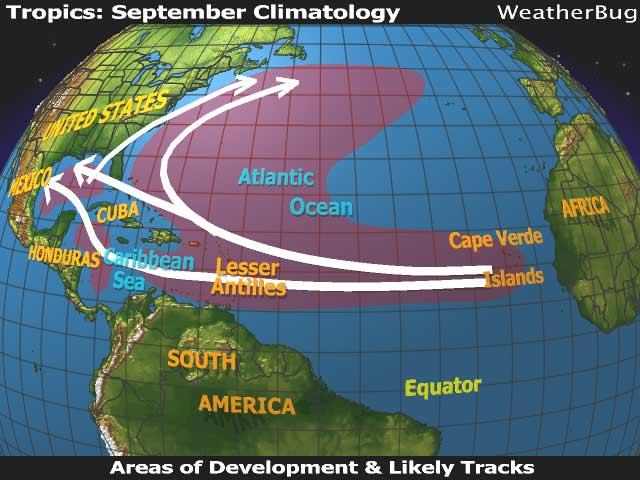
Development of tropical weather systems in September is not much different from what’s seen during August. Tropical storms and hurricanes can develop pretty much anywhere over the warm open waters of the Gulf of Mexico, Caribbean Sea, and the Atlantic Ocean as far east as the Cape Verde Islands.
Clockwise flow of air around a large area of high pressure dominating the north-central Atlantic steers tropical system westward across the warm ocean waters. The westward extension of the north-central Atlantic high pressure system helps to determine whether storms will track through the Caribbean and into the Gulf of Mexico, move across Florida or make the turn up the U.S. East Coast or Bermuda.
The entire Gulf of Mexico and Atlantic U.S. coastlines are vulnerable to tropical storms and hurricanes during the month of September.
The month of September has been active in recent years. Major hurricanes Helene and Kirk were two of six named storms that formed in September 2024, with those two being the strongest as they peaked as Category 4 hurricanes. Helene was particularly disastrous for the U.S. as it made landfall on the Florida Peninsula and caused catastrophic flooding in the southern Appalachians.
There were six named storms in September 2023, including Nigel and Margot, which intensified into hurricanes. Lee was a powerhouse, explosively intensifying to a Category 5 hurricane on the Saffir-Simpson Wind Scale with sustained winds of 165 mph and higher gusts during predawn on September on September 8\. Lee brushed Bermuda as a Category 1 hurricane on September 16 and made landfall in Atlantic Canada two days later.
Notable September hurricanes include:
* Hurricane Gloria — 1985
* Hurricane Hugo — 1989
* Hurricane Bob — 1991
* Hurricane Fran — 1996
* Hurricanes Dennis and Floyd — 1999
* Hurricane Isabel — 2003
* Hurricane Ivan — 2004
* Hurricane Rita — 2005
* Hurricane Ivan — 2004
* Hurricane Rita — 2005
* Hurricane Ike — 2008
* Hurricane Irma and Maria — 2017
We use technologies, such as cookies, to analyze your use (i.e., pages visited), to customize content, for our internal analytics purposes and for security and other purposes. By continuing to use this website, you agree to this usage. Please review our [privacy policy](/legal/privacy) for more details as well as for information on how to contact us to object to these activities. [Ad Choices](/legal/privacy#digitaladvertisingandyourchoices)
```json
{"@context":"https://schema.org","@type":"NewsArticle","mainEntityOfPage":{"@type":"WebPage","@id":"https://www.weatherbug.com/news/September-Hurricane-Climatology"},"headline":"September Hurricane Climatology","description":"September is typically the busiest month for Atlantic Basin tropical activity.","image":["https://cms-assets-con.cdn.weatherbug.net/assets/contentitems/fa/facadb87-7e23-4f4b-a329-cfef0c9b3996/52e0ce98-d40a-4283-82d1-d0fe816ebf4b/d761e042-de64-4812-9721-7c597a2be49a.jpg"],"datePublished":"2025-09-01T09:14:19Z","dateModified":"2025-09-01T09:14:19Z","dateCreated":"2025-09-01T09:14:19Z","articleSection":"Weather News","keywords":"Atlantic,hurricane,September,Tropics","articleBody":"September is the prime month for tropical formation in the Atlantic Basin. The climatological peak or day that tends to have the most tropical activity is September 10.
\r\n
\r\nFour storms typically develop in any given September. This is more than any other month of the season. After September, Atlantic tropical activity tends to decrease until the season’s end on November 30.
\r\n
\r\nBy September 1, an \"average\" season would have already seen four named storms. Two of these would have been hurricanes, with one a major hurricane, Category 3 or higher (winds more than 111 mph).
\r\n
\r\nDevelopment of tropical weather systems in September is not much different from what’s seen during August. Tropical storms and hurricanes can develop pretty much anywhere over the warm open waters of the Gulf of Mexico, Caribbean Sea, and the Atlantic Ocean as far east as the Cape Verde Islands.
\r\n
\r\nClockwise flow of air around a large area of high pressure dominating the north-central Atlantic steers tropical system westward across the warm ocean waters. The westward extension of the north-central Atlantic high pressure system helps to determine whether storms will track through the Caribbean and into the Gulf of Mexico, move across Florida or make the turn up the U.S. East Coast or Bermuda.
\r\n
\r\nThe entire Gulf of Mexico and Atlantic U.S. coastlines are vulnerable to tropical storms and hurricanes during the month of September.
\r\n
\r\nThe month of September has been active in recent years. Major hurricanes Helene and Kirk were two of six named storms that formed in September 2024, with those two being the strongest as they peaked as Category 4 hurricanes. Helene was particularly disastrous for the U.S. as it made landfall on the Florida Peninsula and caused catastrophic flooding in the southern Appalachians.
\r\n
\r\nThere were six named storms in September 2023, including Nigel and Margot, which intensified into hurricanes. Lee was a powerhouse, explosively intensifying to a Category 5 hurricane on the Saffir-Simpson Wind Scale with sustained winds of 165 mph and higher gusts during predawn on September on September 8. Lee brushed Bermuda as a Category 1 hurricane on September 16 and made landfall in Atlantic Canada two days later.
\r\n
\r\nNotable September hurricanes include:\r\n\r\n\t- Hurricane Gloria — 1985
\r\n\t- Hurricane Hugo — 1989
\r\n\t- Hurricane Bob — 1991
\r\n\t- Hurricane Fran — 1996
\r\n\t- Hurricanes Dennis and Floyd — 1999
\r\n\t- Hurricane Isabel — 2003
\r\n\t- Hurricane Ivan — 2004
\r\n\t- Hurricane Rita — 2005
\r\n\t- Hurricane Ivan — 2004
\r\n\t- Hurricane Rita — 2005
\r\n\t- Hurricane Ike — 2008
\r\n\t- Hurricane Irma and Maria — 2017
\r\n
\r\n","author":{"@type":"Person","name":"Updated By WeatherBug Meteorologists","url":"https://www.weatherbug.com"},"publisher":{"@type":"Organization","name":"WeatherBug","logo":{"@type":"ImageObject","url":"https://www.weatherbug.com/images/sharing/f1ff28ba-6f06-4745-a782-011a20397e16.png"}}}
{"@context":"https://schema.org","@type":"WebSite","mainEntityOfPage":{"@type":"WebPage","@id":"https://www.weatherbug.com/news/September-Hurricane-Climatology","relatedLink":"https://www.weatherbug.com/news/September-Hurricane-Climatology"},"name":"WeatherBug","url":"https://www.weatherbug.com/news/September-Hurricane-Climatology","headline":"September Hurricane Climatology","description":"September is typically the busiest month for Atlantic Basin tropical activity.","dateModified":"2025-09-01T09:14:19Z","publisher":{"@type":"Organization","name":"WeatherBug","url":"https://www.weatherbug.com","sameAs":["https://www.facebook.com/WeatherBug","https://instagram.com/WeatherBug","https://www.linkedin.com/company/weatherbug","https://www.pinterest.com/weatherbug","https://twitter.com/WeatherBug","https://www.youtube.com/user/WeatherBugVideo"],"logo":{"@type":"ImageObject","url":"https://www.weatherbug.com/images/logos/weatherbug_logo_620x447.png"}},"author":{"@type":"Organization","name":"WeatherBug","url":"https://www.weatherbug.com","sameAs":["https://www.facebook.com/WeatherBug","https://instagram.com/WeatherBug","https://www.linkedin.com/company/weatherbug","https://www.pinterest.com/weatherbug","https://twitter.com/WeatherBug","https://www.youtube.com/user/WeatherBugVideo"],"logo":{"@type":"ImageObject","url":"https://www.weatherbug.com/images/logos/weatherbug_logo_620x447.png"}}}
{"@context":"https://schema.org","@type":"Organization","name":"WeatherBug","logo":"https://www.weatherbug.com/images/logos/weatherbug_logo_620x447.png","url":"https://www.weatherbug.com","sameAs":["https://www.facebook.com/WeatherBug","https://instagram.com/WeatherBug","https://www.linkedin.com/company/weatherbug","https://www.pinterest.com/weatherbug","https://twitter.com/WeatherBug","https://www.youtube.com/user/WeatherBugVideo"]}
```