Back to forecast
2023 Summer Outlook: Hot Weather With A Delayed Start to Wildfire Season
May 25, 2023 at 02:19 PM EDT
By WeatherBug Meteorologists
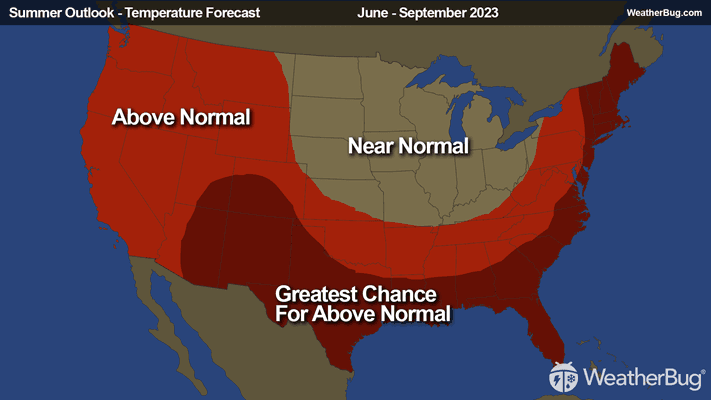
Summer 2023 is on the horizon… Despite a soggy start to the year, Mother Nature will deliver unusually hot weather to the West with normal to below normal rainfall. In contrast, expect a surplus of moisture for the eastern half of the U.S.
The El Niño -Southern Oscillation, or ENSO, is a recurring climate pattern involving changes in the temperature of waters in the central and eastern tropical Pacific Ocean. It can be a major factor in determining temperature and precipitation patterns across North America.
The most recent observation shows ENSO is currently in an ENSO-Neutral phase. However, a transition from ENSO-Neutral to El Niño is favored by early summer. The chances for El Niño increase to greater than 90 percent by later this summer. El Niño is warming of the ocean surface or above-average sea surface temperatures in the central and eastern tropical Pacific Ocean. ENSO has the strongest impact in the winter months, but it does have an influence on the weather during the summer.
“When we just consider El Niño, temperatures are usually slightly below average throughout the U.S. during the months of June, July and August,” said AEM Meteorologist Alyssa Robinette. She added, “typically, below average rainfall falls across the north-central U.S. into the Northeast. The rest of the nation experiences near to above normal rainfall.”
Over the past 20 to 25 years, temperatures have been warming throughout the nation due to climate change. Comparing temperatures from the last 10 years to the 30-year average gives you a perspective on where warming is happening the fastest or slowest. AEM Chief Meteorologist Mark Hoekzema says, “It would seem in the recent few years, the eastern half of the U.S. has not been warming as much as the West. Recent drought could play into the warming trend we are seeing across the western U.S.”
AEM Senior Meteorologist, James Aman, also mentioned that “there has been some slower warming in the Northeast, while the middle U.S. and Southeast have been steadier.”
When we consider both the El Niño pattern and the more recent warming trends, temperatures are typically going to be warmer than average along and west of the Rockies, while near to slightly above normal temperatures are found east of the Rockies. The greatest chance for warmer than normal temperatures will be found in the Southwest.
An El Niño pattern could also impact severe weather and tropical activity. An El Niño influence leads to more frequent tornadoes and hailstorms across the West Coast, Southwest and Florida, while tornadoes and hailstorms could be less frequent compared to average for the central U.S. into the Northeast, Mid-Atlantic and Carolinas. This is especially true in the central and southern Plains and Lower Mississippi Valley.
El Niño favors stronger hurricane activity in the central and eastern Pacific basins as there is usually less vertical wind shear. Meanwhile, it suppresses hurricane activity in the Atlantic Basin due to strong vertical shear and trade winds and greater atmospheric stability. The 2023 Hurricane Outlook from AEM calls for a near average year of tropical activity in the Atlantic, which coverage the Atlantic Ocean, Caribbean Sea and the Gulf of Mexico.
Unfortunately, the summer forecast calls for below average rainfall during the Southwest Monsoon, impacting New Mexico and adjacent areas in eastern Arizona and far west Texas. Parts of the Northwest could also see drier than normal weather. In contrast, areas from Arkansas and Missouri to the East Coast will likely see above normal rainfall.
Drought will persist or even expand across the Northwest into the northern Rockies as a result. Drought will likely continue across parts of the southern Plains. However, there is a bit of good news, as drought is likely to diminish from Missouri westwards into the central Plains. There is also a chance for some minor improvements in the drought across the Great Basin and the northern High Plains.
River flooding risks this summer include the Mississippi River from St. Louis to Minneapolis, Minn., the James River in South Dakota and the Red River in North Dakota. There is also a risk of flooding on some smaller rivers in parts of Missouri.
Another area of flood risk is due to snowmelt into the rivers and streams leading down from the Sierra Nevada Mountains in California as well as at the south end of California's Central Valley, where flooding concerns from the return of the Tulare Lake will continue around Corcoran, Calif.
Many areas of the western U.S. have seen unusually heavy precipitation this spring, leading to increase soil moisture and a slow start to the summer fire season. So, the initial areas seeing increased fire risks in June will be in far west Texas, and in the Upper Midwest. By late in the summer, the higher risks for wildfires will be across the West, especially from northern Nevada and southern Idaho up into the interior parts of Washington and Oregon.
Here’s a list of key highlights from this year’s summer outlook:
The El Niño -Southern Oscillation, or ENSO, is a recurring climate pattern involving changes in the temperature of waters in the central and eastern tropical Pacific Ocean. It can be a major factor in determining temperature and precipitation patterns across North America.
The most recent observation shows ENSO is currently in an ENSO-Neutral phase. However, a transition from ENSO-Neutral to El Niño is favored by early summer. The chances for El Niño increase to greater than 90 percent by later this summer. El Niño is warming of the ocean surface or above-average sea surface temperatures in the central and eastern tropical Pacific Ocean. ENSO has the strongest impact in the winter months, but it does have an influence on the weather during the summer.
“When we just consider El Niño, temperatures are usually slightly below average throughout the U.S. during the months of June, July and August,” said AEM Meteorologist Alyssa Robinette. She added, “typically, below average rainfall falls across the north-central U.S. into the Northeast. The rest of the nation experiences near to above normal rainfall.”
Over the past 20 to 25 years, temperatures have been warming throughout the nation due to climate change. Comparing temperatures from the last 10 years to the 30-year average gives you a perspective on where warming is happening the fastest or slowest. AEM Chief Meteorologist Mark Hoekzema says, “It would seem in the recent few years, the eastern half of the U.S. has not been warming as much as the West. Recent drought could play into the warming trend we are seeing across the western U.S.”
AEM Senior Meteorologist, James Aman, also mentioned that “there has been some slower warming in the Northeast, while the middle U.S. and Southeast have been steadier.”
When we consider both the El Niño pattern and the more recent warming trends, temperatures are typically going to be warmer than average along and west of the Rockies, while near to slightly above normal temperatures are found east of the Rockies. The greatest chance for warmer than normal temperatures will be found in the Southwest.
An El Niño pattern could also impact severe weather and tropical activity. An El Niño influence leads to more frequent tornadoes and hailstorms across the West Coast, Southwest and Florida, while tornadoes and hailstorms could be less frequent compared to average for the central U.S. into the Northeast, Mid-Atlantic and Carolinas. This is especially true in the central and southern Plains and Lower Mississippi Valley.
El Niño favors stronger hurricane activity in the central and eastern Pacific basins as there is usually less vertical wind shear. Meanwhile, it suppresses hurricane activity in the Atlantic Basin due to strong vertical shear and trade winds and greater atmospheric stability. The 2023 Hurricane Outlook from AEM calls for a near average year of tropical activity in the Atlantic, which coverage the Atlantic Ocean, Caribbean Sea and the Gulf of Mexico.
Unfortunately, the summer forecast calls for below average rainfall during the Southwest Monsoon, impacting New Mexico and adjacent areas in eastern Arizona and far west Texas. Parts of the Northwest could also see drier than normal weather. In contrast, areas from Arkansas and Missouri to the East Coast will likely see above normal rainfall.
Drought will persist or even expand across the Northwest into the northern Rockies as a result. Drought will likely continue across parts of the southern Plains. However, there is a bit of good news, as drought is likely to diminish from Missouri westwards into the central Plains. There is also a chance for some minor improvements in the drought across the Great Basin and the northern High Plains.
River flooding risks this summer include the Mississippi River from St. Louis to Minneapolis, Minn., the James River in South Dakota and the Red River in North Dakota. There is also a risk of flooding on some smaller rivers in parts of Missouri.
Another area of flood risk is due to snowmelt into the rivers and streams leading down from the Sierra Nevada Mountains in California as well as at the south end of California's Central Valley, where flooding concerns from the return of the Tulare Lake will continue around Corcoran, Calif.
Many areas of the western U.S. have seen unusually heavy precipitation this spring, leading to increase soil moisture and a slow start to the summer fire season. So, the initial areas seeing increased fire risks in June will be in far west Texas, and in the Upper Midwest. By late in the summer, the higher risks for wildfires will be across the West, especially from northern Nevada and southern Idaho up into the interior parts of Washington and Oregon.
Here’s a list of key highlights from this year’s summer outlook:
- Mother Nature Cranks Up the Heat: Above average temperatures will make for a hot summer across the U.S., especially for the West, southern U.S. and Eastern Seaboard.
- West Returns to Normal Rainfall, East Remains Soggy: Almost all the West is likely to see near normal rainfall, with below normal rain in the Northwest and Southwest. In contrast, above normal rainfall is likely for the eastern half of the U.S.
- Delayed Start of Wildfire Season: The wet, active first half of the year will lead to a delayed start of the wildfire season in the West. A return of normal to unusually dry weather will likely cause wildfire concerns to ramp up later this summer.