2025 Year in Review: Billion Dollar Disasters - The California Wildfires
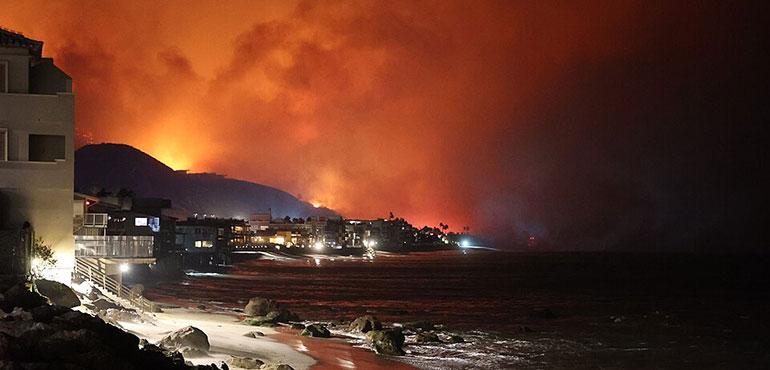
One of the deadliest and most expensive natural disasters of 2025 occurred in southern California in the month of January. More than a dozen fires began on January 7th and continued until near the end of the month. Over 40 lives were lost, over 18,000 homes and businesses were destroyed, and damage costs are estimated to be over 100 billion dollars.
As is often the case, there is a long list of ingredients that came together to create this outbreak of deadly fires. By understanding these factors, we can take steps to prevent future wildfire tragedies.
The geography of southern California is a good starting point. There is a limited amount of flat land between the Pacific Ocean and the Coast Range Mountains. The Los Angeles area has undergone dramatic population growth in the past 100 years, with home building moving up into the mountains, right into shrub forest areas. The houses are often very close to each other and lack open space or firebreaks.
Seasonal weather patterns cause high pressure over inland areas in the autumn and winter, resulting in very dry wind flows from interior California out into the Pacific Ocean. Unfortunately, the coastal ranges often have canyons that line up with these seasonal winds, creating a funneling effect that intensifies the wind. The result is Santa Ana winds, where gusts can reach near 100 mph in the canyons and at the base of the foothills.
Another factor is the “Mediterranean” climate, where most of the rain is confined to the winter months, and summer months are very dry. So, plants that grow in the spring will bake in the summer months and will be very dry in the autumn. This type of climate leads to chapparal vegetation (grasses, shrubs and small trees), which is very flammable when dry.
In the months before the event, more ingredients were added to the mix. The spring of 2024 featured above-normal rainfall, leading to widespread plant growth. The summer of 2024 recorded above-normal temperatures, causing the vegetation to start to dry out. Then, the autumn and early winter were unusually dry as the usual cool-season rain was delayed by several months.
By the start of 2025, much of the Los Angeles basin was experiencing severe drought. There are indications that both climate change and the development of La Niña were influences in deepening this drought. The result was a large amount of very dry vegetation that would fuel the fires.
The final ingredient in this lethal mixture were several extreme Santa Ana wind events starting on January 7 of 2025. These situations were forecasted several days ahead, by the National Weather Service. Local authorities did take steps to ramp up preparedness. The Santa Ana caused wind gusts of 60 to 80 mph or higher, dropping down the canyons into the foothills, combined with extremely low humidity. Once fires started in this environment, they spread rapidly and were very difficult to contain, and ultimately the firefighters were overwhelmed by the sheer scale of the fires.
Here are the largest fires that devastated Southern California in January 2025:
The “Palisades Fire” started at 10:30 a.m. PST on January 7, in the rugged terrain of the Santa Monica Mountains. Strong winds caused the fire to spread quickly southwards, reaching the Pacific Coast Highway within just a few hours. The fire spread in a confused pattern all afternoon, often following wedges of heavy vegetation in open spaces between the neighborhoods as it burned the Pacific Palisades neighborhoods. Wind gusts as high as 74 mph were recorded around the fire that night, with the fire expanding both east and west during the night, devouring additional neighborhoods. The fire ultimately extended almost 8 miles along the Pacific Coast Highway. Winds diminished later January 8, and the spread of the fire slowed in populated areas. The final toll was 23,448 acres burned, 6837 structures destroyed, and 13 confirmed fatalities.
The “Eaton Fire” started at 6:18 p.m. PST on January 7, in Eaton Canyon, in the foothills of the San Gabriel Mountains just north of Altadena. Here again the Santa Ana winds were very strong, with gusts to near 60 mph in the canyons, with flaming embers causing the fire to spread quickly southwards down the canyons into the populated areas. Highly variable wind directions occurred during the mid-evening hours, causing additional dangers to fire-fighters. Overnight the fire spread both east and west along the base of the foothills, spreading rapidly in the Altadena area just before dawn on January 8. Winds decreased later that morning, and the spread of the fire slowed. The final toll for this fire was 14,021 acres burned, 9414 structures destroyed, and 28 fatalities.
Other fires that occurred in early January were the “Hurst Fire” near Sylmar, that started at 10:29 p.m. on January 7. This fire was active for 8 days and burned 799 acres. The “Olivas Fire” started at 10:44 a.m. on January 8 near the Olivas Links Golf Course (about 3 to 4 miles southeast of Ventura California. This fire burned only 11 acres with 1 fatality. The “Kenneth Fire” started at 3:34 p.m. on January 9th, near Hidden Hills, California (on border of Ventura and Los Angeles Counties), and burned 1,052 acres.
Another round of Santa Ana winds occurred later in January. This resulted in the “Hughes Fire,” that started at 10:53 a.m. on January 22nd in the hills of the Castaic Lake State Recreation Area. Strong winds pushed the fire southwestwards towards I-5 and the town of Castaic. Thankfully, firefighters were able to stop the advance of the fire on the outskirts of town. This fire ended up burning 10,425 acres.
The final event was the “Border 2 Fire” that started on January 23 in in the Otay Mountain Wilderness, in the mountains of San Diego County. This fire burned 6,625 acres. The winter rain finally arrived in Los Angeles on January 26, 2025, bringing an end to this disaster.
Information in this story comes from many sources, including the AEM network of live weather stations. A significant independent data source is the Underwriters Laboratories Research Institutes and their “Fire Safety Research Institute” that recent report entitled “Southern California Fires Timeline Report”. Another source of background information come from a National Oceanographic and Atmospheric Administration (NOAA) article https://www.climate.gov/news-features/event-tracker/weather-and-climate-influences-january-2025-fires-around-los-angeles
------
Image: Photos and videos from the Palisades Fire that started in the City of Los Angeles, January 8, 2025. (CAL FIRE_Official via Wikimedia Commons)