---
title: Below-Normal 2026 Atlantic Hurricane Season Predicted | WeatherBug | WeatherBug
description: The upcoming season is expected to feature below-normal tropical activity as El Niño develops.
canonical: https://www.weatherbug.com/news/2026-WeatherBug-Atlantic-Tropical-Outlook-
og:title: Below-Normal 2026 Atlantic Hurricane Season Predicted | WeatherBug | WeatherBug
og:description: The upcoming season is expected to feature below-normal tropical activity as El Niño develops.
og:url: https://www.weatherbug.com/news/2026-WeatherBug-Atlantic-Tropical-Outlook-
og:site_name: WeatherBug
og:locale: en_US
og:image: https://cms-assets-con.cdn.weatherbug.net/assets/contentitems/ab/aba377cd-3e22-4dd1-9379-978768c607b6/52e0ce98-d40a-4283-82d1-d0fe816ebf4b/3aa36000-0322-40e4-a963-97f550a26ef4.png
og:image:width: 800
og:image:height: 600
og:image:alt: 2026 AEM Atlantic Tropical Forecast
og:type: article
article:published_time: 2026-05-12T18:13:10Z
article:modified_time: 2026-05-12T18:13:10Z
article:author: By WeatherBug Meteorologists
article:tag: map
article:tag: maps
article:tag: hurricane
article:tag: tropical
article:tag: rain
article:tag: wind
twitter:card: summary_large_image
twitter:title: Below-Normal 2026 Atlantic Hurricane Season Predicted | WeatherBug
twitter:description: The upcoming season is expected to feature below-normal tropical activity as El Niño develops.
twitter:image: https://cms-assets-con.cdn.weatherbug.net/assets/contentitems/ab/aba377cd-3e22-4dd1-9379-978768c607b6/52e0ce98-d40a-4283-82d1-d0fe816ebf4b/3aa36000-0322-40e4-a963-97f550a26ef4.png
---
[](/)
[Back to forecast](/)
# Below-Normal 2026 Atlantic Hurricane Season Predicted
May 12, 2026 at 02:13 PM EDT
By WeatherBug Meteorologists
WeatherBug in conjunction with meteorologists from AEM/WeatherWorks released its 2026 Atlantic Hurricane Outlook, highlighting a season that is expected to feature below-normal tropical activity as El Niño develops. The Atlantic hurricane season runs from June 1 to November 30 and includes the North Atlantic, Caribbean Sea, and Gulf of Mexico.
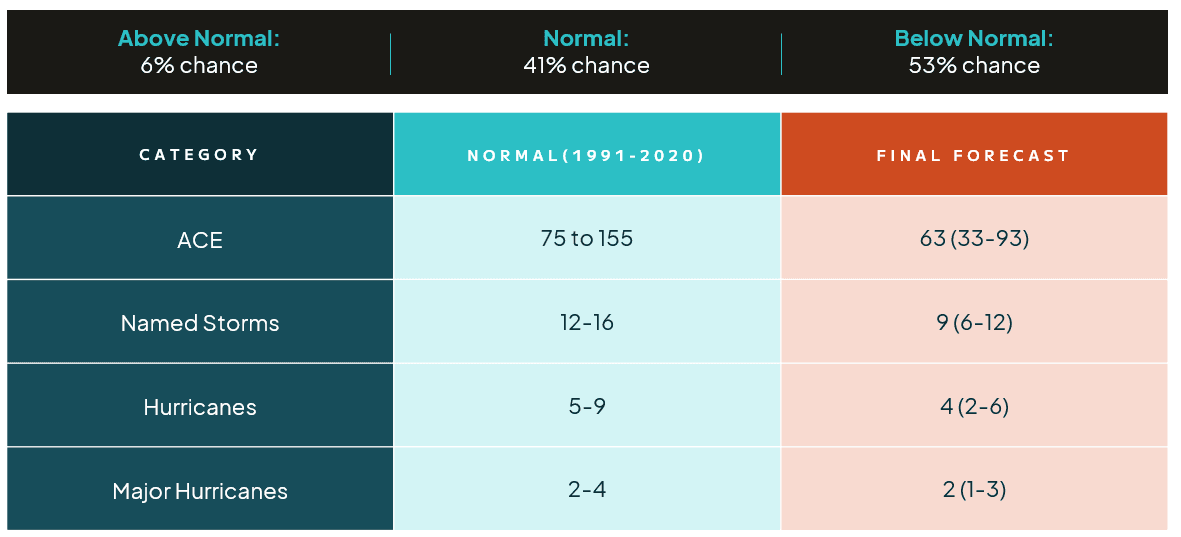
The AEM/WeatherWorks meteorology team predicts 6 to 12 named storms, with 2 to 4 becoming hurricanes and 1 to 3 reaching major hurricane intensity, defined as sustained winds of at least 111 mph. Between 1991 and 2020, the Atlantic Hurricane Basin produced an average of 14.4 named storms, 7.2 hurricanes and 3 major hurricanes per year. The seasonal forecast calls for an Accumulated Cyclone Energy (ACE) index near 63, which is below the long-term average for the Atlantic basin.
This expected reduction in overall activity is driven by the development of a moderate to strong El Niño, characterized by warming sea surface temperatures across the equatorial central and eastern Pacific. As El Niño strengthens through the summer, it will alter global wind patterns, fostering stronger upper-level winds over the tropical Atlantic. These changes increase vertical wind shear, making it more difficult for storms to form and sustain organization. Historical analog years, including 1982, 1991, 1997, 2002, and 2015, reflect similar setups, with fewer storms overall but at least one producing significant impact.
“El Niño does not shut the Atlantic down completely, it just changes where storms are most likely to develop,” explained Matt Mehallow, AEM Meteorologist. “In a year like this, activity is typically less widespread than normal, with development favored in fewer areas across the basin.”
Sea surface temperature patterns in 2026 are expected to play a key role in shaping the risk. Ocean temperatures are forecast to run above normal from the Gulf of Mexico into the subtropical Atlantic, with the greatest warmth concentrated in the central and northern Atlantic basin. In contrast, the Main Development Region (MDR) is expected to remain closer to average.
A broad suppression of tropical cyclone activity is anticipated across much of the basin, including the Caribbean, Gulf of Mexico, and along the U.S. East Coast. However, El Niño introduces a relative shift in where storms are more likely to form, with increased potential for development in portions of the central Atlantic where conditions may periodically become more favorable.
As a result, landfall probabilities along the East Coast and Gulf Coast may be reduced relative to average, and Caribbean activity may trend below normal. At the same time, storms that do develop are more likely to originate in the central Atlantic, where intermittent breaks in unfavorable conditions allow for organization.
“While El Niño is expected to limit activity across much of the basin, there may still be a relative window for development in the central Atlantic,” noted Steve Copertino, WeatherWorks Meteorologist. “Episodes of reduced shear in that region could aid storm development.”
El Niño promotes stronger upper-level winds that limit storm organization, but this influence is not uniform, and pockets of favorable conditions can still materialize, though briefly.
“With fewer storms anticipated, where they form becomes just as important as how many develop,” added Rob Miller, AEM Meteorologist. “Even short periods of favorable conditions can allow a storm to form or intensify quickly, especially closer to the coast.
That variability means overall storm counts don’t always reflect the level of risk for any one location.
“Seasonal forecasts describe the broader environment, not the outcome of any single storm,” emphasized Kevin Winters, WeatherWorks Meteorologist. “Even in a suppressed year, it only takes one system taking advantage of favorable conditions to produce significant impacts.”
The 2025 Atlantic hurricane season underscored how even a modest number of storms can produce notable impacts. The basin saw near-normal activity overall but still delivered considerable damage across the Caribbean.
The most noteworthy system of the season was Hurricane Melissa, which rapidly intensified into a Category 5 hurricane and brought devastating impacts to parts of the Caribbean. Melissa caused widespread damage, particularly in Jamaica and surrounding islands, and was responsible for dozens of fatalities.
The World Meteorological Organization retired the name Melissa in March 2026, replacing it with Molly. Melissa joined Beryl, Helene, and Milton, which were retired after the 2024 season, underscoring that high-impact storms can occur regardless of overall activity levels.
Remember, it only takes one storm to cause devastating winds and storm surge. If you live in an area vulnerable to hurricanes, now is the time to prepare. Update your emergency plans, refresh your emergency kits, and ensure your flood and hurricane insurance policies are current.
We use technologies, such as cookies, to analyze your use (i.e., pages visited), to customize content, for our internal analytics purposes and for security and other purposes. By continuing to use this website, you agree to this usage. Please review our [privacy policy](/legal/privacy) for more details as well as for information on how to contact us to object to these activities. [Ad Choices](/legal/privacy#digitaladvertisingandyourchoices)
```json
{"@context":"https://schema.org","@type":"NewsArticle","mainEntityOfPage":{"@type":"WebPage","@id":"https://www.weatherbug.com/news/2026-WeatherBug-Atlantic-Tropical-Outlook-"},"headline":"Below-Normal 2026 Atlantic Hurricane Season Predicted","description":"The upcoming season is expected to feature below-normal tropical activity as El Niño develops. ","image":["https://cms-assets-con.cdn.weatherbug.net/assets/contentitems/ab/aba377cd-3e22-4dd1-9379-978768c607b6/52e0ce98-d40a-4283-82d1-d0fe816ebf4b/3aa36000-0322-40e4-a963-97f550a26ef4.png"],"datePublished":"2026-05-12T18:13:10Z","dateModified":"2026-05-12T18:13:10Z","dateCreated":"2026-05-12T17:52:55Z","articleSection":"Weather News","keywords":"map,maps,hurricane,tropical,rain,wind","articleBody":"WeatherBug in conjunction with meteorologists from AEM/WeatherWorks released its 2026 Atlantic Hurricane Outlook, highlighting a season that is expected to feature below-normal tropical activity as El Niño develops. The Atlantic hurricane season runs from June 1 to November 30 and includes the North Atlantic, Caribbean Sea, and Gulf of Mexico.
The AEM/WeatherWorks meteorology team predicts 6 to 12 named storms, with 2 to 4 becoming hurricanes and 1 to 3 reaching major hurricane intensity, defined as sustained winds of at least 111 mph. Between 1991 and 2020, the Atlantic Hurricane Basin produced an average of 14.4 named storms, 7.2 hurricanes and 3 major hurricanes per year. The seasonal forecast calls for an Accumulated Cyclone Energy (ACE) index near 63, which is below the long-term average for the Atlantic basin.
This expected reduction in overall activity is driven by the development of a moderate to strong El Niño, characterized by warming sea surface temperatures across the equatorial central and eastern Pacific. As El Niño strengthens through the summer, it will alter global wind patterns, fostering stronger upper-level winds over the tropical Atlantic. These changes increase vertical wind shear, making it more difficult for storms to form and sustain organization. Historical analog years, including 1982, 1991, 1997, 2002, and 2015, reflect similar setups, with fewer storms overall but at least one producing significant impact.
“El Niño does not shut the Atlantic down completely, it just changes where storms are most likely to develop,” explained Matt Mehallow, AEM Meteorologist. “In a year like this, activity is typically less widespread than normal, with development favored in fewer areas across the basin.”
Sea surface temperature patterns in 2026 are expected to play a key role in shaping the risk. Ocean temperatures are forecast to run above normal from the Gulf of Mexico into the subtropical Atlantic, with the greatest warmth concentrated in the central and northern Atlantic basin. In contrast, the Main Development Region (MDR) is expected to remain closer to average.
A broad suppression of tropical cyclone activity is anticipated across much of the basin, including the Caribbean, Gulf of Mexico, and along the U.S. East Coast. However, El Niño introduces a relative shift in where storms are more likely to form, with increased potential for development in portions of the central Atlantic where conditions may periodically become more favorable.
As a result, landfall probabilities along the East Coast and Gulf Coast may be reduced relative to average, and Caribbean activity may trend below normal. At the same time, storms that do develop are more likely to originate in the central Atlantic, where intermittent breaks in unfavorable conditions allow for organization.
“While El Niño is expected to limit activity across much of the basin, there may still be a relative window for development in the central Atlantic,” noted Steve Copertino, WeatherWorks Meteorologist. “Episodes of reduced shear in that region could aid storm development.”
El Niño promotes stronger upper-level winds that limit storm organization, but this influence is not uniform, and pockets of favorable conditions can still materialize, though briefly.
“With fewer storms anticipated, where they form becomes just as important as how many develop,” added Rob Miller, AEM Meteorologist. “Even short periods of favorable conditions can allow a storm to form or intensify quickly, especially closer to the coast.
That variability means overall storm counts don’t always reflect the level of risk for any one location.
“Seasonal forecasts describe the broader environment, not the outcome of any single storm,” emphasized Kevin Winters, WeatherWorks Meteorologist. “Even in a suppressed year, it only takes one system taking advantage of favorable conditions to produce significant impacts.”
The 2025 Atlantic hurricane season underscored how even a modest number of storms can produce notable impacts. The basin saw near-normal activity overall but still delivered considerable damage across the Caribbean.
The most noteworthy system of the season was Hurricane Melissa, which rapidly intensified into a Category 5 hurricane and brought devastating impacts to parts of the Caribbean. Melissa caused widespread damage, particularly in Jamaica and surrounding islands, and was responsible for dozens of fatalities.
The World Meteorological Organization retired the name Melissa in March 2026, replacing it with Molly. Melissa joined Beryl, Helene, and Milton, which were retired after the 2024 season, underscoring that high-impact storms can occur regardless of overall activity levels.
Remember, it only takes one storm to cause devastating winds and storm surge. If you live in an area vulnerable to hurricanes, now is the time to prepare. Update your emergency plans, refresh your emergency kits, and ensure your flood and hurricane insurance policies are current.
","author":{"@type":"Person","name":"By WeatherBug Meteorologists","url":"https://www.weatherbug.com"},"publisher":{"@type":"Organization","name":"WeatherBug","logo":{"@type":"ImageObject","url":"https://www.weatherbug.com/images/sharing/f1ff28ba-6f06-4745-a782-011a20397e16.png"}}}
{"@context":"https://schema.org","@type":"WebSite","mainEntityOfPage":{"@type":"WebPage","@id":"https://www.weatherbug.com/news/2026-WeatherBug-Atlantic-Tropical-Outlook-","relatedLink":"https://www.weatherbug.com/news/2026-WeatherBug-Atlantic-Tropical-Outlook-"},"name":"WeatherBug","url":"https://www.weatherbug.com/news/2026-WeatherBug-Atlantic-Tropical-Outlook-","headline":"Below-Normal 2026 Atlantic Hurricane Season Predicted","description":"The upcoming season is expected to feature below-normal tropical activity as El Niño develops. ","dateModified":"2026-05-12T18:13:10Z","publisher":{"@type":"Organization","name":"WeatherBug","url":"https://www.weatherbug.com","sameAs":["https://www.facebook.com/WeatherBug","https://instagram.com/WeatherBug","https://www.linkedin.com/company/weatherbug","https://www.pinterest.com/weatherbug","https://twitter.com/WeatherBug","https://www.youtube.com/user/WeatherBugVideo"],"logo":{"@type":"ImageObject","url":"https://www.weatherbug.com/images/logos/weatherbug_logo_620x447.png"}},"author":{"@type":"Organization","name":"WeatherBug","url":"https://www.weatherbug.com","sameAs":["https://www.facebook.com/WeatherBug","https://instagram.com/WeatherBug","https://www.linkedin.com/company/weatherbug","https://www.pinterest.com/weatherbug","https://twitter.com/WeatherBug","https://www.youtube.com/user/WeatherBugVideo"],"logo":{"@type":"ImageObject","url":"https://www.weatherbug.com/images/logos/weatherbug_logo_620x447.png"}}}
{"@context":"https://schema.org","@type":"Organization","name":"WeatherBug","logo":"https://www.weatherbug.com/images/logos/weatherbug_logo_620x447.png","url":"https://www.weatherbug.com","sameAs":["https://www.facebook.com/WeatherBug","https://instagram.com/WeatherBug","https://www.linkedin.com/company/weatherbug","https://www.pinterest.com/weatherbug","https://twitter.com/WeatherBug","https://www.youtube.com/user/WeatherBugVideo"]}
```