


Back to forecast
How Do Lightning and Thunder Form?
April 15, 2025 at 06:59 AM EDT
By WeatherBug Meteorologist, John Benedict
As spring transitions to summer, thunderstorms will become much more frequent across the Northern Hemisphere. There are around 1.2 billion lightning strikes each year across the globe and around 20 people each year are killed by lightning in the United States, while closer to 2,000 people are killed globally with many more suffering injuries, some of which can be long lasting. Understanding lightning is important so seeking shelter when thunderstorms threaten is a priority. Let’s take a closer look at how lightning forms.
Thunderstorms begin to develop as pockets of air near the ground warm and begin to rise. When these air parcels reach a certain level in the atmosphere, known as the lifting condensation level or “LCL,” cumulus clouds begin to form. Continued heating and latent heat release as water vapor begins to condense further grow the clouds vertically. Precipitation begins to form within these clouds, and when clouds ballon high into the atmosphere there will also be ice crystals.
A well-developed thunderstorm cloud contains mostly small ice crystals in the upper levels of the cloud, a mixture of small ice crystals and small hail in the middle levels of the cloud and a mixture of rain and melting hail in the lower levels of the cloud. Ice particles will be positively charged while hail will be negatively charged. The lighter ice crystals are lofted upwards in the thunderhead by rising air while the hail tumbles to the lower part of the storm. This leads to the lower and middle portions of the cumulonimbus clouds to be negatively charged while top of the storm is positively charged. As raindrops and ice particles within the storm cloud jostle against one another, the particles become charged. This separation of electrical charges sets the stage for lightning.
A massive electrical potential difference surges between the positively charged top of the storm cloud and the negatively charged Earth's surface below. This immense charge imbalance seeks to neutralize itself, leading to the formation of a lightning bolt. The path of least resistance—a channel of ionized air molecules—becomes the conduit for this electrifying journey. Lightning can occur between opposite charges within the thunderstorm cloud (Intra Cloud Lightning) or between opposite charges in the cloud and on the ground (Cloud-To-Ground Lightning). Cloud-to-ground lightning is divided into two different types of flashes depending on the charge in the cloud where the lightning originates, which is either positive (from the top of the cloud) or negative.
As the bolt of lightning streaks across the sky, it unleashes thunder, the auditory counterpart to the visual spectacle, rumbles through the air, leaving us in awe of its booming presence. But how does thunder form?
When lightning traverses the atmosphere, it superheats the air along its path to an astonishing 50,000 degrees Fahrenheit—nearly five times the temperature of the Sun's surface! The rapid expansion of this heated air creates a shockwave that tears through the atmosphere. The surrounding air molecules, caught off guard by this explosive phenomenon, collide and create a rapid succession of compressions much like a sonic boom. This barrage of pressure waves cascades through the air, eventually reaching our ears as what we call thunder. The sound of thunder travels about a mile every 5 seconds. If you count the seconds between the flash of lightning and the crack of thunder and divide by 5, you get the number of miles the lightning strike is away from you.
In the ever-changing dance between clouds and the Earth, lightning and thunder collaborate to put on a captivating show. These awe-inspiring displays of atmospheric electricity remind us of nature's might. On average you can hear thunder about 10 miles from a lightning strike. Since lightning can strike outward 10 miles from a thunderstorm, if you hear thunder, you are likely within striking distance from the storm. Always remember, “when thunder roars, go indoors.”
Source: weather.gov
-----
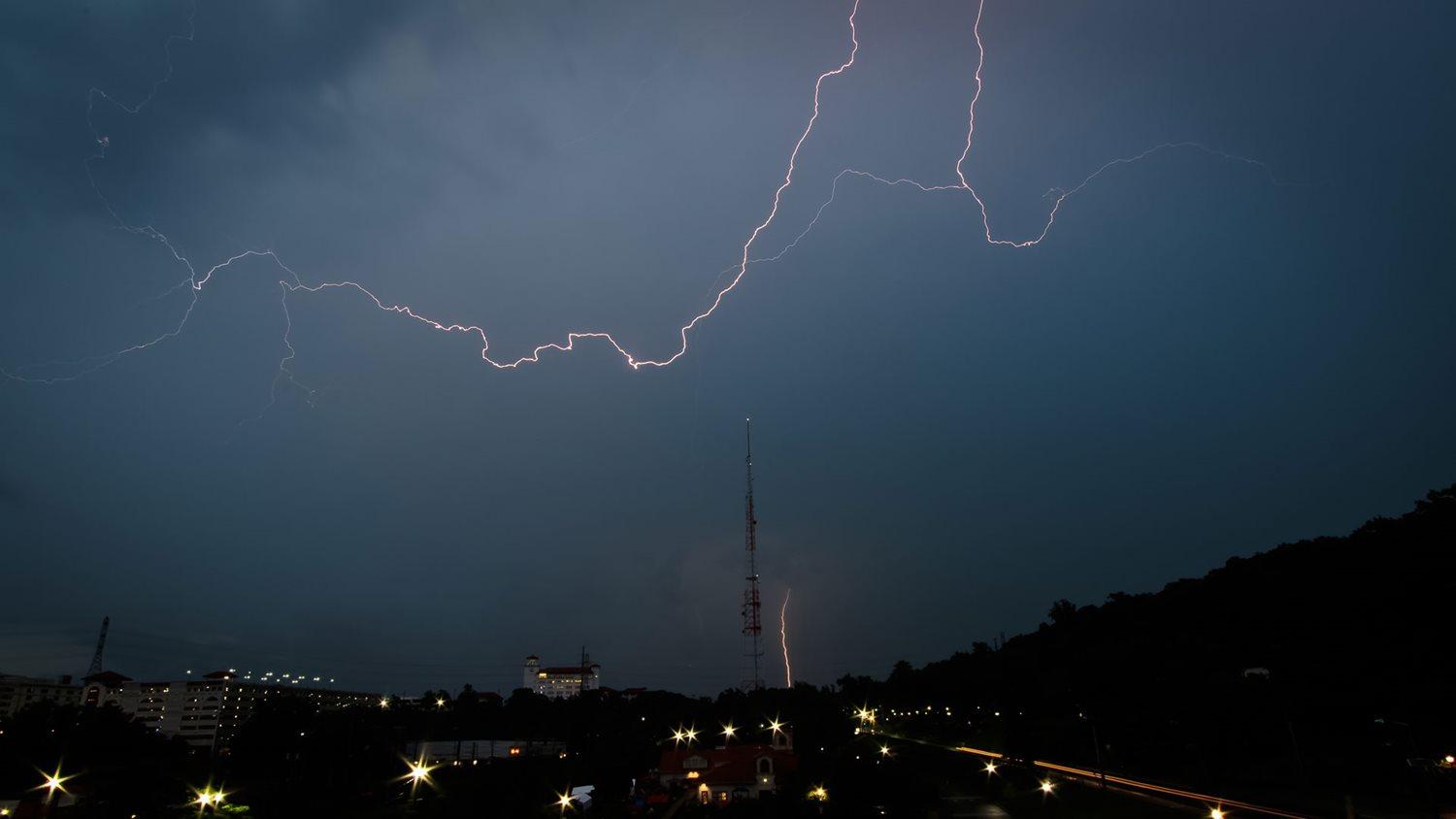
Image: Lightning streaks across the sky while a bolt simultaneously strikes the ground near Montclair State University in Little Falls, New Jersey on July 17, 2021. (Robert Hectus)
Thunderstorms begin to develop as pockets of air near the ground warm and begin to rise. When these air parcels reach a certain level in the atmosphere, known as the lifting condensation level or “LCL,” cumulus clouds begin to form. Continued heating and latent heat release as water vapor begins to condense further grow the clouds vertically. Precipitation begins to form within these clouds, and when clouds ballon high into the atmosphere there will also be ice crystals.
A well-developed thunderstorm cloud contains mostly small ice crystals in the upper levels of the cloud, a mixture of small ice crystals and small hail in the middle levels of the cloud and a mixture of rain and melting hail in the lower levels of the cloud. Ice particles will be positively charged while hail will be negatively charged. The lighter ice crystals are lofted upwards in the thunderhead by rising air while the hail tumbles to the lower part of the storm. This leads to the lower and middle portions of the cumulonimbus clouds to be negatively charged while top of the storm is positively charged. As raindrops and ice particles within the storm cloud jostle against one another, the particles become charged. This separation of electrical charges sets the stage for lightning.
A massive electrical potential difference surges between the positively charged top of the storm cloud and the negatively charged Earth's surface below. This immense charge imbalance seeks to neutralize itself, leading to the formation of a lightning bolt. The path of least resistance—a channel of ionized air molecules—becomes the conduit for this electrifying journey. Lightning can occur between opposite charges within the thunderstorm cloud (Intra Cloud Lightning) or between opposite charges in the cloud and on the ground (Cloud-To-Ground Lightning). Cloud-to-ground lightning is divided into two different types of flashes depending on the charge in the cloud where the lightning originates, which is either positive (from the top of the cloud) or negative.
As the bolt of lightning streaks across the sky, it unleashes thunder, the auditory counterpart to the visual spectacle, rumbles through the air, leaving us in awe of its booming presence. But how does thunder form?
When lightning traverses the atmosphere, it superheats the air along its path to an astonishing 50,000 degrees Fahrenheit—nearly five times the temperature of the Sun's surface! The rapid expansion of this heated air creates a shockwave that tears through the atmosphere. The surrounding air molecules, caught off guard by this explosive phenomenon, collide and create a rapid succession of compressions much like a sonic boom. This barrage of pressure waves cascades through the air, eventually reaching our ears as what we call thunder. The sound of thunder travels about a mile every 5 seconds. If you count the seconds between the flash of lightning and the crack of thunder and divide by 5, you get the number of miles the lightning strike is away from you.
In the ever-changing dance between clouds and the Earth, lightning and thunder collaborate to put on a captivating show. These awe-inspiring displays of atmospheric electricity remind us of nature's might. On average you can hear thunder about 10 miles from a lightning strike. Since lightning can strike outward 10 miles from a thunderstorm, if you hear thunder, you are likely within striking distance from the storm. Always remember, “when thunder roars, go indoors.”
Source: weather.gov
-----
Image: Lightning streaks across the sky while a bolt simultaneously strikes the ground near Montclair State University in Little Falls, New Jersey on July 17, 2021. (Robert Hectus)