


Back to forecast
No Eclipse Glasses? No Problem!
April 8, 2024 at 08:43 AM EDT
By WeatherBug's Alyssa Zimmerman
On April 8th, millions of people across North America will be able to see either a total or partial solar eclipse! If you’re planning on heading outside and watching the eclipse like it’s any old starry night, think again. Here is your how-to guide for watching the solar eclipse safely!
Whether you’re under the direct path of the total eclipse or miles away, it is crucial that a viewing device is used for the duration of the event. Good solar eclipse viewing devices include: a homemade pinhole projector (see directions below), eclipse glasses, or number 14 welder’s glass.
Residents in the direct path of the solar eclipse will have a short chance to see the suns corona. The corona is the outermost layer of the sun’s atmosphere and can only be seen during a total solar eclipse. The moment when the moon completely covers the sun, blocking the sun’s light, the glow of the corona can be seen. Even though the eclipse at this time will only be as bright as a full moon, the corona can still damage your eyes, so a viewing device must still be used.
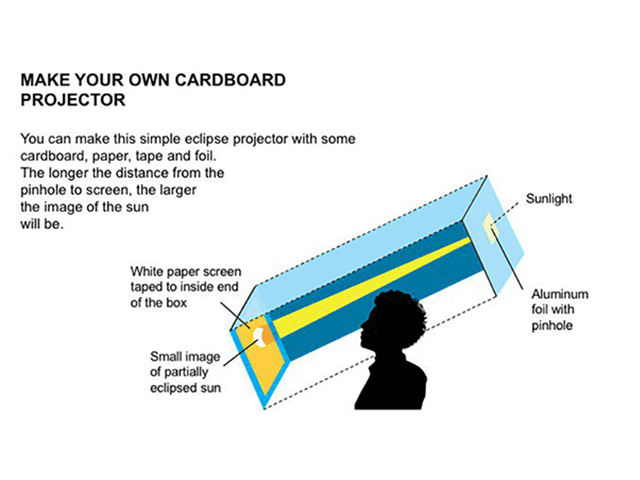
An old box, tinfoil and white paper is about all you need to create a homemade pinhole projector!
1. Cut a small square (1 inch x 1 inch) in one end of the box. Make the cut near either the left or right edge of the box .
2. Tape a piece of tinfoil over the square cut-out.
3. Using a pin or needle, punch a hole in the center of the tinfoil.
4. Tape down a sheet of white paper to the inside of the box on the side opposite of the tinfoil. This acts as an image screen for the eclipse.
5. If you used a box with an open side such as a shoe box, you will flip the box over, closed side up, and place the box over your head to view the eclipse. Just make sure your head doesn’t block the light path!
6. If you are using a closed box, cut another 1 inch by 1 inch square out on a side adjacent to where you taped the white paper. Make the cut so you can see the white paper in its entirety because this will be your viewing hole for the eclipse.
While viewing the eclipse, stand with your back to the sun. Hold the box with the tinfoil side facing the sun and line the box up with its own shadow to line it up with the sun’s light path. This easy homemade device will protect your eyes while still getting to see the solar eclipse!
Keep in mind however, not every home device will provide sufficient protection for your eyes. Sunglasses and homemade filters unfortunately do not make the cut. Also, never use a camera, telescope or binoculars to look at the uneclipsed for partially eclipsed sun.
Happy viewing, and remember, eye safety first!
Sources: NASA and LIVESCIENCE
Image: NASA Sun & Space
Whether you’re under the direct path of the total eclipse or miles away, it is crucial that a viewing device is used for the duration of the event. Good solar eclipse viewing devices include: a homemade pinhole projector (see directions below), eclipse glasses, or number 14 welder’s glass.
Residents in the direct path of the solar eclipse will have a short chance to see the suns corona. The corona is the outermost layer of the sun’s atmosphere and can only be seen during a total solar eclipse. The moment when the moon completely covers the sun, blocking the sun’s light, the glow of the corona can be seen. Even though the eclipse at this time will only be as bright as a full moon, the corona can still damage your eyes, so a viewing device must still be used.
An old box, tinfoil and white paper is about all you need to create a homemade pinhole projector!
1. Cut a small square (1 inch x 1 inch) in one end of the box. Make the cut near either the left or right edge of the box .
2. Tape a piece of tinfoil over the square cut-out.
3. Using a pin or needle, punch a hole in the center of the tinfoil.
4. Tape down a sheet of white paper to the inside of the box on the side opposite of the tinfoil. This acts as an image screen for the eclipse.
5. If you used a box with an open side such as a shoe box, you will flip the box over, closed side up, and place the box over your head to view the eclipse. Just make sure your head doesn’t block the light path!
6. If you are using a closed box, cut another 1 inch by 1 inch square out on a side adjacent to where you taped the white paper. Make the cut so you can see the white paper in its entirety because this will be your viewing hole for the eclipse.
While viewing the eclipse, stand with your back to the sun. Hold the box with the tinfoil side facing the sun and line the box up with its own shadow to line it up with the sun’s light path. This easy homemade device will protect your eyes while still getting to see the solar eclipse!
Keep in mind however, not every home device will provide sufficient protection for your eyes. Sunglasses and homemade filters unfortunately do not make the cut. Also, never use a camera, telescope or binoculars to look at the uneclipsed for partially eclipsed sun.
Happy viewing, and remember, eye safety first!
Sources: NASA and LIVESCIENCE
Image: NASA Sun & Space