Back to forecast
Inauguration Weather Through The Years
January 20, 2021 at 09:57 PM EST
By WeatherBug's Chris Sayles
The U.S. Presidential Inauguration will commence this week, but the weather hasn’t always been friendly for this momentous occasion.
Did you know that inaugurations haven’t always taken place in January? The first inauguration took place on April 30, 1789 in New York City when George Washington was inaugurated. No scary weather was reported in the city as temperatures remained in the spring-like upper 50s!
On the other hand, cold weather would leave a mark on President William Henry Harrison’s Inauguration. History tells us that he was suffering from a cold when he gave his nearly 2-hour long speech in 1841. The Noon temperature that day was a mild 48 degrees but with a cold wind. As a result, President Harrison would develop pneumonia and pass away a month later. In fact, about 12 years later during the outgoing of President Millard Filmore, his wife Abigail would succumb to pneumonia one month after sitting outside during President Pierce’s inauguration in 1853.
Under the U.S. Constitution, Inauguration Day was set on March 4 until 1933. The 20th Amendment would be ratified to the Constitution in 1937 and it allowed for the end of the U.S. presidential term to be moved from March 4 to January 20. This not only allowed for the newly elected president to take office sooner, but it also put the day at risk of wintry weather.
Over the course of history, presidential inaugurations have been known to take place outdoors in massive public settings. This would put the public event at risk of being dampen by any of the harsh wintry elements. One such case was William H. Taft’s inauguration in 1909 where it was moved indoors of the Capitol Building due to a blizzard that year. An estimated 58,000 tons of wet, heavy snow had to be removed from the area that day and many trees were uprooted due to the high winds.
Another time the weather became frightful was during the “Freeze of the Century” which took place in 1985. Temperatures would drop dangerously low in the Nation’s Capital. As such, Ronald Regan’s second inauguration had to be moved indoors of the Capitol amid 7-degree temperatures and wind chills ranging between -10 to -20 degrees below zero. This was the coldest January Inauguration in history.
Old Man Winter wasn’t the only one busy on Inauguration Day as Mother Nature would provide the rainiest one in history in 1937, the first to be held in January. It was Franklin Roosevelt’s second inauguration and record rainfall of 1.77 inches piled up. The Noon temperature barely hoovered over freezing, stalling at 33 degrees.
The average high temperature for January’s Inauguration Day is roughly 43 degrees with an average low of 28 degrees. As Noon approaches, the temperature barely makes it above freezing with an average of 37 degrees. Interesting enough, there’s only about a 10 percent chance of measurable snowfall in Washington, D.C., on Inauguration Day. However, there is about 33 percent chance that some sort of precipitation will fall on Inauguration Day.
Sources: weather.gov, Wikipedia.org
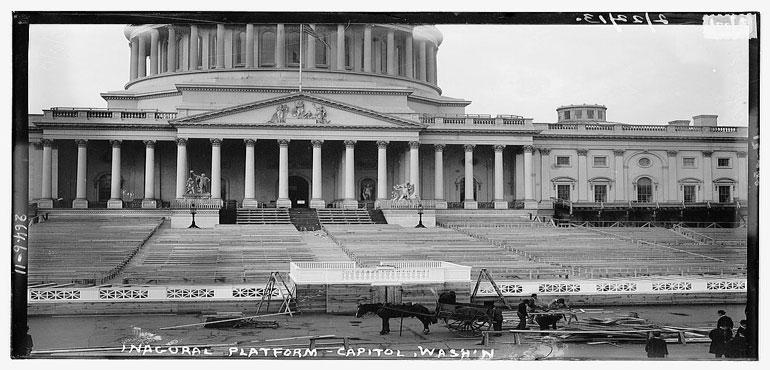
Story Image: Inauguration platform under construction for Woodrow Wilson’s first inauguration in 1913. (Wikimedia Commons)
Did you know that inaugurations haven’t always taken place in January? The first inauguration took place on April 30, 1789 in New York City when George Washington was inaugurated. No scary weather was reported in the city as temperatures remained in the spring-like upper 50s!
On the other hand, cold weather would leave a mark on President William Henry Harrison’s Inauguration. History tells us that he was suffering from a cold when he gave his nearly 2-hour long speech in 1841. The Noon temperature that day was a mild 48 degrees but with a cold wind. As a result, President Harrison would develop pneumonia and pass away a month later. In fact, about 12 years later during the outgoing of President Millard Filmore, his wife Abigail would succumb to pneumonia one month after sitting outside during President Pierce’s inauguration in 1853.
Under the U.S. Constitution, Inauguration Day was set on March 4 until 1933. The 20th Amendment would be ratified to the Constitution in 1937 and it allowed for the end of the U.S. presidential term to be moved from March 4 to January 20. This not only allowed for the newly elected president to take office sooner, but it also put the day at risk of wintry weather.
Over the course of history, presidential inaugurations have been known to take place outdoors in massive public settings. This would put the public event at risk of being dampen by any of the harsh wintry elements. One such case was William H. Taft’s inauguration in 1909 where it was moved indoors of the Capitol Building due to a blizzard that year. An estimated 58,000 tons of wet, heavy snow had to be removed from the area that day and many trees were uprooted due to the high winds.
Another time the weather became frightful was during the “Freeze of the Century” which took place in 1985. Temperatures would drop dangerously low in the Nation’s Capital. As such, Ronald Regan’s second inauguration had to be moved indoors of the Capitol amid 7-degree temperatures and wind chills ranging between -10 to -20 degrees below zero. This was the coldest January Inauguration in history.
Old Man Winter wasn’t the only one busy on Inauguration Day as Mother Nature would provide the rainiest one in history in 1937, the first to be held in January. It was Franklin Roosevelt’s second inauguration and record rainfall of 1.77 inches piled up. The Noon temperature barely hoovered over freezing, stalling at 33 degrees.
The average high temperature for January’s Inauguration Day is roughly 43 degrees with an average low of 28 degrees. As Noon approaches, the temperature barely makes it above freezing with an average of 37 degrees. Interesting enough, there’s only about a 10 percent chance of measurable snowfall in Washington, D.C., on Inauguration Day. However, there is about 33 percent chance that some sort of precipitation will fall on Inauguration Day.
Sources: weather.gov, Wikipedia.org
Story Image: Inauguration platform under construction for Woodrow Wilson’s first inauguration in 1913. (Wikimedia Commons)