



Drought Persists Across Much Of The U.S.
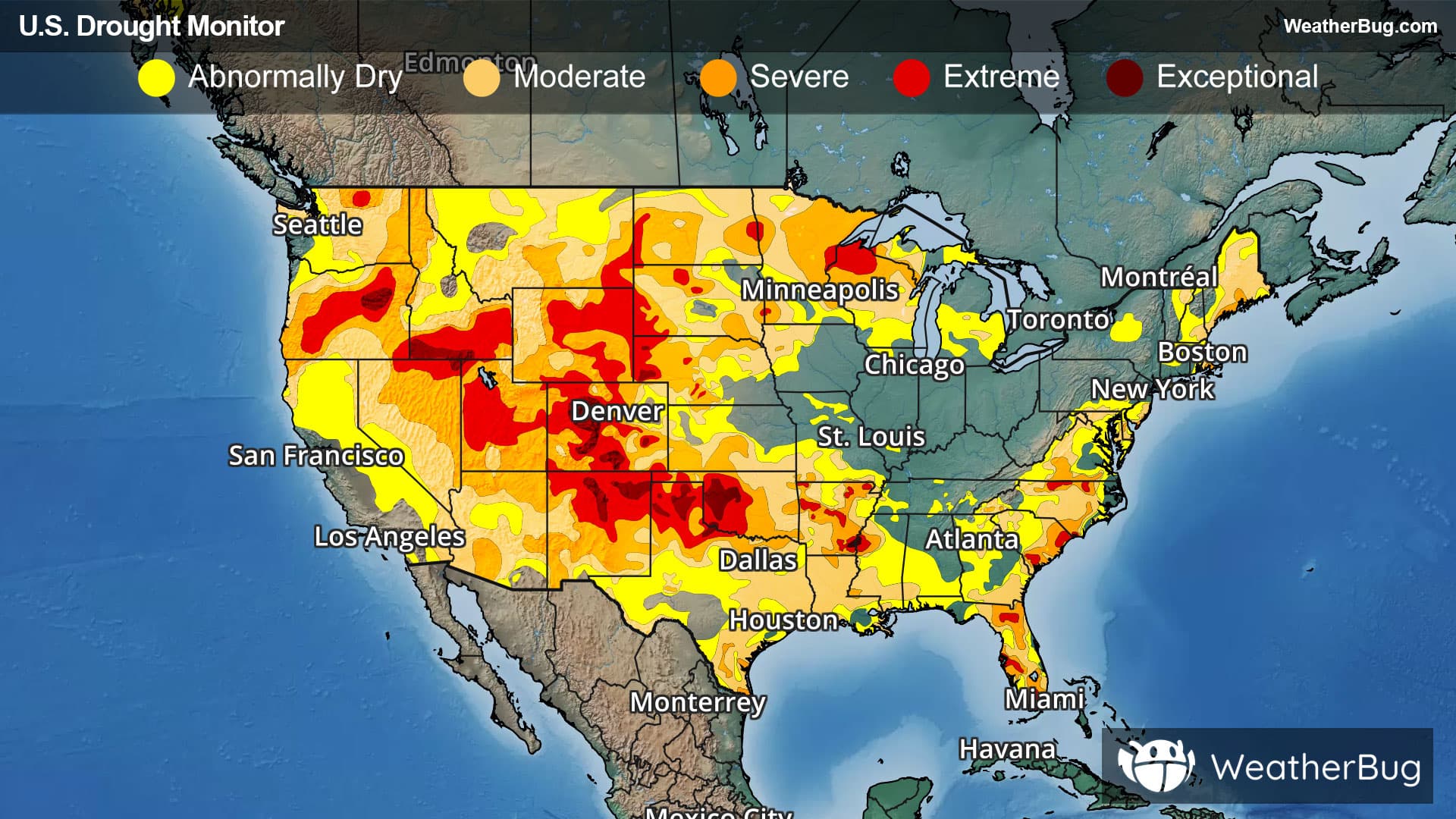
Deepening drought hits much of the south-central and north-central U.S., while drought persists from the central Rockies to the Northwest U.S.
During the past week, a persistent dome of high pressure brought widespread dry weather and late summer heat to the West and south-central US. The combination of dry weather and excessive heat continued to promote rapid onset drought across much of the South region. In contrast, several rounds of thunderstorms occurred in Nebraska and from Illinois across Indiana and Ohio into the Mid-Atlantic. In the Southwest, an active monsoon pattern continued to bring localized relief to parts of Arizona and western New Mexico, while excessive heat and drier conditions promoted drought expansion across eastern New Mexico and portions of the Intermountain West, Great Basin, and the Northwest.
West
Seasonal dryness continued across the Pacific Coast states and much of the Great Basin, where persistent above-normal temperatures drove high demand on water resources and led to localized degradation. Extreme Drought (D3) expanded slightly across southern Oregon and northern Washington, where soil moisture and groundwater levels remained critically poor. Over 90 percent of Oregon remains in some level of drought. Extreme to Exceptional (D3-D4) drought also expanded into northeastern Idaho, with degradation noted in small portions of Utah and the southern California deserts. Elsewhere, ongoing monsoonal convection promoted drought relief across much of Arizona and western New Mexico, though persistent heat and dry conditions drove drought expansion across eastern New Mexico.
High Plains
The High Plains saw a mixture of drought degradation and localized improvement. Rapid drought deterioration continued across southern Kansas and southeastern Colorado, where dry conditions and excessive heat aggravated agricultural impacts. Further north, thunderstorms brought drought relief to northeast Colorado. In contrast, some deterioration occurred in the Rockies of Colorado and Wyoming where decreased water storage from last spring's limited snow cover is leading to mounting impacts. Organized thunderstorms brought drought reduction to central Nebraska. Showers mostly maintained a status-quo depiction across South Dakota, save for small areas of degradation along its respective borders with North Dakota and Minnesota. More widespread drought degradation was noted across North Dakota, where precipitation was rather sparse.
Midwest
Following the widespread heavy rainfall that fell across the Corn Belt in the previous week, lighter precipitation and milder temperatures overspread the region. Conditions were adequate to maintain drought-free conditions across Kentucky, Indiana, and Ohio, while showers brought some relief to Michigan's Lower Peninsula, northern Illinois, and southern Wisconsin. In contrast, another dry week across portions of Minnesota, western and northern Wisconsin, and Michigan's Upper Peninsula aggravated ongoing drought impacts, leading to localized degradation. Severe drought (D3) expanded across northwestern Wisconsin and into eastern Minnesota.
South
A persistent dome of high pressure maintained dry weather, and the addition of unrelenting heat caused widespread rapid drought expansion for another week across the region. Weekly maximum temperatures exceeded 100 degrees F across nearly the entire region - with the exception of Tennessee - and peaked above 110 degrees along the Texas-Oklahoma border. Condition Monitoring Observer Reports (CMOR) submitted to the National Drought Mitigation Center highlighted rapidly worsening impacts, including dry stock ponds, wilting trees, dust storms, and elevated wildfire activity. Drought expansion and intensification were most pronounced across Texas, Oklahoma, Louisiana, and Arkansas, while conditions also began to noticeably deteriorate across Mississippi. Small-scale convection provided only highly localized, brief relief to isolated portions of central Oklahoma and Arkansas.
Southeast
A fairly typical summer thunderstorm pattern remained in place over the Southeast, with the heaviest thunderstorms occurring in the seabreeze-favored regions of the Gulf Coast and South Atlantic coastal plain, resulting in localized improvements across Virginia and the Carolinas. Activity was more meager across central Alabama and Georgia, where above-average temperatures drove gradual degradation. Small areas of degradation also occurred in North Florida, the Treasure Coast, and portions of South Florida due to persistent heat and a lackluster sea-breeze regime. The extent of remaining drought across Florida in late August is extremely unusual, as wet-season rainfall to date has been unable to fully erase the severe deficits built up during the winter and spring. The coverage of severe to extreme (D2-D3) drought in Florida is now over 40 percent.
Northeast
Two rounds of storminess overspread the Mid-Atlantic states and southern New England during the week, bringing widespread rain amounts of 1-2 inches across northern West Virginia, Pennsylvania, and Maryland. Higher amounts fell across parts of New Jersey and Long Island, causing isolated flooding in urban areas and along small streams. The rainfall boosted soil moisture and streamflows across the region, bringing some reduction in the drought depiction across eastern West Virginia, southeastern Pennsylvania, the Delmarva, New Jersey, and Long Island. One limiting factor in broader-scale drought reduction is groundwater conditions, which have been slower to respond following prolonged dryness in prior months. Across Upstate New York and northern New England, rainfall was more widely scattered. While precipitation brought localized relief to central New Hampshire, surrounding areas experienced degradation due to worsening impacts from short-term dryness.
Looking Ahead
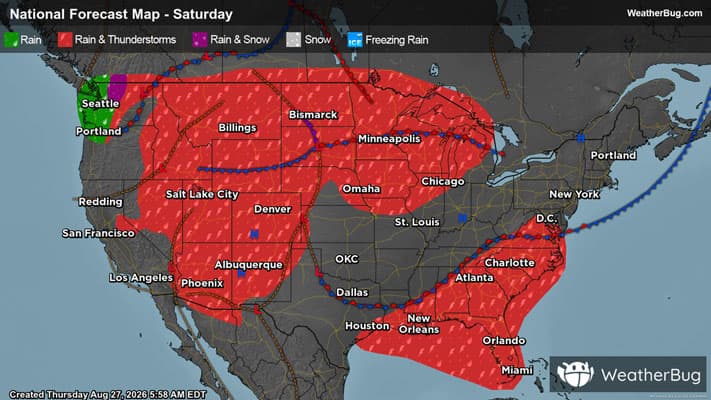
Over the next week, the upper-level area of high pressure is forecast to move eastwards, shifting hotter conditions to the central and eastern portions of the U.S., while bringing a potential reprieve from extreme temperatures to the West. Excessive heat will persist across the south-central U.S., which may continue to fuel rapid drought expansion and intensification. Enhanced monsoonal convection is favored across Arizona, with moisture extending northward into Utah and parts of the northern Rockies, while light, early-season precipitation may overspread southern California. Forecast precipitation amounts across the South region would be insufficient to offset ongoing moisture deficits. Across the Midwest, light to locally moderate precipitation is expected. Seasonal convection will linger across the Southeast early in the period before drier conditions move in by the end of the period. Along the Eastern Seaboard, initial storminess will give way to drier conditions, though unsettled weather may return to the Northeast by late week.
For the 8-to-14-day period, below-normal temperatures are favored across the Northwest, while elevated odds for above-normal temperatures extend across much of the remainder of the nation. The highest probabilities for excessive heat remain anchored over the south-central and southeastern U.S., maintaining heavy evapotranspiration demand in regions experiencing rapid drought degradation. The precipitation outlook exhibits a weaker signal, with slightly enhanced chances for above-normal precipitation across the western U.S. and New England, while near-normal precipitation is favored elsewhere.