
Back to Now Forecast

Potent Storm System Brings Mixed Results to Drought Across the U.S.

January 29, 2026 at 02:42 PM EST
By WeatherBug Meteorologist, Alyssa Robinette
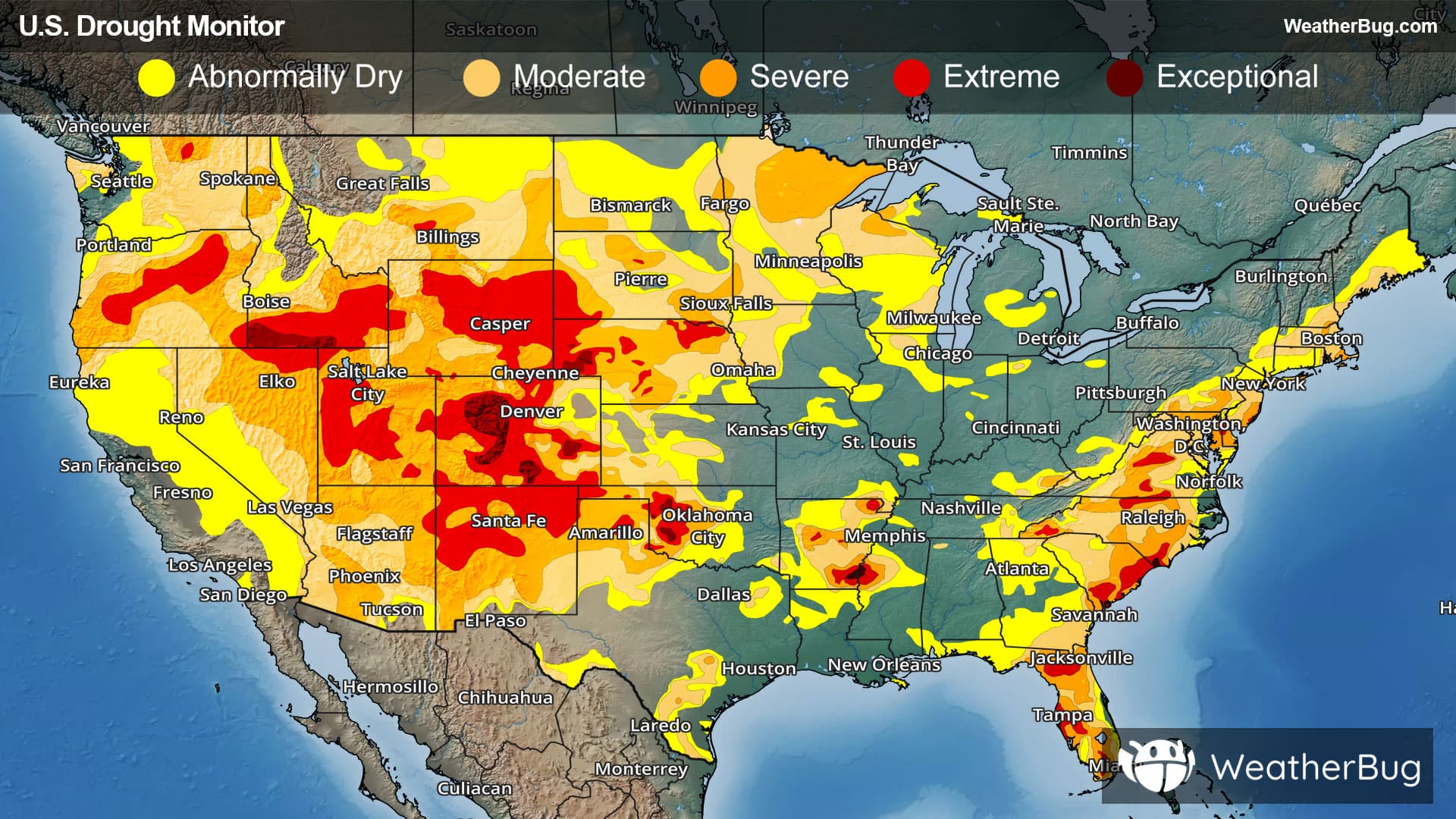
Weekly Drought Map for January 29, 2026

A large, impactful storm system was responsible for almost all the precipitation observed throughout the U.S. this week, bringing a mix of improvements and degradations to the drought depiction.

Heavy to excessive amounts of snow, sleet and freezing rain were widespread from the southernmost Rockies and southern Plains eastward across a large part of the Mississippi and Ohio valleys, the Southeast and the Eastern Seaboard. Winter Storm Warnings at one point covered about one million square miles.

Despite the extensive coverage of impactful precipitation, the storm has not yet brought broad areas of drought relief. Arctic air has settled into the eastern two-thirds of the U.S. in the wake of the storm. As a result, most areas saw precipitation in frozen form, and it has not been able to melt. In most areas, the water could eventually help ease drought conditions, but most improvements will not occur until the frozen precipitation has melted.

Northeast

Due to this potent system, numerous locations across Pennsylvania, New York and New England recorded 1 to 2 feet of snow or a snow/sleet mix. Elsewhere, totals reached as high as 17 inches in West Virgina. Maryland and Delaware generally saw 6 to 12 inches of snow and/or sleet. In addition to the snow and sleet, freezing rain fell across parts of Appalachia, with ice amounts of 0.7 to 0.8 inch in West Virginia.

Liquid-equivalent precipitation totals ranged from 1 to locally 3 inches across the southern half of the Northeast region, with amounts closer to one-half inch observed farther north. Though, isolated higher amounts were observed downwind from Lake Erie and Ontario in association with lake-effect snow that fell.

Improvements were limited to a few small, isolated patches across the Northeast. Most notably, abnormal dryness and moderate drought (D0-D1) contracted across western New York. Most areas were unchanged because the water that would help areas lacking in moisture was locked up in frozen precipitation instead of melting into the ground.

Despite this winter storm, many locations have only recorded one-half to two-thirds of normal precipitation over the last 60 days, with a few lesser amounts in parts of southwestern Pennsylvania and northern New England. Areas immediately downwind of the Great Lakes have been frequent recipients of lake-effect snow, with 60-day precipitation amounts closer to normal there.


Southeast

The winter storm brought widespread moderate to heavy precipitation to large parts of the Southeast region, with near or below normal totals restricted to Florida, portions of southern and eastern Georgia and scattered areas across the Carolinas. Intense sleet and freezing rain fell across interior portions of the Southeast. Sleet totals topped out near 7 inches in western North Carolina. Localized sleet amounts reached 4 inches in the Carolinas and Virginia. Thick ice accumulation of 0.7 to 0.8 inch was reported in parts of Georgia and Virginia, with ice amounts of an inch in Alabama and South Carolina. Liquid-equivalent of 1 to several inches was widespread across most of Alabama, western Georgia and northern Virginia.

Temperatures did allow for some melting, so there were some improvements made to the drought depiction. Improvements were made across much of Alabama, where precipitation outside the northern tier fell mostly in liquid form. Some slight improvements were also made in west-central Virginia. Improvements were less common farther east, where totals were generally lower and more of the precipitation fell in frozen form.

On the other hand, precipitation deficits continued to mount in areas that missed the bulk of the moisture, specifically along the Tennessee/North Carolina border, in a few spots across northern and south-central Georgia, and especially across the Florida Peninsula, where the week was dry and moisture deficits increased. Large patches across the southern half of the Florida Peninsula and a few areas farther north have recorded less than one-quarter of normal precipitation during the last 90 days. Extreme drought (D3) was introduced over part of the northern Florida Peninsula, and severe drought (D2) was expanded into more of the southern and east-central Florida Peninsula.


South

Much of the Southern region was also impacted by this significant storm system. Sleet totals up to 15 inches occurred in Oklahoma! Louisiana and Mississippi picked up 7 inches of sleet, with up to 4 inches in Texas. Freezing rain fell in abundance across portions of the South. Ice amounts of up to 1 inch were reported in parts of Oklahoma, Louisiana and Mississippi, with 0.7 to 0.8 inch seen in Texas and Tennessee. Liquid-equivalent of 1 to 3 inches were recorded from eastern Texas and western Arkansas eastward through most of Tennessee. Up to 10 inches of liquid precipitation fell on one patch in southwestern Louisiana and there were also some localized amounts exceeding 4 inches in northern Mississippi.

Improvements were introduced in several areas, generally the areas that received the most precipitation, where much of the precipitation fell in liquid form or where drought was already waning. Some relatively broad improvements were introduced in Tennessee and much of Mississippi. Slight improvements were made to west-central and central Arkansas and southeastern and central Texas. While not as significant as the rest of the region, western Texas near El Paso did see beneficial moisture, with up to an inch of liquid-equivalent precipitation. This allowed for some improvements to the drought depiction.

Despite the precipitation accompanying the massive winter storm, many areas from northern Arkansas to the Louisiana Gulf Coast are reporting 8 to 10 inches less than normal over the past 90 days, with a few spots in northeastern Arkansas and east-central Louisiana recording deficits approaching 12 inches during the period.


Midwest

The winter storm brought plenty of moisture to southern parts of the Midwest. Parts of Ohio had up to 17 inches of snow and/or sleet, with 15 inches of snow/sleet falling in parts of Missouri, Illinois and Indiana. Up to a foot of snow/sleet piled up in Kentucky.

This translates generally into 1.5 to 3 inches of liquid-equivalent precipitation reported across much of Kentucky and near the Ohio/Mississippi rivers’ confluence. However, amounts were much less impressive farther north. The southern tiers of Illinois, Indiana and Ohio recorded 0.5 to 1 inch of liquid-equivalent precipitation, with western portions of the Lower Peninsula of Michigan also getting 0.5 to 1 inch mostly from lake-effect snows downwind from Lake Michigan. Meanwhile, parts of the eastern Lower Peninsula along with a swath from northern Missouri through northwestern Ohio were on the periphery of the storm and recorded only a few tenths of an inch. Across the Upper Peninsula of Michigan, Wisconsin, Minnesota, Iowa and northwestern Illinois, little to no precipitation fell.

Drought improvement were introduced in parts of Kentucky where dryness was already waning when the storm hit, and also in a part of southern Illinois and adjacent Missouri where over 1.5 inches fell. Elsewhere, bitterly cold conditions kept the ground frozen and squelched both human and environmental moisture demands, so drought remained unchanged across Missouri and most areas north of the Ohio River this week.


High Plains

Unlike the eastern two-thirds of the U.S., most of the High Plains Region was dry last week, from amounts of a few tenths to approaching one inch fell on much of central and eastern Kansas and on scattered higher elevations in Colorado and Wyoming. Otherwise, little or nothing fell.

Except for higher elevations, the High Plains region is climatologically cold and dry this time of year, so precipitation deficits increase very slowly, and demand is lower this time of year. Dryness and drought were essentially unchanged in most of the region, with some scattered deterioration introduced in parts of western Colorado (either moderate or severe drought). Drought intensification was also introduced around the Black Hills and adjacent western South Dakota (either abnormal dryness or moderate drought), where snowpack is deficient and slowly declining.


West

The southern fringe of the Western region was impacted by the western edge of the winter storm, resulting in over 1.5 inches of liquid-equivalent precipitation across a few patches from southeastern Arizona across southern New Mexico. Amounts exceeded 3 inches in parts of south-central New Mexico north of the Texas Big Bend. The precipitation fell mostly in liquid form in southeastern Arizona and was sufficient to bring improvements into that area. Farther east, although amounts were a little heavier, the precipitation was primarily in frozen form and remained unmelted. Therefore, only a few targeted improvements were introduced in a few small areas reporting the highest precipitation amounts (over 3 inches).

Elsewhere, most of the region received no measurable precipitation, with just a few tenths falling on some of the higher elevations of the Rockies. Still, there was no tangible deterioration across the region during the dry week, in part because it followed a few weeks of relatively abundant precipitation. As a result, the drought depiction was unchanged outside parts of the southern fringes of Arizona and New Mexico.


Looking Ahead

Not much precipitation is expected across the contiguous U.S. for upcoming drought monitoring period. A strong but compact coastal low is expected to intensify rapidly off the Carolina coast. There is a great deal of uncertainty regarding the evolution of this system, exacerbated by the compact nature of the system, which means a small change in track could have big implications for precipitation amounts at any given location. The Carolinas and southern Virginia are the most likely regions to receive moderate to heavy precipitation, and given the much below normal temperatures in place, it will likely be mostly or entirely snow. Snow could affect a larger area surrounding this region, but odds for heavy snow drop moving away from the Carolinas and southern Virginia.

Later, the strong low pressure system will head northeastward, possibly pushing moderate to heavy snow onto portions of the immediate Atlantic Coast from Maryland northward. In the areas most directly affected, amounts near or exceeding one inch (liquid equivalent) are expected, with several tenths of an inch possible a bit farther away from the storm.

Moderate to heavy precipitation is also expected over the western half of Washington and adjacent Oregon. The Washington Cascades and far northwestern Washington are expecting 2.5 to 5.0 inches of precipitation, with totals ranging from near 1.0 to 2.5 inches in the rest of the area.

Only light to locally moderate precipitation, if any, is forecast elsewhere across the contiguous U.S. Several tenths to an inch may fall on northern Idaho, and a few tenths of an inch are forecast across some of the higher elevations of Wyoming and Colorado, parts of the northern Plains, and portions of the Florida Peninsula. At best, light amounts are expected elsewhere across most of the contiguous U.S.

-----

Source: U.S. Drought Monitor