


Back to forecast
OTD in 1991 -- Bangladesh Cyclone
May 12, 2021 at 05:58 PM EDT
By WeatherBug's Chris Sayles
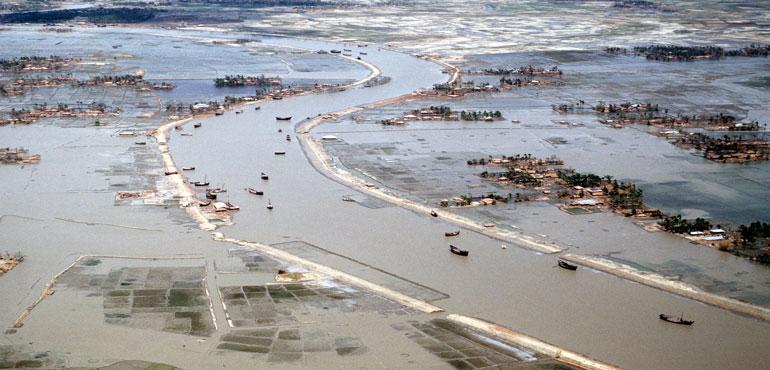
One of the most devastating cyclones to form in the Indian Ocean made landfall across Bangladesh 30 years ago today. The Bangladesh Cyclone of 1991 was classified as a super cyclone that packed deadly winds, powerful storm surge and massive flooding.
The storm developed over the southern region of the Bay of Bengal as a region of thunderstorms that had recently banded together. Thanks to warm, moist air and lack of wind shear, this system quickly organized into a Tropical Cyclone by April 24, 1991. From here, the storm increased in strength, becoming classified as a Severe Cyclonic Storm (equivalent to a Tropical Storm in the U.S., with winds up to 73 mph) by the India Meteorological Department on April 25.
The storm went into overdrive as wind shear decreased further, strengthening to a Super Cyclonic Storm (equivalent to a Category 5 Hurricane on the Saffir-Simpson Hurricane Wind Scale) with sustained winds of 150 mph by April 29. As the storm traverse the warm waters, a subtropical ridge sunk southward, steering the storm northeastward.
This powerful cyclone impacted the city of Chittagong, Bangladesh, just after midnight on April 29, making it even harder to detect tornadoes and flying debris associated with the storm. The hilly nature of the city helped to weaken this behemoth of a storm, but damaging scars were left in the storm’s midst before it dissipated on April 30.
Damages stemmed from massive storm surge that struck during high tide. At its peak, the surge piled up to 20 feet high on top of 18 feet of higher-than-normal tide waters. The storm surge coupled with winds more than 140 mph led to the deaths of 138,000 people with damages upwards of $1.7 billion U.S. in 1991 (equivalent to more than $3 billion in 2021). In Chittagong, livestock was deceased and up to 90% of homes were destroyed.
This cyclone was so devastating that it is known as the fifth deadliest storm cyclone on record. In the aftermath, the U.S. and many other countries provided disaster relief in the wake of this detrimental storm. Thanks to Operation Sea Angel which began on May 10, 1991, more than 3,000 tons of supplies were delivered to the areas affect by this cyclone, and it helped to save more than 200,000 people.
Source(s): World Meteorological Organization (WMO)
Story Image: Flooded villages and fields around a river in Bangladesh the day after the 1991 Bangladesh cyclone had struck the country. (Staff Sergeant Val Gempis (USAF)/Wikimedia Commons)
The storm developed over the southern region of the Bay of Bengal as a region of thunderstorms that had recently banded together. Thanks to warm, moist air and lack of wind shear, this system quickly organized into a Tropical Cyclone by April 24, 1991. From here, the storm increased in strength, becoming classified as a Severe Cyclonic Storm (equivalent to a Tropical Storm in the U.S., with winds up to 73 mph) by the India Meteorological Department on April 25.
The storm went into overdrive as wind shear decreased further, strengthening to a Super Cyclonic Storm (equivalent to a Category 5 Hurricane on the Saffir-Simpson Hurricane Wind Scale) with sustained winds of 150 mph by April 29. As the storm traverse the warm waters, a subtropical ridge sunk southward, steering the storm northeastward.
This powerful cyclone impacted the city of Chittagong, Bangladesh, just after midnight on April 29, making it even harder to detect tornadoes and flying debris associated with the storm. The hilly nature of the city helped to weaken this behemoth of a storm, but damaging scars were left in the storm’s midst before it dissipated on April 30.
Damages stemmed from massive storm surge that struck during high tide. At its peak, the surge piled up to 20 feet high on top of 18 feet of higher-than-normal tide waters. The storm surge coupled with winds more than 140 mph led to the deaths of 138,000 people with damages upwards of $1.7 billion U.S. in 1991 (equivalent to more than $3 billion in 2021). In Chittagong, livestock was deceased and up to 90% of homes were destroyed.
This cyclone was so devastating that it is known as the fifth deadliest storm cyclone on record. In the aftermath, the U.S. and many other countries provided disaster relief in the wake of this detrimental storm. Thanks to Operation Sea Angel which began on May 10, 1991, more than 3,000 tons of supplies were delivered to the areas affect by this cyclone, and it helped to save more than 200,000 people.
Source(s): World Meteorological Organization (WMO)
Story Image: Flooded villages and fields around a river in Bangladesh the day after the 1991 Bangladesh cyclone had struck the country. (Staff Sergeant Val Gempis (USAF)/Wikimedia Commons)