


Back to forecast
On This Day: Hurricane Camille Batters Gulf Coast in 1969
August 15, 2020 at 03:25 PM EDT
By WeatherBug's Chris Sayles
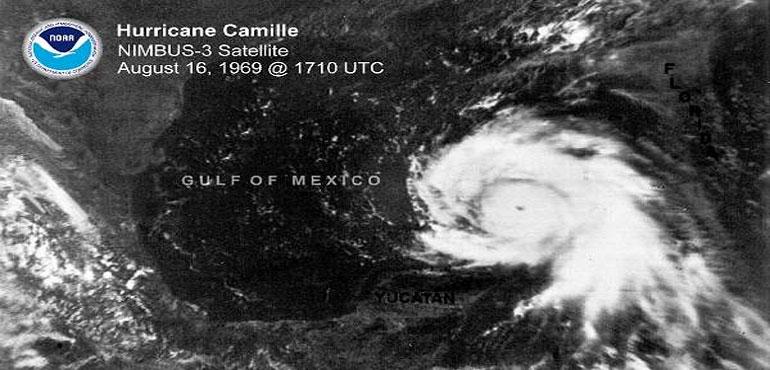
On August 17, 1969, the Gulf Coast was rammed by the perfect storm. Hurricane Camille impacted the Mississippi coastline and left a trail of devastation that would leave scars more than 50 years afterwards.
Although the Gulf Coast is not a stranger to tropical weather, nothing could’ve prepared residents for Camille. The storm developed from a tropical wave that swept off the coast of Africa on August 5 into the vast waters of the Atlantic Ocean. From that point on, the storm organized as it travelled hundreds of miles into the warm Caribbean. By August 14, Camille formed as a tropical depression before strengthening rapidly into a strong tropical storm just south of northwestern Cuba.
As Camille moved into an even more favorable environment, including low wind shear and warm temperatures, the storm underwent a period of rapid strengthening the very next day. The storm jumped from a tropical storm with sustained winds of 60 mph to a Category 2 hurricane with maximum sustained winds of 110 mph. Even though the system was dubbed a small storm, it was still a potent Category 2 hurricane as it brushed over Cuba on August 15. Once the system entered the open waters of the Gulf Coast, fear and panic settled in. Initial forecasts had the storm making a beeline for the Florida Panhandle, but this was not the case.
Hurricane hunters flew into the storm’s eye to analyze its structure and strength on August 16 and they found something quite daunting. The former Category 2 storm would break barriers as it rapidly intensified into a Category 5 Hurricane, the worst-case scenario. The central pressure was 908 mb or 26.82 inches of mercury, and top sustained winds were at an estimated 175 mph. After briefly weakening to a Category 4 Hurricane thanks to the storm going through an eyewall replacement cycle (ERC), Hurricane Camille would regain its prowess as a Category 5 storm with its eye set on the central Gulf Coast.
Hurricane Camille made landfall as a Category 5 hurricane with sustained winds estimated at 175 mph just before midnight on August 17, 1969. Cataclysmic damage was done to Mississippi at the time of Camille’s landfall. As a matter of fact, weather stations were wiped out, prohibiting official wind reports of the storm.
Although it was considered a tiny storm, Hurricane Camille still wreaked havoc along the entire central Gulf Coast. Severe storm surge that raised tides to nearly 25 feet paired with devastating winds led to damages skyrocketing to more than $900 million in Mississippi alone. Camille would claim the lives of more than 140 people across Mississippi, Alabama and Louisiana. Camille tied Hurricane Betsy for the costliest storm up to that time with a bill of $1.42 billion.
Camille would go down in the record books as one of only four hurricanes in the Atlantic to make landfall in the United States as a Category 5 hurricane. The other three storms in that list include the Florida hurricane of 1935, Hurricane Andrew in 1992 and Hurricane Michael in 2018.
Sources: NOAA
--------------------
Story Image: NIMBUS-3 satellite imagery of Hurricane Camille on August 16, 1969. (NOAA)
Although the Gulf Coast is not a stranger to tropical weather, nothing could’ve prepared residents for Camille. The storm developed from a tropical wave that swept off the coast of Africa on August 5 into the vast waters of the Atlantic Ocean. From that point on, the storm organized as it travelled hundreds of miles into the warm Caribbean. By August 14, Camille formed as a tropical depression before strengthening rapidly into a strong tropical storm just south of northwestern Cuba.
As Camille moved into an even more favorable environment, including low wind shear and warm temperatures, the storm underwent a period of rapid strengthening the very next day. The storm jumped from a tropical storm with sustained winds of 60 mph to a Category 2 hurricane with maximum sustained winds of 110 mph. Even though the system was dubbed a small storm, it was still a potent Category 2 hurricane as it brushed over Cuba on August 15. Once the system entered the open waters of the Gulf Coast, fear and panic settled in. Initial forecasts had the storm making a beeline for the Florida Panhandle, but this was not the case.
Hurricane hunters flew into the storm’s eye to analyze its structure and strength on August 16 and they found something quite daunting. The former Category 2 storm would break barriers as it rapidly intensified into a Category 5 Hurricane, the worst-case scenario. The central pressure was 908 mb or 26.82 inches of mercury, and top sustained winds were at an estimated 175 mph. After briefly weakening to a Category 4 Hurricane thanks to the storm going through an eyewall replacement cycle (ERC), Hurricane Camille would regain its prowess as a Category 5 storm with its eye set on the central Gulf Coast.
Hurricane Camille made landfall as a Category 5 hurricane with sustained winds estimated at 175 mph just before midnight on August 17, 1969. Cataclysmic damage was done to Mississippi at the time of Camille’s landfall. As a matter of fact, weather stations were wiped out, prohibiting official wind reports of the storm.
Although it was considered a tiny storm, Hurricane Camille still wreaked havoc along the entire central Gulf Coast. Severe storm surge that raised tides to nearly 25 feet paired with devastating winds led to damages skyrocketing to more than $900 million in Mississippi alone. Camille would claim the lives of more than 140 people across Mississippi, Alabama and Louisiana. Camille tied Hurricane Betsy for the costliest storm up to that time with a bill of $1.42 billion.
Camille would go down in the record books as one of only four hurricanes in the Atlantic to make landfall in the United States as a Category 5 hurricane. The other three storms in that list include the Florida hurricane of 1935, Hurricane Andrew in 1992 and Hurricane Michael in 2018.
Sources: NOAA
--------------------
Story Image: NIMBUS-3 satellite imagery of Hurricane Camille on August 16, 1969. (NOAA)