Back to forecast
On This Day In 1906: San Francisco Earthquake and Fire
April 18, 2023 at 06:48 PM EDT
By WeatherBug Sr. Meteorologist, James Aman
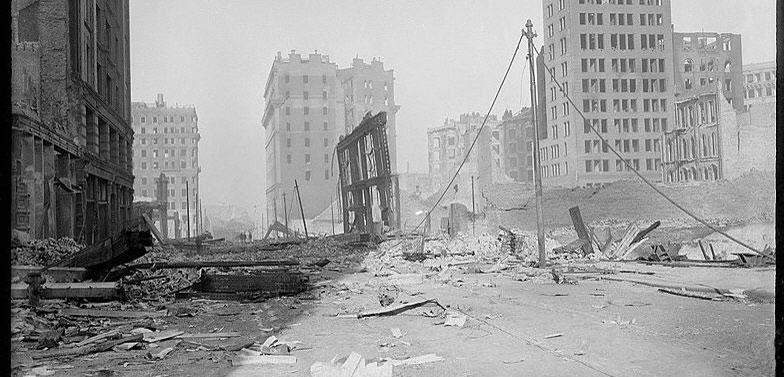
News headlines from 1906 stated that San Francisco was wrecked by a Great Earthquake that struck at 5:12 a.m. Pacific Standard Time on Wednesday, April 18, 1906. A major aftershock struck at 8:14 a.m., causing damaged buildings to totally collapse. Modern research shows an estimated 7.9 magnitude, with the epicenter near San Francisco.
The earthquake was caused by the San Andreas fault, which lies along the coast of California and passes under parts of San Francisco. A huge rupture extended for over 280 miles along the fault, with the ground moving by over 20 feet in some places along the fault-line. The earthquake was felt from southern Oregon to south of Los Angeles and inland as far as central Nevada.
The heaviest damage occurred in areas that once had been wetlands near San Francisco Bay, and then were filled in and built on. During the earthquake, the wet soil below ground liquified, causing huge surface ruptures and most of the buildings collapsed. The earthquake also damaged or destroyed most of the water supply pipes in the city, so most of the fire hydrants went dry. Scattered fires started in the damaged areas, and there was little or no water to fight the fires. The fires developed into a great conflagration. The city police and fire departments were quickly augmented by soldiers and sailors from the U.S. Army and Navy. In some areas of the city, the fire was stopped by dynamiting of buildings. The fires were finally controlled after four days, but much of the city lay in ruins. The United States Mint building was saved due to stone and concrete construction, and its own onsite well and water supply.
The combination of earthquake and fire caused an estimated 3000 deaths in the San Francisco Bay area. In the city of San Francisco, over 28,000 buildings were destroyed, and over 225,000 people were left homeless (in a city of 400,000 residents).
Massive relief efforts began almost immediately after the earthquake. Charitable contributions came from across the United States and other countries offered helped as well. Several temporary housing camps were established around the city, and rebuilding efforts continued for several years afterwards.
The disaster also spurred intensive research. The California governor appointed Professor Andrew C. Lawson from University of California at Berkeley, to lead the Earthquake Investigation Commission. Several universities and the U.S. Geological Survey combined to issue a report in 1908, called the Lawson Report, that led to a much greater understanding of what caused the earthquake. The report also showed how damage was related to both building construction methods and underlying ground conditions - - the soft wet soil near San Francisco Bay was much more dangerous to build on than rocky ground.
Sources: California Department of Conservation, Museum of the City of San Francisco, USGS, SFGate
--------
Image: This is a view from Montgomery Street looking towards Market. In the background to the right are the remains of the Palace Hotel. (Courtesy Edith Irvine Collection, L. Tom Perry Special Collections, Harold B. Lee Library, Brigham Young University; 1906)
The earthquake was caused by the San Andreas fault, which lies along the coast of California and passes under parts of San Francisco. A huge rupture extended for over 280 miles along the fault, with the ground moving by over 20 feet in some places along the fault-line. The earthquake was felt from southern Oregon to south of Los Angeles and inland as far as central Nevada.
The heaviest damage occurred in areas that once had been wetlands near San Francisco Bay, and then were filled in and built on. During the earthquake, the wet soil below ground liquified, causing huge surface ruptures and most of the buildings collapsed. The earthquake also damaged or destroyed most of the water supply pipes in the city, so most of the fire hydrants went dry. Scattered fires started in the damaged areas, and there was little or no water to fight the fires. The fires developed into a great conflagration. The city police and fire departments were quickly augmented by soldiers and sailors from the U.S. Army and Navy. In some areas of the city, the fire was stopped by dynamiting of buildings. The fires were finally controlled after four days, but much of the city lay in ruins. The United States Mint building was saved due to stone and concrete construction, and its own onsite well and water supply.
The combination of earthquake and fire caused an estimated 3000 deaths in the San Francisco Bay area. In the city of San Francisco, over 28,000 buildings were destroyed, and over 225,000 people were left homeless (in a city of 400,000 residents).
Massive relief efforts began almost immediately after the earthquake. Charitable contributions came from across the United States and other countries offered helped as well. Several temporary housing camps were established around the city, and rebuilding efforts continued for several years afterwards.
The disaster also spurred intensive research. The California governor appointed Professor Andrew C. Lawson from University of California at Berkeley, to lead the Earthquake Investigation Commission. Several universities and the U.S. Geological Survey combined to issue a report in 1908, called the Lawson Report, that led to a much greater understanding of what caused the earthquake. The report also showed how damage was related to both building construction methods and underlying ground conditions - - the soft wet soil near San Francisco Bay was much more dangerous to build on than rocky ground.
Sources: California Department of Conservation, Museum of the City of San Francisco, USGS, SFGate
--------
Image: This is a view from Montgomery Street looking towards Market. In the background to the right are the remains of the Palace Hotel. (Courtesy Edith Irvine Collection, L. Tom Perry Special Collections, Harold B. Lee Library, Brigham Young University; 1906)