


Back to forecast
On This Day: Krakatoa's Final Eruption Rocks The World in 1883
August 25, 2020 at 08:08 PM EDT
By WeatherBug's Chris Sayles
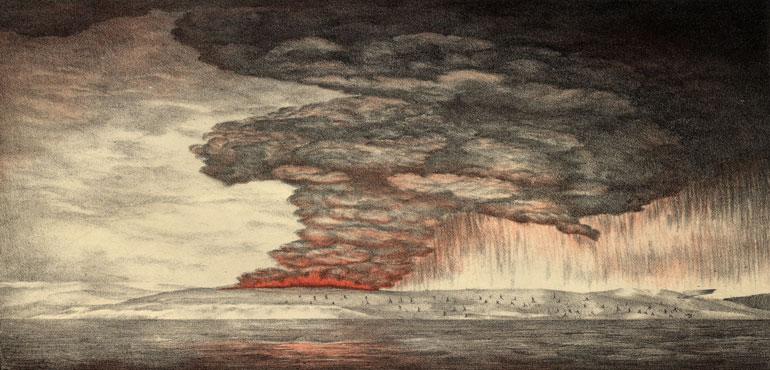
An eruption felt around the world happened on this day nearly 150 years ago. The famous volcano Krakatoa would commence its final eruption and become the most deadliest and destructive eruption recorded in history.
Over the course of the summer in 1883, the volcano known as Krakatoa located on the island of Krakatau, Indonesia, would begin producing ash clouds as early as May 1883. This would frighten the locals as it would be a sign that the volcano was starting to “wake up” and an eruption was near. Not only that, but before the ash cloud came a series of miniature earthquakes around this island which so happens to lie of the “Ring of Fire.” This region is the area outlining the Pacific Ocean’s tectonic plate where most tectonic activity such as earthquakes are volcanoes are located. This would be a precursor to the eruption that would shake the world.
A fun fact about Krakatoa, this volcano was known as a stratovolcano or composite volcano making it cone-shaped with a height of about 10 kilometers, that is roughly six miles high! This type of volcano is so volatile when it erupts because of the pyroclastic flows they can produce. This inconceivable but true ash cloud races down the volcano at speeds over 50 mph while packing super high heat between 390-1300 degrees Fahrenheit, incinerating everything in its path. Volcano also produced dense ash clouds that would blanket the sky for neighboring islands. But nothing could prepare the locals for what was about to take place.
Krakatoa would erupt not just once but multiple times before the major eruption heard around the world. The first eruption of the chain eruptions would begin on August 25 with ash clouds being sent as high as 10 to 15 miles into the sky, this led to falling volcanic ash about 30 miles away and produced a tsunami at nearby islands of Java and Sumatra. However, the third eruption would be the most volatile of the series.
In the early morning of August 26, Krakatoa would have an intense eruption that would be heard from thousands of miles away. In fact, Perth, Australia, nearly 2,000 miles away, heard the blast. The Sunda Strait would be affected by massive pyroclastic flows and tsunamis as high as 100 feet that would wreck ships travelling at the time. In fact, half of a neighboring volcano was blown to bits by Krakatoa ferocious eruption.
The combination of the volcanic ash clouds, pyroclastic flows and massive tsunamis would lead to the deaths of over 36,000 people. The island that once was the home of Krakatoa would be almost eviscerated and neighboring islands would also be left in shambles. This eruption would also affect climate a year later as global temperatures would be 32.9 degrees cooler on average and remain abnormal until 1888. Also, record rainfall of nearly 40 inches total would be received in southern California in the following year.
You’ve probably heard the saying that “history repeats itself,” and this case was not any different. After the dust settled, the island of Krakatau would begin to develop a new volcano known as Anak Krakatoa, “Child of Krakatoa.” This new volcano is active and has been erupting since its 1927 formation from the caldera volcano formed after the Krakatoa eruptions. In fact, it had a massive eruption in 2018 which led to the deaths of over 400 people and injuring more than 14,000.
Sources: USGS, NOAA
Story Image: An 1888 lithograph of the 1883 eruption of Krakatoa. (Parker & Coward/Wikimedia Commons)
Over the course of the summer in 1883, the volcano known as Krakatoa located on the island of Krakatau, Indonesia, would begin producing ash clouds as early as May 1883. This would frighten the locals as it would be a sign that the volcano was starting to “wake up” and an eruption was near. Not only that, but before the ash cloud came a series of miniature earthquakes around this island which so happens to lie of the “Ring of Fire.” This region is the area outlining the Pacific Ocean’s tectonic plate where most tectonic activity such as earthquakes are volcanoes are located. This would be a precursor to the eruption that would shake the world.
A fun fact about Krakatoa, this volcano was known as a stratovolcano or composite volcano making it cone-shaped with a height of about 10 kilometers, that is roughly six miles high! This type of volcano is so volatile when it erupts because of the pyroclastic flows they can produce. This inconceivable but true ash cloud races down the volcano at speeds over 50 mph while packing super high heat between 390-1300 degrees Fahrenheit, incinerating everything in its path. Volcano also produced dense ash clouds that would blanket the sky for neighboring islands. But nothing could prepare the locals for what was about to take place.
Krakatoa would erupt not just once but multiple times before the major eruption heard around the world. The first eruption of the chain eruptions would begin on August 25 with ash clouds being sent as high as 10 to 15 miles into the sky, this led to falling volcanic ash about 30 miles away and produced a tsunami at nearby islands of Java and Sumatra. However, the third eruption would be the most volatile of the series.
In the early morning of August 26, Krakatoa would have an intense eruption that would be heard from thousands of miles away. In fact, Perth, Australia, nearly 2,000 miles away, heard the blast. The Sunda Strait would be affected by massive pyroclastic flows and tsunamis as high as 100 feet that would wreck ships travelling at the time. In fact, half of a neighboring volcano was blown to bits by Krakatoa ferocious eruption.
The combination of the volcanic ash clouds, pyroclastic flows and massive tsunamis would lead to the deaths of over 36,000 people. The island that once was the home of Krakatoa would be almost eviscerated and neighboring islands would also be left in shambles. This eruption would also affect climate a year later as global temperatures would be 32.9 degrees cooler on average and remain abnormal until 1888. Also, record rainfall of nearly 40 inches total would be received in southern California in the following year.
You’ve probably heard the saying that “history repeats itself,” and this case was not any different. After the dust settled, the island of Krakatau would begin to develop a new volcano known as Anak Krakatoa, “Child of Krakatoa.” This new volcano is active and has been erupting since its 1927 formation from the caldera volcano formed after the Krakatoa eruptions. In fact, it had a massive eruption in 2018 which led to the deaths of over 400 people and injuring more than 14,000.
Sources: USGS, NOAA
Story Image: An 1888 lithograph of the 1883 eruption of Krakatoa. (Parker & Coward/Wikimedia Commons)