


Missing translation for key: backTo forecast
On This Day: The Night of the Twisters
June 3, 2020 at 01:58 PM EDT
By WeatherBug Sr. Meteorologist, James West
This is not a reference to a sci-fi movie from the 1950s, “The Night of the Twisters” was indeed a major tornado outbreak that occurred on this day 40 years ago. Seven tornadoes roared across Grand Island, Neb., killing five and injuring 200 others.
The June 3, 1980, Grand Island tornado outbreak was during the second evening of a two-day outbreak that also produced tornadoes throughout Tornado Alley, including another deadly tornado near Crawfordsville, Ind. However, the Grand Island Tornado Outbreak will be long remembered for its ferocity and uniqueness. Heck, much of the rubble and debris left by the tornadoes was placed in a landfill, forming Tornado Hill, a popular sled location on the flat Nebraska prairie.
On the evening of June 3, 1980, a supercell, the towering thunderstorm that produces tornadoes, damaging winds and large hail, developed just north of Grand Island, a central Nebraska prairie town with a population of about 30,000 in 1980. This slow-moving complex— its forward speed was only 8 mph— moved south-southwest towards the city.
The first tornado touched down at 8:45 p.m. CDT, traveling more than 14.5 miles over the next 49 minutes, killing one person and injuring 25 more. This F3 tornado, with winds ranging from an estimated 158 to 206 mph, tore farmhouses apart.
The next three tornadoes, including an F3 tornado that damaged part of the local Veteran Affairs hospital, were rare anticyclonic, or clockwise spinning, tornadoes. It is estimated that only one percent of all tornadoes are anticyclonic and the Grand Island Supercell produced three of them. Most anticyclone tornadoes are weak and are satellite tornadoes of larger cyclonic, or anticlockwise spinning, tornadoes. Anticyclonic tornadoes are spawned by tropical systems.
Ninety-minutes after the first tornado, the deadliest and most powerful tornado hit. An F4 tornado —estimated winds of 207 to 260 mph— struck the Grand Island’s East side. This 1,000-yard wide tornado took 12 minutes to move 6 miles. It “obliterated” homes and businesses and caused 4 deaths and 110 injuries.
The final two tornadoes swept across farmland, injuring another 18 people. More than two and a half hours later, the final tornado finally ended.
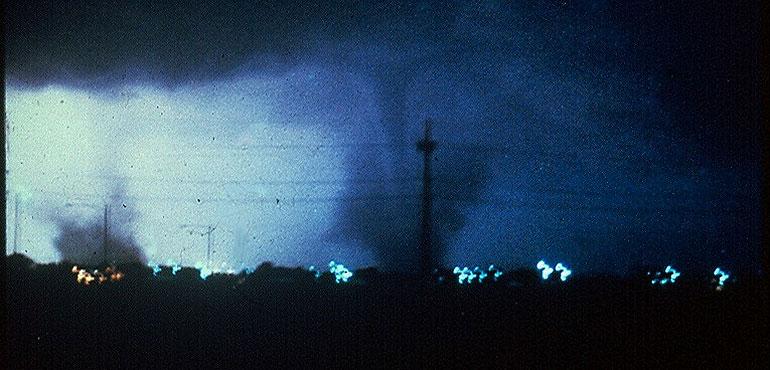
Post-storm surveying showed the paths of the tornadoes often curved, with the first tornado looping over its own path. Photographs show the second and third tornadoes occurring at the same time while the National Weather Service radar detected the signatures of the first and third tornadoes simultaneously.
Total damage was estimated to be $285 million ($885 million in 2020), with most of the damage occurring during the deadliest F4 tornado. Even though the tornadoes occurred at night, the slow-forward speed of the storm complex allowed the local National Weather Service office to warn people of the danger, likely lowering the death toll.
Finally, the name “Night of the Twisters” comes from a 1984 semi-fictionalized book written by Nebraska-native children’s author Ivy Ruckman. He used the seven tornadoes in the Grand Island tornado outbreak as part of the book’s plot. The book would later be turned into a 1996 made-for-cable television movie of the same name.
Source: National Weather Service
Image: Tornadoes #2 (Left) and #3 (Right) looking north from North Johnson Drive, or roughly Webb and Faidley. Photo by Rod Gartner about 9:00 p.m. (National Weather Service website)
The June 3, 1980, Grand Island tornado outbreak was during the second evening of a two-day outbreak that also produced tornadoes throughout Tornado Alley, including another deadly tornado near Crawfordsville, Ind. However, the Grand Island Tornado Outbreak will be long remembered for its ferocity and uniqueness. Heck, much of the rubble and debris left by the tornadoes was placed in a landfill, forming Tornado Hill, a popular sled location on the flat Nebraska prairie.
On the evening of June 3, 1980, a supercell, the towering thunderstorm that produces tornadoes, damaging winds and large hail, developed just north of Grand Island, a central Nebraska prairie town with a population of about 30,000 in 1980. This slow-moving complex— its forward speed was only 8 mph— moved south-southwest towards the city.
The first tornado touched down at 8:45 p.m. CDT, traveling more than 14.5 miles over the next 49 minutes, killing one person and injuring 25 more. This F3 tornado, with winds ranging from an estimated 158 to 206 mph, tore farmhouses apart.
The next three tornadoes, including an F3 tornado that damaged part of the local Veteran Affairs hospital, were rare anticyclonic, or clockwise spinning, tornadoes. It is estimated that only one percent of all tornadoes are anticyclonic and the Grand Island Supercell produced three of them. Most anticyclone tornadoes are weak and are satellite tornadoes of larger cyclonic, or anticlockwise spinning, tornadoes. Anticyclonic tornadoes are spawned by tropical systems.
Ninety-minutes after the first tornado, the deadliest and most powerful tornado hit. An F4 tornado —estimated winds of 207 to 260 mph— struck the Grand Island’s East side. This 1,000-yard wide tornado took 12 minutes to move 6 miles. It “obliterated” homes and businesses and caused 4 deaths and 110 injuries.
The final two tornadoes swept across farmland, injuring another 18 people. More than two and a half hours later, the final tornado finally ended.
Post-storm surveying showed the paths of the tornadoes often curved, with the first tornado looping over its own path. Photographs show the second and third tornadoes occurring at the same time while the National Weather Service radar detected the signatures of the first and third tornadoes simultaneously.
Total damage was estimated to be $285 million ($885 million in 2020), with most of the damage occurring during the deadliest F4 tornado. Even though the tornadoes occurred at night, the slow-forward speed of the storm complex allowed the local National Weather Service office to warn people of the danger, likely lowering the death toll.
Finally, the name “Night of the Twisters” comes from a 1984 semi-fictionalized book written by Nebraska-native children’s author Ivy Ruckman. He used the seven tornadoes in the Grand Island tornado outbreak as part of the book’s plot. The book would later be turned into a 1996 made-for-cable television movie of the same name.
Source: National Weather Service
Image: Tornadoes #2 (Left) and #3 (Right) looking north from North Johnson Drive, or roughly Webb and Faidley. Photo by Rod Gartner about 9:00 p.m. (National Weather Service website)