Back to forecast
On This Day in 1848: Niagara Falls Comes To A Halt
March 31, 2021 at 05:07 PM EDT
By WeatherBug Sr. Meteorologist, Chad Merrill
One of Mother Nature’s most fascinating natural wonders since its discovery in the late 1600s, Niagara Falls, stopped for the first time in recorded history on this day 173 years ago.
More than 400-million years ago, mud was deposited from a former ancient sea floor that extended from what is now Ontario, Canada to the Upper Midwest. Over time, this mud went through different geological processes, including weathering, erosion and uplift. It eventually formed the Niagara Escarpment, which essentially is a steep slope where elevation drops off markedly. Then, the Ice Age produced a huge canopy of ice against the escarpment more than 12,000 years ago. As the ice retreated, water released from melting ice poured over the edge of this escarpment where Niagara River connects Lake Erie with Ontario Canada. This became famously known as Niagara Falls.
Although formation of the falls dates back 12,000 years, the natural beauty wasn’t discovered until a 1678 expedition by French priest, Father Louis Hennepin. Father Hennepin published a book about the falls when he returned to France and this encouraged others to explore the region.
Beyond attracting tourism, industrialists used the opportunity to capitalize on the falls potential to harness electricity. The first large-scale hydroelectric generating station opened in Niagara Falls in 1895. The power generated from the falls was directed to Buffalo, N.Y.
Between April and the end of October, the amount of water rushing over Niagara Falls each minute is equal to that of 3,326 swimming pools. Three-fourths of the water is diverted through tunnels and canals for hydroelectric purposes and then pushed down river of the fall into the lower Niagara River during the winter. The flow over the falls is thus reduced to 1,663 swimming pools full of water dumping over the falls each minute during the cold weather season.
What reduces the power of Niagara Falls running water? The answer---ice! During particularly cold winters, mist and spray that result from water crashing over the falls form a crust of ice over the rushing water, making it appear the falls have stopped. As a matter of fact, the ice crust can grow to a thickness equivalent to the height of ten stories! This made it a popular pastime in the 1800s for folks to enjoy each other’s company and refreshments in outdoor huts set up on the ice surface.
It’s difficult to fathom anything completely stopping such a large volume of water from crashing over the falls. However, it was accomplished on this day in 1848 as high winds pushed millions of tons of ice from Lake Erie to the source of the Niagara River. Believe it or not, for 30 hours, ice completely blocked the channel and locals acclimated to the sound of the river heard an eerie silence. Brave souls even walked or rode horses across the basin. The silence broke when the self-produced ice dam shifted and allowed the water to break through.
Ice became such a hazard it damaged bridges and equipment used to divert water for hydroelectric power usage. So, in 1964, officials placed a 30-foot-long steel pontoon, called an ice boom, that stretches across the outlet of Lake Erie, southwest of Buffalo’s water intake crib.
The portion of Niagara Falls on the U.S. side, called the American Falls, appear to freeze more readily than water on the Canadian side (called the Horseshoe Falls). This is indeed true because only 7 percent of the Niagara River flow is directed to the American Falls whereas the Horseshoe Falls receive 93 percent of the water.
Could the falls ever go silent again from an ice jam? The answer is no. The ice boom installed every winter since 1964 prevents enough ice buildup to completely stop the water from going over the falls.
While Niagara Falls is a spectacle to see any time of the year, winter showcases Mother Nature’s beauty the best. Not only is the sound of crashing water evident but the ice formations offer a natural and magical winter wonderland.
---
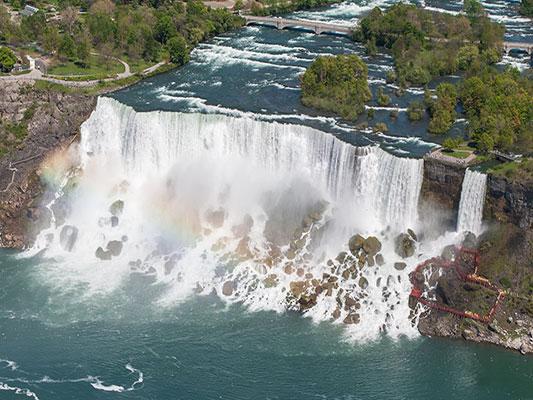
Story Image: American Falls and Bridal Veil Falls are seen from Skylong Tower. (Courtesy Robert F. Tobler, Wikimedia Commons (CC-BY-SA 4.0))
More than 400-million years ago, mud was deposited from a former ancient sea floor that extended from what is now Ontario, Canada to the Upper Midwest. Over time, this mud went through different geological processes, including weathering, erosion and uplift. It eventually formed the Niagara Escarpment, which essentially is a steep slope where elevation drops off markedly. Then, the Ice Age produced a huge canopy of ice against the escarpment more than 12,000 years ago. As the ice retreated, water released from melting ice poured over the edge of this escarpment where Niagara River connects Lake Erie with Ontario Canada. This became famously known as Niagara Falls.
Although formation of the falls dates back 12,000 years, the natural beauty wasn’t discovered until a 1678 expedition by French priest, Father Louis Hennepin. Father Hennepin published a book about the falls when he returned to France and this encouraged others to explore the region.
Beyond attracting tourism, industrialists used the opportunity to capitalize on the falls potential to harness electricity. The first large-scale hydroelectric generating station opened in Niagara Falls in 1895. The power generated from the falls was directed to Buffalo, N.Y.
Between April and the end of October, the amount of water rushing over Niagara Falls each minute is equal to that of 3,326 swimming pools. Three-fourths of the water is diverted through tunnels and canals for hydroelectric purposes and then pushed down river of the fall into the lower Niagara River during the winter. The flow over the falls is thus reduced to 1,663 swimming pools full of water dumping over the falls each minute during the cold weather season.
What reduces the power of Niagara Falls running water? The answer---ice! During particularly cold winters, mist and spray that result from water crashing over the falls form a crust of ice over the rushing water, making it appear the falls have stopped. As a matter of fact, the ice crust can grow to a thickness equivalent to the height of ten stories! This made it a popular pastime in the 1800s for folks to enjoy each other’s company and refreshments in outdoor huts set up on the ice surface.
It’s difficult to fathom anything completely stopping such a large volume of water from crashing over the falls. However, it was accomplished on this day in 1848 as high winds pushed millions of tons of ice from Lake Erie to the source of the Niagara River. Believe it or not, for 30 hours, ice completely blocked the channel and locals acclimated to the sound of the river heard an eerie silence. Brave souls even walked or rode horses across the basin. The silence broke when the self-produced ice dam shifted and allowed the water to break through.
Ice became such a hazard it damaged bridges and equipment used to divert water for hydroelectric power usage. So, in 1964, officials placed a 30-foot-long steel pontoon, called an ice boom, that stretches across the outlet of Lake Erie, southwest of Buffalo’s water intake crib.
The portion of Niagara Falls on the U.S. side, called the American Falls, appear to freeze more readily than water on the Canadian side (called the Horseshoe Falls). This is indeed true because only 7 percent of the Niagara River flow is directed to the American Falls whereas the Horseshoe Falls receive 93 percent of the water.
Could the falls ever go silent again from an ice jam? The answer is no. The ice boom installed every winter since 1964 prevents enough ice buildup to completely stop the water from going over the falls.
While Niagara Falls is a spectacle to see any time of the year, winter showcases Mother Nature’s beauty the best. Not only is the sound of crashing water evident but the ice formations offer a natural and magical winter wonderland.
---
Story Image: American Falls and Bridal Veil Falls are seen from Skylong Tower. (Courtesy Robert F. Tobler, Wikimedia Commons (CC-BY-SA 4.0))