


Back to forecast
On This Day in 1926: The Great Miami Hurricane Makes Landfall
September 18, 2023 at 07:52 AM EDT
By WeatherBug Meteorologist, Matt Mehallow
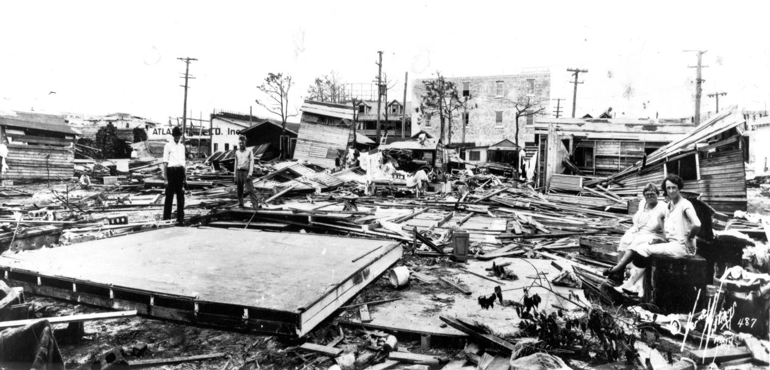
The Great Miami Hurricane of 1926 was a catastrophic storm that produced immense destruction in southeast Florida when it made landfall 97 years ago. It brought the rapid growth of southeast Florida during the early 20th century to a screeching halt.
The system was a classic Cape Verde-type, first known to the United States Weather Bureau from ship reports in the central tropical Atlantic on September 11, 1926, when it developed into a tropical storm. From there, it moved north of the Leeward Islands and Puerto Rico on September 14 to 16, strengthening into a Category 4 hurricane as it neared the Turks and Caicos Islands.
This track evaded the typical channels of Caribbean information, which meant the storm remained a relative mystery due to limited observations and no satellite pictures and reconnaissance aircraft. The only detection of the hurricane came from a few ship reports as the system continued westward into the southern Bahamas at its peak intensity early on September 17.
The hurricane slightly weakened as it accelerated through the southern Bahamas throughout September 17, eventually passing near Nassau and then over on Andros Island early on September 18. Thereafter, the hurricane headed toward Florida, moving ashore on the coast of South Florida near Perrine, located just 15 miles south of downtown Miami, during the morning on September 18 with maximum sustained winds of 145 mph and a minimum pressure estimated at 930 millbars.
The eye of the hurricane, with its period of relative calm, passed over downtown Miami and parts of Coconut Grove and South Miami. The lull lasted only about 35 minutes, which was followed by the worst part of the hurricane. Strong onshore southeasterly winds brought a 10-foot storm surge onto Miami Beach and the barrier islands. At the height of the storm surge, the water from the Atlantic pushed across Miami Beach and Biscayne Bay into the city of Miami for several city blocks.
The 1926 Miami Hurricane emerged in the Gulf of Mexico on September 19, then restrengthened into a major Category 3 hurricane before making a second landfall in Florida on September 20 near Pensacola, Fla. It then pushed inland in a weakened state to coastal Mississippi and Louisiana on September 21.
The Red Cross reported that 372 persons had died in the storm and over 6,000 persons were injured. Damages in 1926 dollars were estimated at $105 million, which would be more than $164 billion in today's dollars. Officials estimated the storm destroyed 4,700 homes in South Florida and left 25,000 people without shelter.
Sources: NOAA, NWS, Wikipedia
-----------
Story Image: Devastation in Miami from the 1926 Hurricane courtesy of Library of Congress
The system was a classic Cape Verde-type, first known to the United States Weather Bureau from ship reports in the central tropical Atlantic on September 11, 1926, when it developed into a tropical storm. From there, it moved north of the Leeward Islands and Puerto Rico on September 14 to 16, strengthening into a Category 4 hurricane as it neared the Turks and Caicos Islands.
This track evaded the typical channels of Caribbean information, which meant the storm remained a relative mystery due to limited observations and no satellite pictures and reconnaissance aircraft. The only detection of the hurricane came from a few ship reports as the system continued westward into the southern Bahamas at its peak intensity early on September 17.
The hurricane slightly weakened as it accelerated through the southern Bahamas throughout September 17, eventually passing near Nassau and then over on Andros Island early on September 18. Thereafter, the hurricane headed toward Florida, moving ashore on the coast of South Florida near Perrine, located just 15 miles south of downtown Miami, during the morning on September 18 with maximum sustained winds of 145 mph and a minimum pressure estimated at 930 millbars.
The eye of the hurricane, with its period of relative calm, passed over downtown Miami and parts of Coconut Grove and South Miami. The lull lasted only about 35 minutes, which was followed by the worst part of the hurricane. Strong onshore southeasterly winds brought a 10-foot storm surge onto Miami Beach and the barrier islands. At the height of the storm surge, the water from the Atlantic pushed across Miami Beach and Biscayne Bay into the city of Miami for several city blocks.
The 1926 Miami Hurricane emerged in the Gulf of Mexico on September 19, then restrengthened into a major Category 3 hurricane before making a second landfall in Florida on September 20 near Pensacola, Fla. It then pushed inland in a weakened state to coastal Mississippi and Louisiana on September 21.
The Red Cross reported that 372 persons had died in the storm and over 6,000 persons were injured. Damages in 1926 dollars were estimated at $105 million, which would be more than $164 billion in today's dollars. Officials estimated the storm destroyed 4,700 homes in South Florida and left 25,000 people without shelter.
Sources: NOAA, NWS, Wikipedia
-----------
Story Image: Devastation in Miami from the 1926 Hurricane courtesy of Library of Congress