Back to forecast
On This Day in 1974: "Lucy" is Discovered in East Africa
November 25, 2020 at 06:23 PM EST
By WeatherBug's Chris Sayles
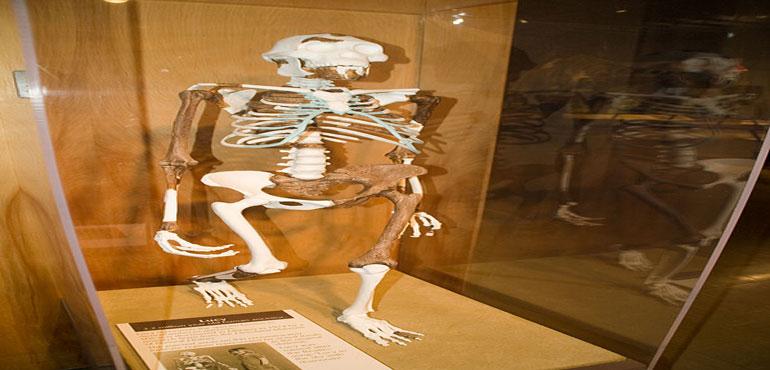
On this day in 1974, “Lucy,” the species of ancient Hominin was discovered in East Africa. In fact, a scientist at the Institute of Human Origins dates the fossil’s age back nearly 3.5-million years ago.
This ground-breaking discovery took place at an excavation site in the Afar Triangle in Ethiopia in 1974. American Paleoanthropologist Donald Johanson led the expedition and produced research for the Museum of Natural History of early Australopithecine (a specific tribe in the Hominin species). The fundamental principle of the research is to prove that humans evolved from a primitive species.
The fossil, AL-288-1, or “Lucy” was believed to be a female, having a pelvic bone structure as well as a sacrum. Her species was known to have walked erect, meaning on two feet and had a brain size comparable to human anatomy.
Lucy was about 3 feet and 7 inches tall and weighed in about 64 pounds. Due to these specifications, scientist believed that she resembled a chimpanzee. However, her bone structure made them think twice since it resembled more modern humanlike features. Lucy’s discovery created so much jubilation that many parents began naming their children “Lucy” during that period. Incidentally, the Beatles song “Lucy in the Sky with Diamonds” may have also contributed to the increasing number of children named “Lucy.”
Lucy’s death remains a mystery, however, scientists did notice signs in her body that she suffered from a degenerative disease. They also found a tooth marking near her pelvic bone that may have occurred near her time of death. Lucy died at age 12, but this was still considered young for the species age.
Lucy’s artifacts were on display across the U.S. in 2007 and given the name Lucy's Legacy: The Hidden Treasures of Ethiopia. The Pacific Science Center in Seattle displayed Lucy in 2008. The following year, New York City’s Discovery Times Square Exposition housed the fossils until October 2009. Lucy’s artifacts were returned to Addis Ababa, Ethiopia in 2013 after the U.S. six-year tour concluded, and they remain there today. Many photos of this spectacle in the evolutionary sciences can still be found online.
Sources: Arizona State University, Institute of Human Origins
---------------------------------------
Story Image: Photo of a cast of Lucy on display at the Cleveland Natural History Museum. (Andrew/Wikimedia Commons)
This ground-breaking discovery took place at an excavation site in the Afar Triangle in Ethiopia in 1974. American Paleoanthropologist Donald Johanson led the expedition and produced research for the Museum of Natural History of early Australopithecine (a specific tribe in the Hominin species). The fundamental principle of the research is to prove that humans evolved from a primitive species.
The fossil, AL-288-1, or “Lucy” was believed to be a female, having a pelvic bone structure as well as a sacrum. Her species was known to have walked erect, meaning on two feet and had a brain size comparable to human anatomy.
Lucy was about 3 feet and 7 inches tall and weighed in about 64 pounds. Due to these specifications, scientist believed that she resembled a chimpanzee. However, her bone structure made them think twice since it resembled more modern humanlike features. Lucy’s discovery created so much jubilation that many parents began naming their children “Lucy” during that period. Incidentally, the Beatles song “Lucy in the Sky with Diamonds” may have also contributed to the increasing number of children named “Lucy.”
Lucy’s death remains a mystery, however, scientists did notice signs in her body that she suffered from a degenerative disease. They also found a tooth marking near her pelvic bone that may have occurred near her time of death. Lucy died at age 12, but this was still considered young for the species age.
Lucy’s artifacts were on display across the U.S. in 2007 and given the name Lucy's Legacy: The Hidden Treasures of Ethiopia. The Pacific Science Center in Seattle displayed Lucy in 2008. The following year, New York City’s Discovery Times Square Exposition housed the fossils until October 2009. Lucy’s artifacts were returned to Addis Ababa, Ethiopia in 2013 after the U.S. six-year tour concluded, and they remain there today. Many photos of this spectacle in the evolutionary sciences can still be found online.
Sources: Arizona State University, Institute of Human Origins
---------------------------------------
Story Image: Photo of a cast of Lucy on display at the Cleveland Natural History Museum. (Andrew/Wikimedia Commons)