Back to forecast
On This Day in 1984: Deadly Carolinas Tornado Outbreak
March 27, 2023 at 05:43 PM EDT
By WeatherBug Meteorologist, Matt Mehallow
The Carolinas Outbreak of March 28, 1984 is remembered as one of the deadliest, most destructive tornado outbreaks in the history of the Carolinas. On that day, tornadoes swept through North and South Carolina, devastating many communities.
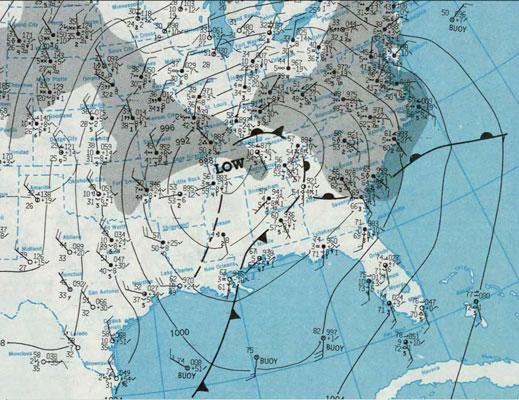
The weather setup late on March 27th featured a strong surface low pressure in Texas. Behind the surface low, a potent upper-level trough across the southern Rocky Mountains was pushing eastward into the Plains. In addition, a warm front was situated just inland along the Gulf coast. The low eventually drifted northeast to near Memphis, Tennessee during the night of March 27th and the morning of March 28th.
Temperatures aloft cooled due to the upper-level trough moving east out of the Plains, while very warm, humid air was being drawn northward from the Gulf of Mexico. This created a very unstable situation across Georgia and the Carolinas during the afternoon of March 28th. Once the surface low moved into eastern Tennessee, a strong mesoscale low developed in northern Alabama along the warm front.
Warm, moist air and the development of the new mesoscale low pressure allowed for a cluster of thunderstorms to erupt along and south of the warm front in northern Georgia. As the mesoscale low strengthened and moved northeast into the Carolinas, surface winds increased out of the south and strong upper-level winds remained out of the southwest. This led to a strongly sheared environment supportive of rotating supercell thunderstorms.
Instability also increased greatly during the afternoon, with CAPE (Convective Available Potential Energy) rising into the 2000 to 3000 J/kg range across the Carolinas. As thunderstorms exited northern Georgia and pushed into southern Carolina late in the afternoon on March 28, the first tornadoes touched down in Upstate South Carolina.
Thunderstorms tracked northeastward during the evening, moving between Columbia and Charlotte around 6 p.m., before arriving in Fayetteville by 8 p.m. The result was several long-tracked tornadoes that swept over the Sandhills and into the coastal Plain of northeastern North Carolina at speeds as fast as 65 mph. The tornadoes fortunately dissipated at around 10 p.m. north of the Albemarle Sound in northeastern North Carolina.
The outbreak was staggering and perhaps unprecedented in the history of North and South Carolina. In its totality, this was the most destructive tornado outbreak to sweep through the Carolinas since the 1884 Enigma Outbreak. There were 24 confirmed tornadoes, including 7 F4 tornadoes, 5 F3 tornadoes and 7 F2 tornadoes. Many of the tornado damage paths were 3/4 to 1 mile wide. The outbreak caused 57 deaths (42 in North Carolina, 15 in South Carolina) and 1248 injuries (799 in North Carolina, 448 in South Carolina, and 1 in Georgia).
Sources: weather.gov, spc.gov
----------
Story Image: The large-scale weather setup during the morning of March 28, 1984, before the tornado outbreak occurred (library.noaa.gov).
The weather setup late on March 27th featured a strong surface low pressure in Texas. Behind the surface low, a potent upper-level trough across the southern Rocky Mountains was pushing eastward into the Plains. In addition, a warm front was situated just inland along the Gulf coast. The low eventually drifted northeast to near Memphis, Tennessee during the night of March 27th and the morning of March 28th.
Temperatures aloft cooled due to the upper-level trough moving east out of the Plains, while very warm, humid air was being drawn northward from the Gulf of Mexico. This created a very unstable situation across Georgia and the Carolinas during the afternoon of March 28th. Once the surface low moved into eastern Tennessee, a strong mesoscale low developed in northern Alabama along the warm front.
Warm, moist air and the development of the new mesoscale low pressure allowed for a cluster of thunderstorms to erupt along and south of the warm front in northern Georgia. As the mesoscale low strengthened and moved northeast into the Carolinas, surface winds increased out of the south and strong upper-level winds remained out of the southwest. This led to a strongly sheared environment supportive of rotating supercell thunderstorms.
Instability also increased greatly during the afternoon, with CAPE (Convective Available Potential Energy) rising into the 2000 to 3000 J/kg range across the Carolinas. As thunderstorms exited northern Georgia and pushed into southern Carolina late in the afternoon on March 28, the first tornadoes touched down in Upstate South Carolina.
Thunderstorms tracked northeastward during the evening, moving between Columbia and Charlotte around 6 p.m., before arriving in Fayetteville by 8 p.m. The result was several long-tracked tornadoes that swept over the Sandhills and into the coastal Plain of northeastern North Carolina at speeds as fast as 65 mph. The tornadoes fortunately dissipated at around 10 p.m. north of the Albemarle Sound in northeastern North Carolina.
The outbreak was staggering and perhaps unprecedented in the history of North and South Carolina. In its totality, this was the most destructive tornado outbreak to sweep through the Carolinas since the 1884 Enigma Outbreak. There were 24 confirmed tornadoes, including 7 F4 tornadoes, 5 F3 tornadoes and 7 F2 tornadoes. Many of the tornado damage paths were 3/4 to 1 mile wide. The outbreak caused 57 deaths (42 in North Carolina, 15 in South Carolina) and 1248 injuries (799 in North Carolina, 448 in South Carolina, and 1 in Georgia).
Sources: weather.gov, spc.gov
----------
Story Image: The large-scale weather setup during the morning of March 28, 1984, before the tornado outbreak occurred (library.noaa.gov).