Back to forecast
On This Day in 1993: Space Shuttle Program STS-61
December 1, 2020 at 04:05 PM EST
By WeatherBug's Christopher Smith
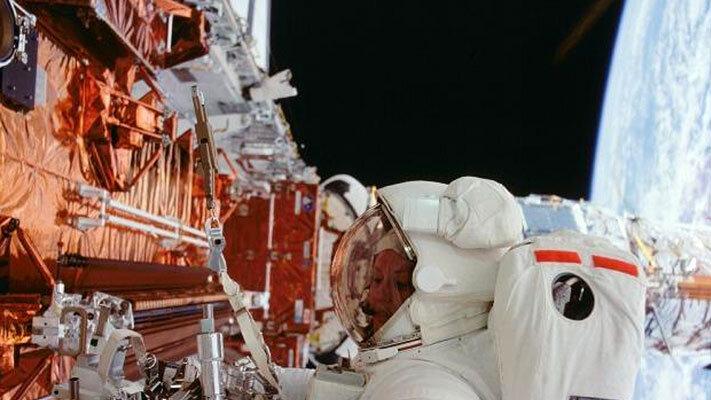
On this day in 1993, space shuttle mission STS-61 was launched, marking the first servicing mission for the Hubble Space Telescope.
The STS-61 mission was considered one of the most complex manned-missions to occur at the time, with six days of operational service conducted. On December 2, 1993, the mission was launched in the pre-dawn from the Kennedy Space Center in Florida and returned 10 days and 4.4-million miles (round-trip) later.
During the telescope’s first servicing mission, a record 35 hours and 28 minutes of five back-to-back space walks were completed by two teams of astronauts.
On the mission’s third day, the Hubble Space Telescope was docked for service. Many goals were accomplished in the following six days, including installation of new solar arrays on the telescope. In addition, what was expected to be a four-hour repair of Hubble’s planetary camera only took a quick, efficient 40 minutes with no problems encountered.
Other services completed during the mission were the replacement of electrical control units and the installation of an optical correction instrument and spectrograph kit.
Many U.S. space-walking records at time were shattered, including Tom Akers who reached 29 hours and 39 minutes for his career, besting the old record of 24 hours and 14 minutes set 20 years prior by Eugene Cernan.
The STS-61 mission was a huge accomplishment for NASA. As a matter of fact, since the STS-1 mission, there were four others service missions for the Hubble Space Telescope. Since the mission, the space-walking record has been broken yet again. Today that record stands at more than 60 hours set by Michael Lopez-Alegria in 2007. This certainly far exceeds the 24-hour record set in 1993!
Looking into the future, there are many planned missions for space by institutions such as NASA and SpaceX. The goal: Studying dark matter to greater exploration of Mars. The future of space exploration certainly is exciting.
Source: nasa.gov, space.com
----------
Story Image: Astronaut Kathryn C. Thorton works with equipment to service the Hubble Space Telescope during the STS-61 mission (NASA).
The STS-61 mission was considered one of the most complex manned-missions to occur at the time, with six days of operational service conducted. On December 2, 1993, the mission was launched in the pre-dawn from the Kennedy Space Center in Florida and returned 10 days and 4.4-million miles (round-trip) later.
During the telescope’s first servicing mission, a record 35 hours and 28 minutes of five back-to-back space walks were completed by two teams of astronauts.
On the mission’s third day, the Hubble Space Telescope was docked for service. Many goals were accomplished in the following six days, including installation of new solar arrays on the telescope. In addition, what was expected to be a four-hour repair of Hubble’s planetary camera only took a quick, efficient 40 minutes with no problems encountered.
Other services completed during the mission were the replacement of electrical control units and the installation of an optical correction instrument and spectrograph kit.
Many U.S. space-walking records at time were shattered, including Tom Akers who reached 29 hours and 39 minutes for his career, besting the old record of 24 hours and 14 minutes set 20 years prior by Eugene Cernan.
The STS-61 mission was a huge accomplishment for NASA. As a matter of fact, since the STS-1 mission, there were four others service missions for the Hubble Space Telescope. Since the mission, the space-walking record has been broken yet again. Today that record stands at more than 60 hours set by Michael Lopez-Alegria in 2007. This certainly far exceeds the 24-hour record set in 1993!
Looking into the future, there are many planned missions for space by institutions such as NASA and SpaceX. The goal: Studying dark matter to greater exploration of Mars. The future of space exploration certainly is exciting.
Source: nasa.gov, space.com
----------
Story Image: Astronaut Kathryn C. Thorton works with equipment to service the Hubble Space Telescope during the STS-61 mission (NASA).