Back to forecast
On This Day in 1995: Galileo Reaches Jupiter
December 6, 2020 at 08:25 PM EST
By WeatherBug's Chris Sayles
The groundbreaking scientific phenomenon Galileo reached Jupiter on this day in 1995 after traveling over 2 billion miles to the gas giant. Galileo would become the first spacecraft to orbit an outer planet in our solar system.
Named after the famous scientist Galileo Galilei who is known as the “Father of Modern Physics,” the Galileo spacecraft was built in Pasadena, Calif., and was launched on October 18, 1989. It would not arrive in Jupiter’s orbit until December 7, 1995, six years later. Even though it took Galileo six years to reach Jupiter’s orbit, the mission was set for only two years. NASA’s Jet Propulsion Laboratory (JPL) would manage this project and the main goal of NASA’s Galileo spacecraft was to collect further information on Jupiter’s orientation and atmospheric composition.
To fulfill these goals, Galileo was equipped with 10 instruments including a probe that was released during its collision with Jupiter’s atmosphere. Prior to its demise on September 21, 2003, Galileo was able to give not only information about Jupiter but its surrounding moons as well. Volcanoes previously discovered by Voyager 1 on Jupiter’s moon Io were determined to be hotter than the ones found on Earth. It was also discovered that another one of Jupiter’s moons, Europa, has more water than that of the Earth.
The descent probe that was released into the atmosphere of Jupiter at the conclusion of the Galileo mission was astounding. It weighed roughly 750 pounds and was about 50 inches in diameter! The probe was built with technology that would protect it from the extreme heat and pressure it would be exposed to in Jupiter’s atmosphere. When released, the probe would travel over 100,000 mph as it descended into the gas giant.
Not only did Galileo accomplish the goals set in place, but it would excel beyond them. Lasting until 2003, Galileo provided great intel on the atmospheric and solar conditions of Jupiter as well as its surrounding moons. In fact, the observations from Galileo’s mission allowed scientist to ponder the idea of sending a lander to one of Jupiter’s moons one day.
Sources: nasa.gov, NASA-JPL
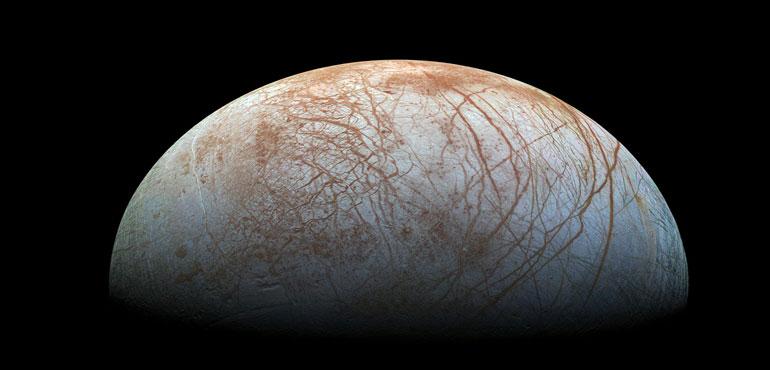
Story Image: The puzzling, fascinating surface of Jupiter's icy moon Europa looms large in this newly-reprocessed color view, made from images taken by NASA's Galileo spacecraft in the late 1990s. (NASA / Jet Propulsion Lab-Caltech / SETI Institute/Wikimedia Commons).
Named after the famous scientist Galileo Galilei who is known as the “Father of Modern Physics,” the Galileo spacecraft was built in Pasadena, Calif., and was launched on October 18, 1989. It would not arrive in Jupiter’s orbit until December 7, 1995, six years later. Even though it took Galileo six years to reach Jupiter’s orbit, the mission was set for only two years. NASA’s Jet Propulsion Laboratory (JPL) would manage this project and the main goal of NASA’s Galileo spacecraft was to collect further information on Jupiter’s orientation and atmospheric composition.
To fulfill these goals, Galileo was equipped with 10 instruments including a probe that was released during its collision with Jupiter’s atmosphere. Prior to its demise on September 21, 2003, Galileo was able to give not only information about Jupiter but its surrounding moons as well. Volcanoes previously discovered by Voyager 1 on Jupiter’s moon Io were determined to be hotter than the ones found on Earth. It was also discovered that another one of Jupiter’s moons, Europa, has more water than that of the Earth.
The descent probe that was released into the atmosphere of Jupiter at the conclusion of the Galileo mission was astounding. It weighed roughly 750 pounds and was about 50 inches in diameter! The probe was built with technology that would protect it from the extreme heat and pressure it would be exposed to in Jupiter’s atmosphere. When released, the probe would travel over 100,000 mph as it descended into the gas giant.
Not only did Galileo accomplish the goals set in place, but it would excel beyond them. Lasting until 2003, Galileo provided great intel on the atmospheric and solar conditions of Jupiter as well as its surrounding moons. In fact, the observations from Galileo’s mission allowed scientist to ponder the idea of sending a lander to one of Jupiter’s moons one day.
Sources: nasa.gov, NASA-JPL
Story Image: The puzzling, fascinating surface of Jupiter's icy moon Europa looms large in this newly-reprocessed color view, made from images taken by NASA's Galileo spacecraft in the late 1990s. (NASA / Jet Propulsion Lab-Caltech / SETI Institute/Wikimedia Commons).