Back to forecast
On This Day in 2004: Mars Opportunity Starts Its Journey
January 22, 2023 at 06:29 PM EST
By WeatherBug Meteorologist, Matt Mehallow
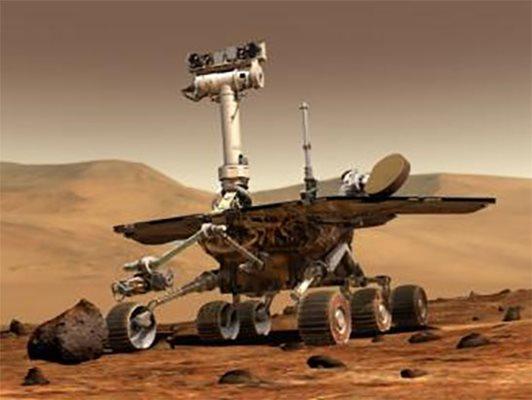
After flying 283 million miles over the span of six months, NASA’s robotic geologist, Opportunity, landed on Mars on January 25, 2004. The craft, nestled between air bags, set down about three weeks after the arrival of its twin rover, Spirit.
Although there were spots on Mars that were thought to contain liquid water, the spacecraft landed on the opposite side of the planet. The landing sites were at Gusev Crater, a potential past lake in a massive impact crater, and Eagle Crater on Meridiani Planum, where mineral deposits hint that Mars had a wet past. The primary scientific objectives of the missions were to hunt for and distinguish a variety of rocks and soils that might hold signs of past water activity on Mars.
Each rover was equipped with a five foot tall, camera-topped mast and rock-grinding tools, scoops and multiple spectrometers used to scope out minerals and rock compositions. Guided by pictures from satellites above, Opportunity investigated numerous craters and traces of waterborne rock beds during its more than 5,000 “sols”, or Mars days, or about 5,200 Earth days. The rovers traveled slowly across the Martian landscape as Opportunity had a top speed of 0.1 miles per hour. In fact, in its liftime, Opportunity only covered 28 miles - although this was far more than the 90 sols and 1,100 yards that was expected.
The rovers were solar-powered, and NASA believed they would not make it through a Martian winter. To survive the rough environment, they rested on a tilt during winter months to allow more direct sunlight to reach their solar panels. Fortunately, the powerful Martian winds consistently made sure the panels were free of dust.
During their journey across the rugged Martian landscape, plenty of evidence of ancient water was found. They discovered unique rock formations likely shaped by flowing water and located clay formations that may have been hospitable for microbes long ago. Opportunity studied more than 100 different craters across the surface of Mars.
Both rovers years of Martian service came to a noble end. Spirit’s final contact with Earth was in 2010, after it became stuck in the Gusev crater. In June 2018, NASA disclosed Opportunity had gone into “sleep” mode due to a huge dust storm that obscured the sunlight, causing the rover’s batteries to drain. This sent it into a “low-power fault” status that took days to see through. Even though NASA officials thought Opportunity might ride out the storm, they reported in October of 2018 that the rover did not wake up and send a signal once the storm had abated. After this unsuccessful campaign to transmit a wake-up call to Opportunity, NASA declared the end of the mission.
Over the course of their scientific mission, these Red Planet robotic explorers sent hundreds of thousands of images, helping to reshape our understanding of Mars’ surface for over 14 years. The twin rovers brought Mars to life in ways no previous explorers had done in the past.
Although there were spots on Mars that were thought to contain liquid water, the spacecraft landed on the opposite side of the planet. The landing sites were at Gusev Crater, a potential past lake in a massive impact crater, and Eagle Crater on Meridiani Planum, where mineral deposits hint that Mars had a wet past. The primary scientific objectives of the missions were to hunt for and distinguish a variety of rocks and soils that might hold signs of past water activity on Mars.
Each rover was equipped with a five foot tall, camera-topped mast and rock-grinding tools, scoops and multiple spectrometers used to scope out minerals and rock compositions. Guided by pictures from satellites above, Opportunity investigated numerous craters and traces of waterborne rock beds during its more than 5,000 “sols”, or Mars days, or about 5,200 Earth days. The rovers traveled slowly across the Martian landscape as Opportunity had a top speed of 0.1 miles per hour. In fact, in its liftime, Opportunity only covered 28 miles - although this was far more than the 90 sols and 1,100 yards that was expected.
The rovers were solar-powered, and NASA believed they would not make it through a Martian winter. To survive the rough environment, they rested on a tilt during winter months to allow more direct sunlight to reach their solar panels. Fortunately, the powerful Martian winds consistently made sure the panels were free of dust.
During their journey across the rugged Martian landscape, plenty of evidence of ancient water was found. They discovered unique rock formations likely shaped by flowing water and located clay formations that may have been hospitable for microbes long ago. Opportunity studied more than 100 different craters across the surface of Mars.
Both rovers years of Martian service came to a noble end. Spirit’s final contact with Earth was in 2010, after it became stuck in the Gusev crater. In June 2018, NASA disclosed Opportunity had gone into “sleep” mode due to a huge dust storm that obscured the sunlight, causing the rover’s batteries to drain. This sent it into a “low-power fault” status that took days to see through. Even though NASA officials thought Opportunity might ride out the storm, they reported in October of 2018 that the rover did not wake up and send a signal once the storm had abated. After this unsuccessful campaign to transmit a wake-up call to Opportunity, NASA declared the end of the mission.
Over the course of their scientific mission, these Red Planet robotic explorers sent hundreds of thousands of images, helping to reshape our understanding of Mars’ surface for over 14 years. The twin rovers brought Mars to life in ways no previous explorers had done in the past.