


Back to forecast
On This Day in 2004: The Powerful Indian Ocean Earthquake and Tsunami
December 21, 2023 at 04:55 PM EST
By WeatherBug Meteorologist, Matt Mehallow
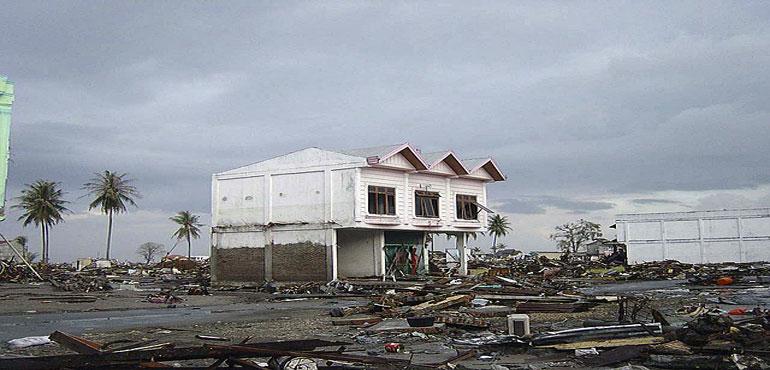
19 years ago today, the powerful Indian Ocean earthquake and tsunami caused enormous devastation and deaths throughout the Indian Ocean region.
Early on Sunday morning December 26, 2004, at 00:58:53 UTC (7:58:53 local time), a massive earthquake measuring 9.1 on the Richter scale struck off the west coast of Sumatra, Indonesia. The epicenter was 30 kilometers under the seabed and approximately 250 kilometers south to south-west of Banda Aceh, Indonesia. The earthquake occurred along a tectonic subduction zone in which the India Plate, an oceanic plate, is being subducted beneath the Burma micro-plate, part of the larger Sunda plate.
The shaking was felt not only in Indonesia, but also in Bangladesh, India, Malaysia, the Maldives, Myanmar, Singapore, Sri Lanka, and Thailand. The earthquake produced a series of immense waves which extended outward in all directions. These waves would travel as fast as 80 kilometers per hour in shallow water, causing the largest impacts in Indonesia and Sri Lanka.
Within 15 to 20 minutes of the earthquake, the first giant waves began hitting the coasts of northern Sumatra and the Nicobar Islands. Waves as high as 51 meters were documented as the tsunami swept through Aceh, the hardest hit region of Indonesia, which caused flooding up to three miles (five kilometers) inland.
Nearly two hours after the earthquake struck, waves impacted Sri Lanka, India, and Thailand. An hour later, waves reached the Maldives, and then about seven hours after the initial quake, the tsunami was seen in Mauritius and along the east coast of Africa.
The tsunami waves caused widespread death and injuries, displaced thousands, destroyed towns, homes, livelihoods, infrastructure, and wrecked coastal areas. According to the United Nations, approximately 227,898 people were killed in fourteen countries, making this the deadliest tsunami in history.
The worst hit country was Indonesia with 167,540 listed as dead or missing. The remaining fatalities occurred in Sri Lanka (35,322), India (16,269), Thailand (8,212), Somalia (289), Maldives (108), Malaysia (75), Myanmar (61), Tanzania (13), Bangladesh (2), Seychelles (2), South Africa (2), Yemen (2), and Kenya (1). The total estimated losses in the Indian Ocean region were $10 billion.
Following the earthquake and subsequent tsunami, the largest emergency relief response in history was prompted. The international community pledged over $14 billion in aid for the overall emergency relief and recovery operations.
---------
Story Image: Trash and debris litter the streets near a standing house in downtown Banda Aceh, Sumatra, Indonesia, following the 2004 Indian Ocean earthquake and tsunami that struck the area on December 26, 2004. (Michael L. Bak via Wikimedia Commons)
Early on Sunday morning December 26, 2004, at 00:58:53 UTC (7:58:53 local time), a massive earthquake measuring 9.1 on the Richter scale struck off the west coast of Sumatra, Indonesia. The epicenter was 30 kilometers under the seabed and approximately 250 kilometers south to south-west of Banda Aceh, Indonesia. The earthquake occurred along a tectonic subduction zone in which the India Plate, an oceanic plate, is being subducted beneath the Burma micro-plate, part of the larger Sunda plate.
The shaking was felt not only in Indonesia, but also in Bangladesh, India, Malaysia, the Maldives, Myanmar, Singapore, Sri Lanka, and Thailand. The earthquake produced a series of immense waves which extended outward in all directions. These waves would travel as fast as 80 kilometers per hour in shallow water, causing the largest impacts in Indonesia and Sri Lanka.
Within 15 to 20 minutes of the earthquake, the first giant waves began hitting the coasts of northern Sumatra and the Nicobar Islands. Waves as high as 51 meters were documented as the tsunami swept through Aceh, the hardest hit region of Indonesia, which caused flooding up to three miles (five kilometers) inland.
Nearly two hours after the earthquake struck, waves impacted Sri Lanka, India, and Thailand. An hour later, waves reached the Maldives, and then about seven hours after the initial quake, the tsunami was seen in Mauritius and along the east coast of Africa.
The tsunami waves caused widespread death and injuries, displaced thousands, destroyed towns, homes, livelihoods, infrastructure, and wrecked coastal areas. According to the United Nations, approximately 227,898 people were killed in fourteen countries, making this the deadliest tsunami in history.
The worst hit country was Indonesia with 167,540 listed as dead or missing. The remaining fatalities occurred in Sri Lanka (35,322), India (16,269), Thailand (8,212), Somalia (289), Maldives (108), Malaysia (75), Myanmar (61), Tanzania (13), Bangladesh (2), Seychelles (2), South Africa (2), Yemen (2), and Kenya (1). The total estimated losses in the Indian Ocean region were $10 billion.
Following the earthquake and subsequent tsunami, the largest emergency relief response in history was prompted. The international community pledged over $14 billion in aid for the overall emergency relief and recovery operations.
---------
Story Image: Trash and debris litter the streets near a standing house in downtown Banda Aceh, Sumatra, Indonesia, following the 2004 Indian Ocean earthquake and tsunami that struck the area on December 26, 2004. (Michael L. Bak via Wikimedia Commons)