---
title: On This Day in 2007: Cyclone Kyrill Impacts Europe | WeatherBug | WeatherBug
description: The beginning of 2007 was particularly dangerous weather-wise across Europe, as a series of major storms pummeled the continent with wind and rain. The strongest of these storms made its mark on this date, January 18, across the United Kingdom.
canonical: https://www.weatherbug.com/news/On-This-Day-in-2007-Cyclone-Kyrill-Impacts-Europe
og:title: On This Day in 2007: Cyclone Kyrill Impacts Europe | WeatherBug | WeatherBug
og:description: The beginning of 2007 was particularly dangerous weather-wise across Europe, as a series of major storms pummeled the continent with wind and rain. The strongest of these storms made its mark on this date, January 18, across the United Kingdom.
og:url: https://www.weatherbug.com/news/On-This-Day-in-2007-Cyclone-Kyrill-Impacts-Europe
og:site_name: WeatherBug
og:locale: en_US
og:image: https://cms-assets-con.cdn.weatherbug.net/assets/contentitems/c2/c21fd353-0be2-4593-a757-eef2aba8ee20/52e0ce98-d40a-4283-82d1-d0fe816ebf4b/a89aa573-b37c-45f5-94ac-50db435c3c1a.jpg
og:image:width: 800
og:image:height: 600
og:image:alt: Satellite composite view of Kyrill on January 18, 2007. (EUMETSAT/Wikimedia Commons)
og:type: article
article:published_time: 2021-01-17T19:27:48Z
article:modified_time: 2021-01-17T19:27:48Z
article:author: By WeatherBug's Chris Sayles
article:tag: Cyclone
article:tag: Europe
article:tag: Kyrill
article:tag: storm
article:tag: "United Kingdom"
article:tag: Weather
twitter:card: summary_large_image
twitter:title: On This Day in 2007: Cyclone Kyrill Impacts Europe | WeatherBug
twitter:description: The beginning of 2007 was particularly dangerous weather-wise across Europe, as a series of major storms pummeled the continent with wind and rain. The strongest of these storms made its mark on this date, January 18, across the United Kingdom.
twitter:image: https://cms-assets-con.cdn.weatherbug.net/assets/contentitems/c2/c21fd353-0be2-4593-a757-eef2aba8ee20/52e0ce98-d40a-4283-82d1-d0fe816ebf4b/a89aa573-b37c-45f5-94ac-50db435c3c1a.jpg
---
[](/)
[Back to forecast](/)
# On This Day in 2007: Cyclone Kyrill Impacts Europe
January 17, 2021 at 02:27 PM EST
By WeatherBug's Chris Sayles
The beginning of 2007 was particularly dangerous weather-wise across Europe, as a series of major storms pummeled the continent with wind and rain. The strongest of these storms made its mark on this date, January 18, across the United Kingdom.
At the time, there wasn’t a standardized naming system in place for European storms, although this would earn the name “Kyrill.” Nearly 50 people were killed from Britain to Russia, leaving damage estimated in excess of 1 billion euros.
After starting innocently enough as a low pressure system in the cold waters of the northern Atlantic became a formidable extratropical cyclone on January 15, 2007\. From there, the storm would pack hurricane-force winds as it crossed over Ireland and Great Britain. By the time the system moved onto the continent on January 18, Kyrill’s would be producing sustained winds approaching 100 mph. Gusts in excess of 125 mph were measured across the mountainous terrain of northern Germany and Poland, along with numerous tornadoes reported.
Thanks to the storm’s size, the devastation from Kyrill stretched across all of northern Europe. Over 25,000 people lost electricity in southern England while over 50,000 lost power in Germany. The outages would last well into the weekend and schools in Germany had to close due to massive outages.
Along with the power outages, many roads, houses and business were laid to waste due to flood damages sustained from the storm. Countries such as Poland and the Netherlands have systems in place to alarm the public of dangerous flooding, but nothing could’ve prepared them for this storm. Kyrill would increase tides 12 to 15 feet above normal, leading to major flood issues. While Germany suffered the most deaths from Kyrill with 13 reports, but the U.K., Ireland, The Netherlands, Poland, Czech Republic, France, Belgium and Austria all suffered deaths due to this storm.
At the time, the UK Meteorological Office had not yet introduced their colorized storm-warning system that is now common across Europe. However, it was determined later that this storm would have met all the criteria be a top-of-the-scale Red Warning storm.
**Source(s):** University of Reading, BBC
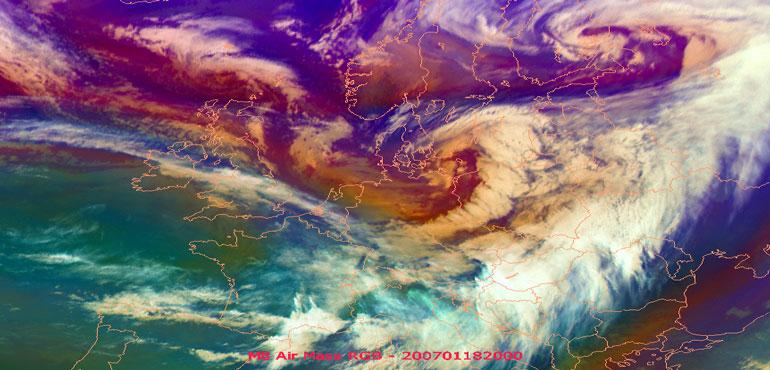
**_Story Image:_** Satellite composite view of Kyrill on January 18, 2007\. (EUMETSAT/Wikimedia Commons)
We use technologies, such as cookies, to analyze your use (i.e., pages visited), to customize content, for our internal analytics purposes and for security and other purposes. By continuing to use this website, you agree to this usage. Please review our [privacy policy](/legal/privacy) for more details as well as for information on how to contact us to object to these activities. [Ad Choices](/legal/privacy#digitaladvertisingandyourchoices)
```json
{"@context":"https://schema.org","@type":"NewsArticle","mainEntityOfPage":{"@type":"WebPage","@id":"https://www.weatherbug.com/news/On-This-Day-in-2007-Cyclone-Kyrill-Impacts-Europe"},"headline":"On This Day in 2007: Cyclone Kyrill Impacts Europe","description":"The beginning of 2007 was particularly dangerous weather-wise across Europe, as a series of major storms pummeled the continent with wind and rain. The strongest of these storms made its mark on this date, January 18, across the United Kingdom.","image":["https://cms-assets-con.cdn.weatherbug.net/assets/contentitems/c2/c21fd353-0be2-4593-a757-eef2aba8ee20/52e0ce98-d40a-4283-82d1-d0fe816ebf4b/a89aa573-b37c-45f5-94ac-50db435c3c1a.jpg"],"datePublished":"2021-01-17T19:27:48Z","dateModified":"2021-01-17T19:27:48Z","dateCreated":"2021-01-17T19:27:48Z","articleSection":"Weather News","keywords":"Cyclone,Europe,Kyrill,storm,\"United Kingdom\",Weather","articleBody":"The beginning of 2007 was particularly dangerous weather-wise across Europe, as a series of major storms pummeled the continent with wind and rain. The strongest of these storms made its mark on this date, January 18, across the United Kingdom.
\r\n
\r\nAt the time, there wasn’t a standardized naming system in place for European storms, although this would earn the name “Kyrill.” Nearly 50 people were killed from Britain to Russia, leaving damage estimated in excess of 1 billion euros.
\r\n
\r\nAfter starting innocently enough as a low pressure system in the cold waters of the northern Atlantic became a formidable extratropical cyclone on January 15, 2007. From there, the storm would pack hurricane-force winds as it crossed over Ireland and Great Britain. By the time the system moved onto the continent on January 18, Kyrill’s would be producing sustained winds approaching 100 mph. Gusts in excess of 125 mph were measured across the mountainous terrain of northern Germany and Poland, along with numerous tornadoes reported.
\r\n
\r\nThanks to the storm’s size, the devastation from Kyrill stretched across all of northern Europe. Over 25,000 people lost electricity in southern England while over 50,000 lost power in Germany. The outages would last well into the weekend and schools in Germany had to close due to massive outages.
\r\n
\r\nAlong with the power outages, many roads, houses and business were laid to waste due to flood damages sustained from the storm. Countries such as Poland and the Netherlands have systems in place to alarm the public of dangerous flooding, but nothing could’ve prepared them for this storm. Kyrill would increase tides 12 to 15 feet above normal, leading to major flood issues. While Germany suffered the most deaths from Kyrill with 13 reports, but the U.K., Ireland, The Netherlands, Poland, Czech Republic, France, Belgium and Austria all suffered deaths due to this storm.
\r\n
\r\n
\r\nAt the time, the UK Meteorological Office had not yet introduced their colorized storm-warning system that is now common across Europe. However, it was determined later that this storm would have met all the criteria be a top-of-the-scale Red Warning storm.
\r\n
\r\nSource(s): University of Reading, BBC
\r\n
\r\nStory Image: Satellite composite view of Kyrill on January 18, 2007. (EUMETSAT/Wikimedia Commons)","author":{"@type":"Person","name":"By WeatherBug's Chris Sayles","url":"https://www.weatherbug.com"},"publisher":{"@type":"Organization","name":"WeatherBug","logo":{"@type":"ImageObject","url":"https://www.weatherbug.com/images/sharing/f1ff28ba-6f06-4745-a782-011a20397e16.png"}}}
{"@context":"https://schema.org","@type":"WebSite","mainEntityOfPage":{"@type":"WebPage","@id":"https://www.weatherbug.com/news/On-This-Day-in-2007-Cyclone-Kyrill-Impacts-Europe","relatedLink":"https://www.weatherbug.com/news/On-This-Day-in-2007-Cyclone-Kyrill-Impacts-Europe"},"name":"WeatherBug","url":"https://www.weatherbug.com/news/On-This-Day-in-2007-Cyclone-Kyrill-Impacts-Europe","headline":"On This Day in 2007: Cyclone Kyrill Impacts Europe","description":"The beginning of 2007 was particularly dangerous weather-wise across Europe, as a series of major storms pummeled the continent with wind and rain. The strongest of these storms made its mark on this date, January 18, across the United Kingdom.","dateModified":"2021-01-17T19:27:48Z","publisher":{"@type":"Organization","name":"WeatherBug","url":"https://www.weatherbug.com","sameAs":["https://www.facebook.com/WeatherBug","https://instagram.com/WeatherBug","https://www.linkedin.com/company/weatherbug","https://www.pinterest.com/weatherbug","https://twitter.com/WeatherBug","https://www.youtube.com/user/WeatherBugVideo"],"logo":{"@type":"ImageObject","url":"https://www.weatherbug.com/images/logos/weatherbug_logo_620x447.png"}},"author":{"@type":"Organization","name":"WeatherBug","url":"https://www.weatherbug.com","sameAs":["https://www.facebook.com/WeatherBug","https://instagram.com/WeatherBug","https://www.linkedin.com/company/weatherbug","https://www.pinterest.com/weatherbug","https://twitter.com/WeatherBug","https://www.youtube.com/user/WeatherBugVideo"],"logo":{"@type":"ImageObject","url":"https://www.weatherbug.com/images/logos/weatherbug_logo_620x447.png"}}}
{"@context":"https://schema.org","@type":"Organization","name":"WeatherBug","logo":"https://www.weatherbug.com/images/logos/weatherbug_logo_620x447.png","url":"https://www.weatherbug.com","sameAs":["https://www.facebook.com/WeatherBug","https://instagram.com/WeatherBug","https://www.linkedin.com/company/weatherbug","https://www.pinterest.com/weatherbug","https://twitter.com/WeatherBug","https://www.youtube.com/user/WeatherBugVideo"]}
```