Back to forecast
On This Day in 2011: The Catastrophic Joplin, Mo., Tornado
May 20, 2023 at 08:16 PM EDT
By WeatherBug Meteorologist, Fred Allen
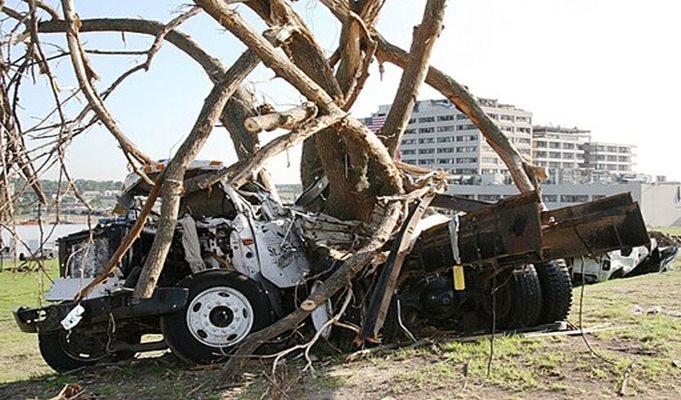
Rivaled by few in United States history, a deadly tornado given the highest rating on the Enhanced Fujita (EF) Scale decimated one-third of the city of Joplin, Mo., on Sunday, May 22, 2011.
A multiple vortices tornado was first reported by storm spotters near the intersection of JJ Highway and West 32nd Street on the western edge of Joplin, Mo., city limits at 5:34 p.m. CDT. Rapidly intensifying, rain-wrapped, and reaching three-quarters to one mile-wide at its peak, the tornado lumbered through the south side of Joplin, Mo., finally exiting the city limits around 5:53 p.m. CDT.
Homes, businesses, and vehicles were destroyed. Well-built St. John’s Medical Center sustained a direct hit, causing severe interior wall and ceiling damage. The ferocity of the tornado led to debris piling in the hospital’s parking lot, with vehicles crushed, flattened, or wrapped around trees. Large steel support beams were curved, twisted, or mangled as well. At the tornado’s peak, St. Mary’s Catholic Church was nearly leveled. All that remained was a steel cross and a small part of the metal roof.
Further east, whole neighborhoods on McClelland Drive were unrecognizable; houses were swept away from their foundations. Large sections of Joplin High School suffered complete destruction. Businesses, homes, and buildings near the high school also suffered catastrophic damage, while boards, limbs, steel beams, fencing, and other materials were found embedded deeply in the ground in open fields.
The tornado’s destructive prowess left Home Depot, Walmart, Academy Sports, and a Pepsi distribution center unrecognizable along Range Line Road. Asphalt in the parking lots was scoured and vehicles were crushed, an indication of the tornado’s raw power. East Middle School was destroyed, as were numerous warehouse buildings and many more neighborhoods, even as the tornado had weakened to EF-4 and EF-3 intensity upon exiting the eastern city limits of Joplin, Mo.
The groundwork for explosive supercell thunderstorm development had already been met that infamous day. A cloudless sky boosted the mercury into the lower 80s while southerly winds helped bring unseasonably humid dewpoints in the lower to middle 70s northward throughout the afternoon. An area of low pressure then formed at the intersection of the warm and cold fronts and dry line known as the triple point. This intersection is where thunderstorms have a greater opportunity to be stronger and produce tornadoes.
The tornado was on the ground from 5:34 p.m. to 6:12 p.m. CDT, or 38 minutes, dissipating near Granby, Mo., in Newton County. In a historical context, the numbers and aftermath are just jaw-dropping:
• Rated EF-5 intensity with winds greater than 200 mph
• Path length was 22.1 miles
• Maximum width was three-quarters to one-mile wide
• A total of 1,371 injuries were documented by the National Weather Service (NWS) and Federal Emergency Management Agency (FEMA)
• There were 161 deaths directly linked to the tornado
• A total of 8,264 homes were impacted, 4,380 were destroyed and 3,884 were significantly damaged
• 553 business structures destroyed or damaged
• 3 million cubic yards of debris scattered
• 130 transmission poles were damaged, leading to lengthy power outages
Taking a deeper statistical dive, the Joplin, Mo., tornado ranks as the seventh deadliest tornado in United States history. Its 38-minute lifetime created $3.37-billion dollars in 2023 United States currency. The Tri-State (MO/IL/IN) tornado, Natchez, Miss., St. Louis, Mo., Tupelo, Miss., Gainesville, Ga., and Woodward, Okla., tornadoes are the only twisters that have caused more single-event deaths than the Joplin, Mo., tornado. All tornado events prior to Joplin, Mo., occurred in the 1800s and 1900s, the most recent being the Woodward, Okla., tornado on April 9, 1947. The Tri-State tornado on March 18, 1925, resulted in 695 deaths, the all-time record for a single event.
The Joplin, Mo., tornado also served as the springboard to building a “Weather-Ready Nation.” The goal is to make sure every community is “ready and responsive” before and after a severe weather event. The memo behind the plan is to be prepared, have a safe place, find a way to get weather notifications, and to respond efficiently and safely after the event. Ultimately, this would save lives, lead to less property loss, and a quick recovery.
---
Story Image: This mangled truck was left in front of St. Johns Hospital in Joplin, Mo., in the wake of an EF-5 tornado touchdown on Sunday, May, 22, 2011. (Source: Wikimedia Commons via John Daves, U.S. Army Corps of Engineers, Kansas City District)