Polar Vortex: What Is It?
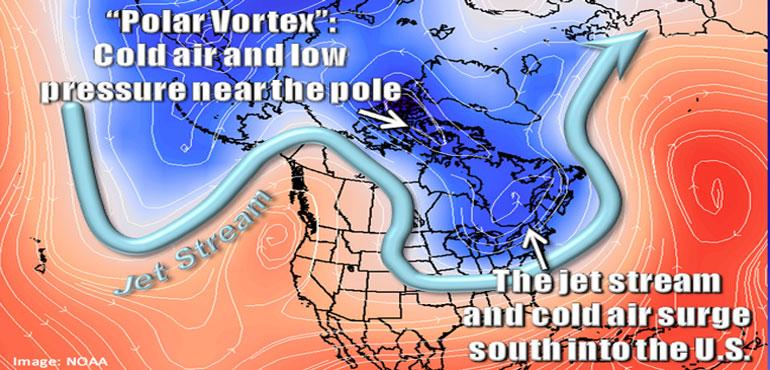
It’s that time of year again where a certain term will be frequently used which may send chills through the U.S. Time to discuss what a polar vortex is and how it affects the weather pattern.
To limit confusion, a polar vortex is simply an area of low pressure that is centered over the poles of the Earth which is where you will find extremely high winds and cold air. This air mass is considered permanent, but it intensifies during the respective winter months for each hemisphere.
Breaking down the term itself though, the word “vortex” refers to a rotating batch of air that drags cooler air towards the North and South poles. As previously mentioned, the winter months are prime times for this colder air to expand and shift. For the Northern Hemisphere, cooler air typically shifts southward as the jet stream dips. This typically results in cold outbreaks for areas such as the Great Lakes and Northeast during the wintertime.
One example of a time when this took place was January 5-7, 2014, where an Arctic chill was sent over the northern half of the U.S. Thanks to the polar vortex that year, Chicago experienced its coldest temperature of 16 degrees below zero. This blitzed past the previous record of 14 degrees below zero which was set in 1884 and tied again in 1988. Temperatures in northern Illinois were reportedly 30 to 40 degrees below normal because of this cold snap. To make matters even more chilling, the lowest wind chill reported was in Steward, Ill., which was 50 degrees below zero!
Although the term has gotten more publicity as of late, polar vortex is not something that just recently appeared. Polar vortices have always been present and they are a great way to analyze how colder air in the upper atmosphere is affecting the surface. Though it may sound scary, try to remember that the polar vortex is just a normal part of the Earth.
Yes, there could be times where Arctic air dipping southward can lead to extreme events, but it’s just like severe weather outbreaks during the summer when instability is at its peak. It’s best to just stay informed and be prepared when the season’s change so Old Man Winter doesn’t ruin your plans.
Source(s): National Weather Service
(Image provided by NOAA)