


Back to forecast
Probability of Precipitation, A Surprisingly Confusing Concept
November 7, 2025 at 01:49 PM EST
By WeatherBug's Chris Sayles
When you look at your area’s weather forecast you always see the same basic parameters: temperature, wind speed, probability of precipitation, etc. These forecast elements seem quite simple, but one is very misunderstood-- Probability of precipitation!
This probability is often written as “the chance of rain or storms,” or “chance of snow.” Despite its ostensibly simple nature, this term has been interpreted in numerous ways, many of which are incorrect. So how exactly is this term defined?
What is Probability of Precipitation (PoP)?
From a technical sense, probability of precipitation refers to the chance of any type of precipitation taking place over any point in a selected area. This probability is derived from this equation:
PoP = C x A
C is the confidence of the forecast
A is the percentage of the defined area that will receive measurable precipitation
Measurable precipitation is defined as an amount exceeding 0.01 inches, or one hundredth of an inch.
One hundredth of an inch is akin to about a 15-minute steady shower or 5-minute downpour, or when discussing wintry weather, a light dusting of snowfall. Additionally, the probability forecast must apply to a specific timeframe, i.e. hours, day, or even multiple days for certain events.
What is the difference between hourly and daily PoP?
Often, confusion arises when hourly PoPs are substantially lower than the daily PoP. In order to understand this conundrum, we must understand two key things.
First, daily and hourly PoPs are related— both share the same probabilistic formula— the time frame is just shorter. Secondly, the nature of different weather events affects the relationship between daily and hourly PoPs. For example, small scale events such as random thunderstorms are much more sporadic, affecting the PoP.
Now, most thunderstorms don’t last in one area for more than an hour, resulting in individual hours becoming independent of one another. This hourly independence could be treated as a separate chance of precipitation. Remember, the daily PoP is the confidence of measurable rain or snow that will occur at any point (or period of time) during the whole day, not just in one hour. In the summertime on a particular day, a forecaster can have a high confidence of 80% that at least one thunderstorm will hit the forecast area over the course of the day but have a lower confidence of 20% in the exact hours that a storm will form and produce precipitation.
On the other hand, large scale rain or snow events such as hurricanes or blizzards are longer duration events and hourly chances are often very close to the daily PoP.
How should you view a forecast with PoP included?
Timing is everything in the world of meteorology. Whenever a meteorologist gives you a PoP, it’s their way of saying how likely “measurable” precipitation will fall in your area over a specific period. Usually, you will see values such as 20% for five hours or 70% over the course of a day. Keep in mind, the time frame is the biggest player in the forecast. The larger the percentage, the greater the chance of measurable precipitation will fall in the aforementioned time frame.
Why should you care about PoP?
For both the meteorologist and general public, weather forecasts can be frustrating but rewarding at times. The imperfections of the science itself makes it difficult for a meteorologist to be 100% certain that it’ll rain or snow—it isn’t always just a yes or no answer. PoP was created in order to help communicate more effectively to the public about the “confidence” in rain or snow chances.
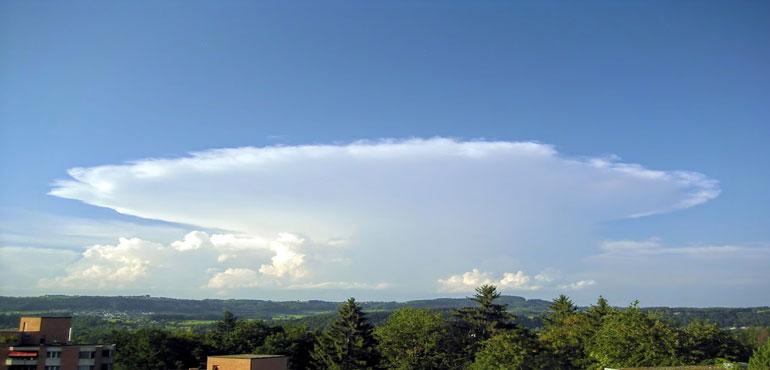
Image: April 7, 2005, Simon Eugster captured a big cumulonimbus cloud with big anvil. (Wikimedia Commons)
This probability is often written as “the chance of rain or storms,” or “chance of snow.” Despite its ostensibly simple nature, this term has been interpreted in numerous ways, many of which are incorrect. So how exactly is this term defined?
What is Probability of Precipitation (PoP)?
From a technical sense, probability of precipitation refers to the chance of any type of precipitation taking place over any point in a selected area. This probability is derived from this equation:
PoP = C x A
C is the confidence of the forecast
A is the percentage of the defined area that will receive measurable precipitation
Measurable precipitation is defined as an amount exceeding 0.01 inches, or one hundredth of an inch.
One hundredth of an inch is akin to about a 15-minute steady shower or 5-minute downpour, or when discussing wintry weather, a light dusting of snowfall. Additionally, the probability forecast must apply to a specific timeframe, i.e. hours, day, or even multiple days for certain events.
What is the difference between hourly and daily PoP?
Often, confusion arises when hourly PoPs are substantially lower than the daily PoP. In order to understand this conundrum, we must understand two key things.
First, daily and hourly PoPs are related— both share the same probabilistic formula— the time frame is just shorter. Secondly, the nature of different weather events affects the relationship between daily and hourly PoPs. For example, small scale events such as random thunderstorms are much more sporadic, affecting the PoP.
Now, most thunderstorms don’t last in one area for more than an hour, resulting in individual hours becoming independent of one another. This hourly independence could be treated as a separate chance of precipitation. Remember, the daily PoP is the confidence of measurable rain or snow that will occur at any point (or period of time) during the whole day, not just in one hour. In the summertime on a particular day, a forecaster can have a high confidence of 80% that at least one thunderstorm will hit the forecast area over the course of the day but have a lower confidence of 20% in the exact hours that a storm will form and produce precipitation.
On the other hand, large scale rain or snow events such as hurricanes or blizzards are longer duration events and hourly chances are often very close to the daily PoP.
How should you view a forecast with PoP included?
Timing is everything in the world of meteorology. Whenever a meteorologist gives you a PoP, it’s their way of saying how likely “measurable” precipitation will fall in your area over a specific period. Usually, you will see values such as 20% for five hours or 70% over the course of a day. Keep in mind, the time frame is the biggest player in the forecast. The larger the percentage, the greater the chance of measurable precipitation will fall in the aforementioned time frame.
Why should you care about PoP?
For both the meteorologist and general public, weather forecasts can be frustrating but rewarding at times. The imperfections of the science itself makes it difficult for a meteorologist to be 100% certain that it’ll rain or snow—it isn’t always just a yes or no answer. PoP was created in order to help communicate more effectively to the public about the “confidence” in rain or snow chances.
Image: April 7, 2005, Simon Eugster captured a big cumulonimbus cloud with big anvil. (Wikimedia Commons)