Back to forecast
Safely Viewing A Solar Eclipse
April 3, 2024 at 10:58 AM EDT
By WeatherBug Meteorologist, Christian Sayles
With this year’s total solar eclipse on the horizon, it’s time to refresh the “to do’s” and “not to do’s” when viewing a solar eclipse. Hopefully these tips and tricks will keep you safe when observing this year’s solar show!
Everyone knows that you are not supposed to look directly at the Sun due to the harmful ultraviolet (UV) and infrared (IR) rays that it produces. Of course, when you are “out and about” you should wear sunglasses that help to prevent eye damage from occurring. However, your everyday sunglasses will not protect you while directly viewing a solar eclipse.
You MUST use the proper solar filters or solar glasses when viewing the Sun directly during a solar eclipse. Failure to do so may result in permanent eye damage or even blindness. Solar glasses can be purchased from many outlets that are NASA-certified. The inexpensive varieties will cost you up to $4 per pair and they are the most common forms of solar glasses. Thanks to the black polymer material embedded in these glasses, it will completely block out the UV and IR rays from the Sun. In fact, you won’t be able to see anything but the Sun when wearing these lenses. With a total solar eclipse, you can briefly remove your solar eclipse glasses if you are in the path of totality!
NEVER wear your solar glasses while looking directly at the Sun via a telescope or binoculars. Thanks to the glass components of these instruments, the UV and IR rays will become concentrated and will render the solar glasses useless while wearing them. This can lead to eye damage and blindness as well. Instead, consider purchasing solar filters that are meant for telescopes and binoculars.
If wielding glass is available in your region, consider purchasing shades that are 14 or higher (which means it will be darker the higher the number). This glass will filter out the harmful UV and IR radiation while allowing some light to break through. A couple drawbacks of using wielding glass include a greenish tint that may appear while using it and the fragility of the glass itself. If not careful, the glass can break especially if free-handed.
Another method to view the solar eclipse in an indirect way is by using the pinhole projection method. This is by far the most inexpensive way to view the eclipse. All you need is a piece of cardboard or construction paper. Next, use a pen or a pair of scissors to carefully poke a hole in the middle. Lastly, grab a piece of paper or some material to project the Sun’s image onto. DO NOT look directly into the pinhole while using this method as it is meant to project onto another surface instead. Looking directly into the pinhole may result in permanent damage or even blindness.
This year’s total solar eclipse taking place on April 8, 2024. Make sure you have the proper protection while viewing these solar spectacles!
Source(s): NASA, Vanderbilt Dyer Observatory
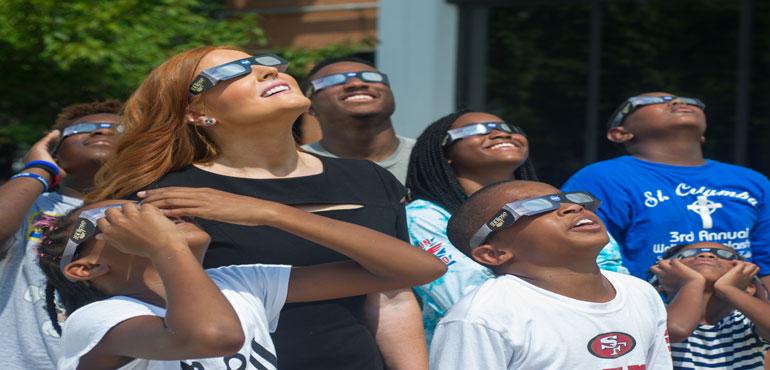
Image: Solar Eclipse viewing at NASA's Goddard Space Flight Center Visitor Center in Greenbelt, Md., on August 21, 2017. (NASA/Goddard/Bill Hrybyk/Wikimedia Commons)
Everyone knows that you are not supposed to look directly at the Sun due to the harmful ultraviolet (UV) and infrared (IR) rays that it produces. Of course, when you are “out and about” you should wear sunglasses that help to prevent eye damage from occurring. However, your everyday sunglasses will not protect you while directly viewing a solar eclipse.
You MUST use the proper solar filters or solar glasses when viewing the Sun directly during a solar eclipse. Failure to do so may result in permanent eye damage or even blindness. Solar glasses can be purchased from many outlets that are NASA-certified. The inexpensive varieties will cost you up to $4 per pair and they are the most common forms of solar glasses. Thanks to the black polymer material embedded in these glasses, it will completely block out the UV and IR rays from the Sun. In fact, you won’t be able to see anything but the Sun when wearing these lenses. With a total solar eclipse, you can briefly remove your solar eclipse glasses if you are in the path of totality!
NEVER wear your solar glasses while looking directly at the Sun via a telescope or binoculars. Thanks to the glass components of these instruments, the UV and IR rays will become concentrated and will render the solar glasses useless while wearing them. This can lead to eye damage and blindness as well. Instead, consider purchasing solar filters that are meant for telescopes and binoculars.
If wielding glass is available in your region, consider purchasing shades that are 14 or higher (which means it will be darker the higher the number). This glass will filter out the harmful UV and IR radiation while allowing some light to break through. A couple drawbacks of using wielding glass include a greenish tint that may appear while using it and the fragility of the glass itself. If not careful, the glass can break especially if free-handed.
Another method to view the solar eclipse in an indirect way is by using the pinhole projection method. This is by far the most inexpensive way to view the eclipse. All you need is a piece of cardboard or construction paper. Next, use a pen or a pair of scissors to carefully poke a hole in the middle. Lastly, grab a piece of paper or some material to project the Sun’s image onto. DO NOT look directly into the pinhole while using this method as it is meant to project onto another surface instead. Looking directly into the pinhole may result in permanent damage or even blindness.
This year’s total solar eclipse taking place on April 8, 2024. Make sure you have the proper protection while viewing these solar spectacles!
Source(s): NASA, Vanderbilt Dyer Observatory
Image: Solar Eclipse viewing at NASA's Goddard Space Flight Center Visitor Center in Greenbelt, Md., on August 21, 2017. (NASA/Goddard/Bill Hrybyk/Wikimedia Commons)