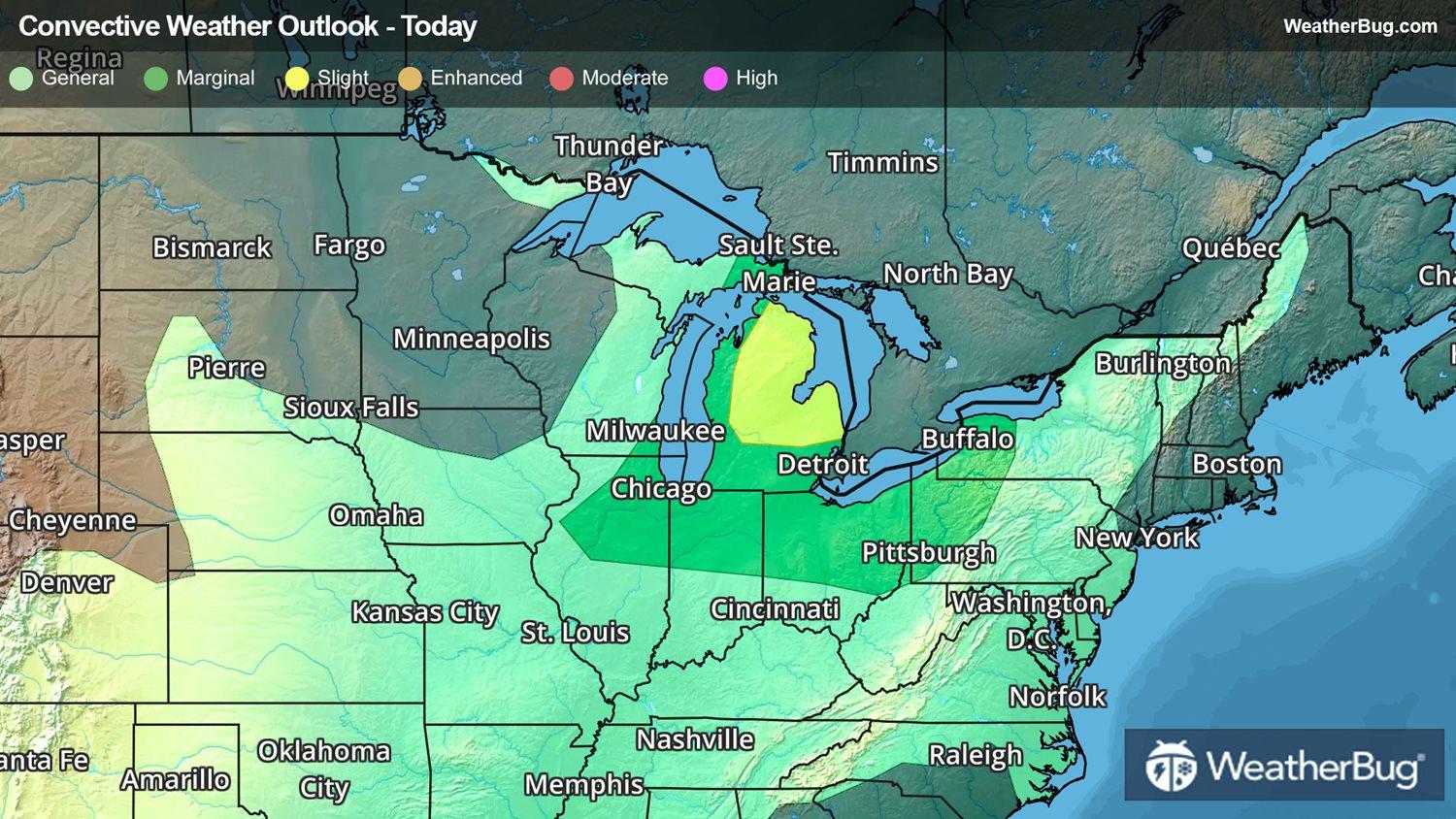
Severe Storms Return to Plains, Midwest

As meteorological spring settles in, so do its infamous severe thunderstorms. Multiple storm systems will strike the Great Plains through the end of the workweek and beyond!
The first of these systems is already forming in the Lower Midwest as a cold, dry air mass infiltrating the High Plains clashes with a persistent flow of humid air from the Gulf. This setup is creating a warm front north of the Lower Ohio Valley and a cold front draped from Texas through Missouri, where severe weather will concentrate.
Clusters of strong-to-severe thunderstorms and a few lone supercells will likely form near these fronts. Damaging gusts, large hail, and a few tornadoes are all on the table today, with the best chance from the mid-afternoon into the evening.
According to the Storm Prediction Center, there is a Slight Risk for severe weather (a 2 out of 5 on the severity scale) from north-central Texas through far southwestern Indiana. Cities under this swath include Dallas, Fayetteville, Ark., Poplar Bluff, Mo., and Evansville, Ind. There is also a Marginal Risk (a 1 out of 5 on the severity scale) from southwestern Ohio through the Texas-Mexico border, including the major metropolitan areas such as Tulsa, Okla., St. Louis, and Louisville, Ky.
Locally heavy rainfall and rain rates are also anticipated near the Ohio River Valley, where Flood Watches and Flood Advisories have been posted for central Indiana through central West Virginia. Local totals exceeding 2 inches are possible across these areas.
On Thursday afternoon, the second storm system will materialize in the High Plains alongside a strong surge of Gulf air northward. The key to igniting the severe storm clusters on Thursday will be a line of dry southwestern air, forcing the Gulf air to rise rapidly.
There is currently a Slight Risk on Thursday for the Texas Panhandle through south-central Kansas, affecting cities such as Dodge City, Kan., as well as Lubbock, Amarillo, and Abilene, Texas. A few tornadoes along with rather large hail will be possible through this corridor, but areas from the Texas-Mexico border through Iowa could observe hail and damaging winds under a Marginal Risk.
The buck does not stop for Friday, where this same storm system brings an Enhanced Risk (a 3 out of 5 on the severity scale) from eastern Oklahoma through northern Missouri and a lesser Slight Risk from north-central Texas through southwestern Wisconsin. The dry line will tag-team with a cold front, robust upper-level winds, and the aforementioned surge of Gulf air to ignite severe thunderstorms across Tornado Alley. Damaging winds, large hail, and tornadoes will again be in play on Friday, and behind the strong cold front, there will even likely be snowfall in the north-central Plains!
Make sure to know the difference between a watch and a warning should they be issued. A “watch” means that conditions are favorable for severe weather to occur, and to be on alert for any rapidly changing conditions. A “warning” means that severe weather is imminent, and you should act fast to remain safe.
The best way to remain safe is to stay prepared and informed about your local weather. Have a severe weather kit packed with a battery-operated radio, water, and non-perishable food items. Also, check the WeatherBug app frequently for any updates on today's severe weather. Remember, "When Thunder Roars, Go Indoors!"