


Back to forecast
Super Bowl Weather History
February 8, 2025 at 02:19 PM EST
By WeatherBug Meteorologist, John Benedict
The finale of the 2024-25 NFL Season is set to kick off this Sunday in New Orleans, Louisiana, between the Philadelphia Eagles and the Kansas City Chiefs. The Superbowl is generally played in warmer climates or beneath a dome to limit the potential risks weather could pose to the game and the fan experience. Looking back through the previous 58 Super Bowls, weather is rarely a factor in the NFL’s championship game, but there have been a few games where the weather has come into play as well as a few close calls.
Of all 59 Super Bowls, 35 have been hosted by just 4 cites, each anchored in the Sunbelt: Miami (11), New Orleans (11), Los Angeles (8) and Tampa Bay (5). Superbowl host cites outside the Sunbelt are nearly always played beneath a domed roof, as Indianapolis, Detroit and Minnesota have all hosted a Super Bowl. Extreme weather is generally a much bigger factor earlier in playoffs, but let’s look at a few times the weather came into to play for the big game.
Super Bowl XLI 2007 Miami, Florida
While a few other Super Bowls have seen a few passing showers, the Super Bowl in 2007 between the Indianapolis Colts and the Chicago Bears featured continuous light to moderate rain. A cold front had stalled south of Miami and breezy onshore winds led to a steady stream of rain that persisted much of day. Nearly an inch of rain was reported that day at nearby Miami International Airport. The Colts were victorious in the rain, defeating the Bears 29-17, and the world ironically witnessed Prince singing "Purple Rain" in the rain!
Super Bowl VI 1972 New Orleans, Louisiana
Despite being played in the dead of winter, the southerly locations of outdoor Super Bowl venues are normally able to escape cold weather. The 1972 Super Bowl was played outdoors in New Orleans in Tulane Stadium. A strong cold front had moved through the Friday before the game, and then an arctic airmass settled across the Gulf Coast for the weekend with temperatures 10 to 15 degrees below normal. The game kicked off with a temperature of 39 degrees, which still stands as the coldest Super Bowl played outdoors. The Dallas Cowboys ended up taking down the Miami Dolphins, 24-3.
Super Bowl XLV 2011 Arlington, Texas
While the weather did not directly affect the game on the field in Super Bowl XLV, a pair of winter storms that hit the Dallas-Fort Worth Metroplex during the week ahead of the game led to numerous logistical issues. An ice storm moved through the region on Tuesday ahead of the game before another storm delivered a few inches of snow on Friday. Snow and ice made travel around the city difficult, and hundreds of flights were cancelled. Seven fans were also injured as snow and ice fell from the roof of Cowboys Stadium. The Green Bay Packers won the game against the Pittsburgh Steelers 31-25 beneath a snow-covered dome.
Super Bowl XLVIII 2014 East Rutherford, New Jersey
The site of the 2014 Super Bowl was unique, being a venue in a cold-weather climate with no roof. The forecast in days leading up to the game were detecting cold temperatures and a potential snowstorm. The snowstorm ended up holding off until the next day and the game was played with mild temperatures in the 40s. The Seattle Seahawks routed the Denver Broncos 43-8.
1967 Championship Game Green Bay, Wisconsin
While not technically a Super Bowl, this championship game is still notable as the coldest game in NFL history. This game between the Green Bay Packers and the Dallas Cowboys was played on December 31st at Lambeau Field, where the temperature at game time registered a frigid 13 degrees below zero and an average wind chill of minus-48 degrees! A layer of condensation had built up between the field and the tarp the night before, causing the field to become frozen and a sheet of ice. It became nicknamed the “Ice Bowl” due to the brutal cold conditions. Additionally, a band was scheduled to play at halftime but several instruments froze and there were reports of brass players getting their lips stuck to their mouthpieces. Multiple band members were also reportedly hospitalized from exposure to the extreme cold. In the end, more than 50,000 people braved the elements that New Year's Eve and watched the Packers claim their third consecutive NFL title, with a 21-17 victory.
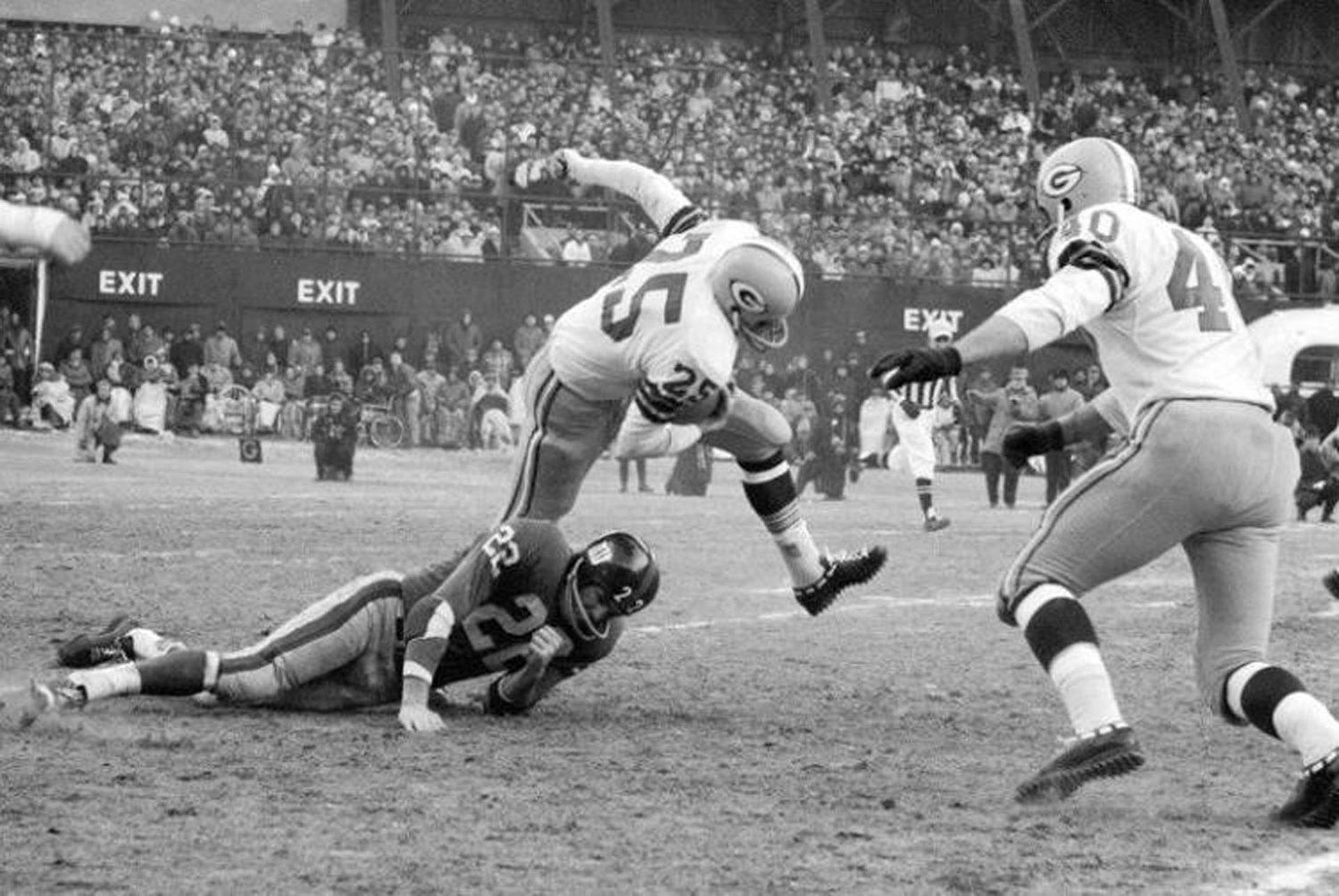
Image: In this Dec. 30, 1962, file photo, Green Bay Packers halfback Tom Moore (25) is stopped by New York Giants` Dick Lynch (22) after returning a kickoff 30 yards in third quarter of the NFL Championship game at New York`s Yankee Stadium. Green Bay won 16-7. (AP Photo/File)
Of all 59 Super Bowls, 35 have been hosted by just 4 cites, each anchored in the Sunbelt: Miami (11), New Orleans (11), Los Angeles (8) and Tampa Bay (5). Superbowl host cites outside the Sunbelt are nearly always played beneath a domed roof, as Indianapolis, Detroit and Minnesota have all hosted a Super Bowl. Extreme weather is generally a much bigger factor earlier in playoffs, but let’s look at a few times the weather came into to play for the big game.
Super Bowl XLI 2007 Miami, Florida
While a few other Super Bowls have seen a few passing showers, the Super Bowl in 2007 between the Indianapolis Colts and the Chicago Bears featured continuous light to moderate rain. A cold front had stalled south of Miami and breezy onshore winds led to a steady stream of rain that persisted much of day. Nearly an inch of rain was reported that day at nearby Miami International Airport. The Colts were victorious in the rain, defeating the Bears 29-17, and the world ironically witnessed Prince singing "Purple Rain" in the rain!
Super Bowl VI 1972 New Orleans, Louisiana
Despite being played in the dead of winter, the southerly locations of outdoor Super Bowl venues are normally able to escape cold weather. The 1972 Super Bowl was played outdoors in New Orleans in Tulane Stadium. A strong cold front had moved through the Friday before the game, and then an arctic airmass settled across the Gulf Coast for the weekend with temperatures 10 to 15 degrees below normal. The game kicked off with a temperature of 39 degrees, which still stands as the coldest Super Bowl played outdoors. The Dallas Cowboys ended up taking down the Miami Dolphins, 24-3.
Super Bowl XLV 2011 Arlington, Texas
While the weather did not directly affect the game on the field in Super Bowl XLV, a pair of winter storms that hit the Dallas-Fort Worth Metroplex during the week ahead of the game led to numerous logistical issues. An ice storm moved through the region on Tuesday ahead of the game before another storm delivered a few inches of snow on Friday. Snow and ice made travel around the city difficult, and hundreds of flights were cancelled. Seven fans were also injured as snow and ice fell from the roof of Cowboys Stadium. The Green Bay Packers won the game against the Pittsburgh Steelers 31-25 beneath a snow-covered dome.
Super Bowl XLVIII 2014 East Rutherford, New Jersey
The site of the 2014 Super Bowl was unique, being a venue in a cold-weather climate with no roof. The forecast in days leading up to the game were detecting cold temperatures and a potential snowstorm. The snowstorm ended up holding off until the next day and the game was played with mild temperatures in the 40s. The Seattle Seahawks routed the Denver Broncos 43-8.
1967 Championship Game Green Bay, Wisconsin
While not technically a Super Bowl, this championship game is still notable as the coldest game in NFL history. This game between the Green Bay Packers and the Dallas Cowboys was played on December 31st at Lambeau Field, where the temperature at game time registered a frigid 13 degrees below zero and an average wind chill of minus-48 degrees! A layer of condensation had built up between the field and the tarp the night before, causing the field to become frozen and a sheet of ice. It became nicknamed the “Ice Bowl” due to the brutal cold conditions. Additionally, a band was scheduled to play at halftime but several instruments froze and there were reports of brass players getting their lips stuck to their mouthpieces. Multiple band members were also reportedly hospitalized from exposure to the extreme cold. In the end, more than 50,000 people braved the elements that New Year's Eve and watched the Packers claim their third consecutive NFL title, with a 21-17 victory.
Image: In this Dec. 30, 1962, file photo, Green Bay Packers halfback Tom Moore (25) is stopped by New York Giants` Dick Lynch (22) after returning a kickoff 30 yards in third quarter of the NFL Championship game at New York`s Yankee Stadium. Green Bay won 16-7. (AP Photo/File)