Back to forecast
The 2023 Annular Solar Eclipse - Clear Skies or Cloudy Nuisance?
October 4, 2023 at 12:16 PM EDT
By WeatherBug Meteorologist, Alyssa Robinette
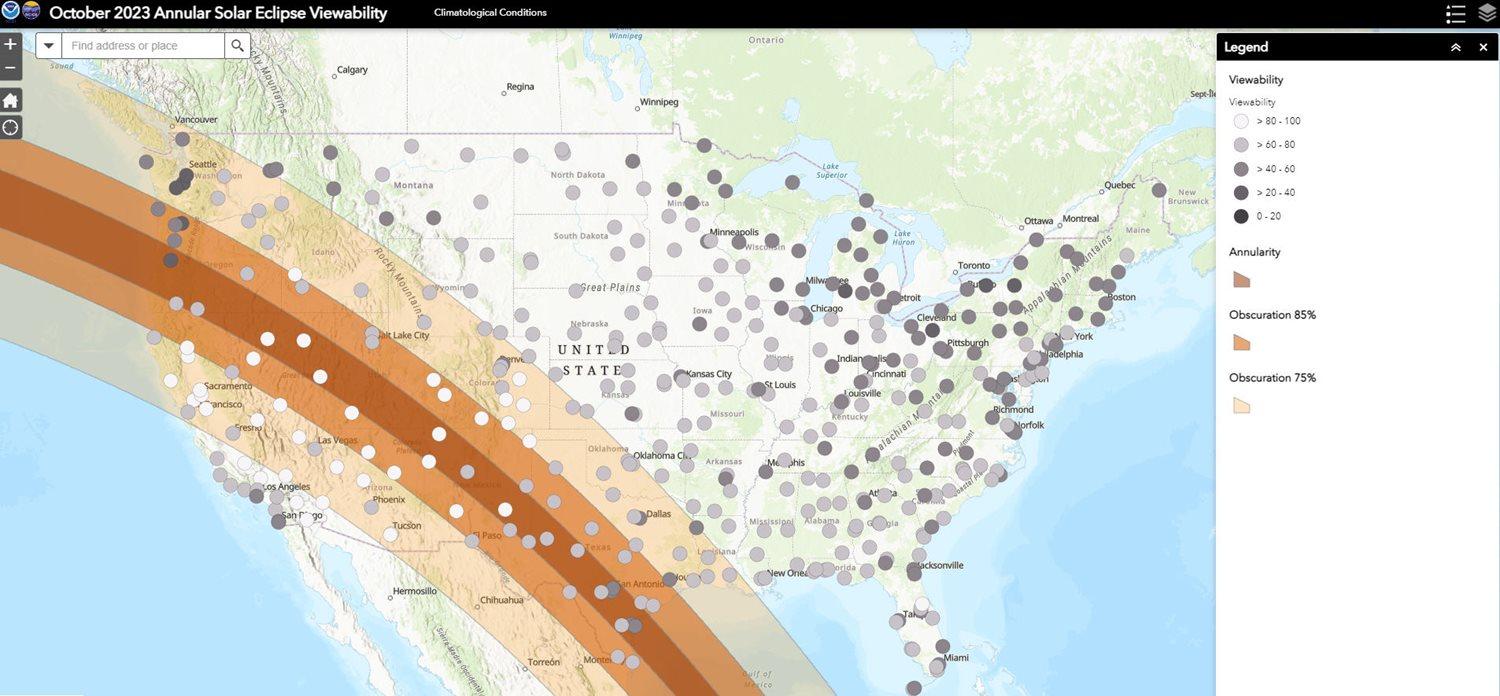
On October 14, 2023, an annular solar eclipse will cross North, Central and South America, with millions of people in its path. So, will clear skies provide a good view, or will there be a cloudy nuisance?
An annular solar eclipse happens when the moon appears relatively small in the sky and does not fully cover the disk of the Sun. Unlike a total solar eclipse that completely darken skies, an annular solar eclipse leaves a thin outer ring often called a “ring of fire.”
The exact amount of cover of the Sun’s disk depends on the moon’s distance from Earth. The moon has a slightly elliptical orbit around Earth, so at two points each month, it is farthest and closest to Earth, making the moon appear slightly smaller and slightly larger than average in our sky. On October 14, 2023, the new moon will look relatively small, and therefore, will cover only 91 percent of the Sun’s disk.
Only within the path of annularity will the ring of fire be visible. This path ranges from 118 to 137 miles and will stretch from Oregon and northern California into northeastern Nevada, central Utah, northeastern Arizona, southwestern Colorado, central Mexico and southern Texas. However, the point of greatest eclipse will occur off the coast of Nicaragua and Costa Rica, where viewers could see a “ring of fire” lasting 5 minutes and 17 seconds.
We are currently a little more than a week out from the 2023 annular solar eclipse, so exact weather conditions will become clearer as we get closer. We can examine the climatological cloud cover in the path of annularity to help find the best places to enjoy this celestial event.
Along the path of annularity that could see up to 91 percent cover of the Sun’s disk, the climatology is as follows:
Source: NCSU, Great American Eclipse, NASA, Space.com
-----
Image: October 2023 Annular Solar Eclipse Viewability (North Carolina State University - NCSU)
An annular solar eclipse happens when the moon appears relatively small in the sky and does not fully cover the disk of the Sun. Unlike a total solar eclipse that completely darken skies, an annular solar eclipse leaves a thin outer ring often called a “ring of fire.”
The exact amount of cover of the Sun’s disk depends on the moon’s distance from Earth. The moon has a slightly elliptical orbit around Earth, so at two points each month, it is farthest and closest to Earth, making the moon appear slightly smaller and slightly larger than average in our sky. On October 14, 2023, the new moon will look relatively small, and therefore, will cover only 91 percent of the Sun’s disk.
Only within the path of annularity will the ring of fire be visible. This path ranges from 118 to 137 miles and will stretch from Oregon and northern California into northeastern Nevada, central Utah, northeastern Arizona, southwestern Colorado, central Mexico and southern Texas. However, the point of greatest eclipse will occur off the coast of Nicaragua and Costa Rica, where viewers could see a “ring of fire” lasting 5 minutes and 17 seconds.
We are currently a little more than a week out from the 2023 annular solar eclipse, so exact weather conditions will become clearer as we get closer. We can examine the climatological cloud cover in the path of annularity to help find the best places to enjoy this celestial event.
Along the path of annularity that could see up to 91 percent cover of the Sun’s disk, the climatology is as follows:
- A 70 to 90-percent chance for clear skies: Winnemucca, Elko and Ely, Nev., and Farmington, Gallup and Roswell, N.M.
- A 50 to 70-percent chance for clear skies: Medford, Ore., Carlsbad Cavern National Park, N.M., and Winkler, Midland and San Angelo, Texas.
- A 30 to 50-percent chance of clear skies: Klamath Falls, Ore., Albuquerque, N.M., and Hondo and Alice, Texas.
- A 20 to 30-percent chance for clear skies: San Antonio and Corpus Christi, Texas.
- A 70 to 90-percent chance of clear skies: Grand Junction, Montrose and Alamosa, Colo., Lovelock, Nev., Cedar City, Utah, Grand Canyon and Winslow, Ariz., and Truth or Consequences, N.M.
- A 50 to 70-percent chance of clear skies: Burns, Ore., Mountain Home, Idaho, Clovis, N.M., and Abilene, Texas.
- A 30 to 50-percent chance of clear skies: Salt Lake City, Reno, Nev., and El Paso, Lubbock, Del Rio, Brownsville and Victoria, Texas.
- Less than a 20 percent chance for clear skies: Portland, Ore.
- A 70 to 90-percent chance for clear skies: Boise, Idaho, Limon, La Junta and Pueblo, Colo., Redding, Sacramento, Stockton and Bishop, Calif., Tonopah, Nev., and Kingman, Ariz.
- A 50 to 70-percent chance for clear skies: Wenatchee and Yakima, Wash., Baker City, Ore., Lewiston and Pocatello, Idaho, Rock Springs and Laramie, Wyo., Colorado Springs, Colo., Garden City and Dodge City, Kan., Oklahoma City, Dallas-Fort Worth and Lufkin, Texas, and Fayette, La., Eureka and Frenso, Calif., Las Vegas and Phoenix.
- A 30 to 50-percent chance for clear skies: Houston and Shreveport, La.
- A 20 to 30-percent chance for clear skies: Quillayute and Bellingham, Wash.
- Less than a 20 percent chance for clear skies: Seattle and Olympia, Wash., and Denver, Colo.
- New York City: Will experience around 23 percent of cover of the Sun’s disk; averages around a 10 to 20-percent for clear skies.
- Philadelphia: Will experience around 25 percent of cover of the Sun’s disk; averages around a 20 to 50-percent for clear skies.
- Miami: Will experience around 58 percent of cover of the Sun’s disk; averages around a 10 to 20-percent for clear skies.
- Chicago: Will experience around 43 percent of cover of the Sun’s disk; averages around a 10 to 20-percent for clear skies.
- St. Louis: Will experience around 68 percent of cover of the Sun’s disk; averages around a 20 to 40-percent for clear skies.
- Los Angeles: Will experience around 71 percent of cover of the Sun’s disk; averages around a 0 to 60-percent for clear skies.
Source: NCSU, Great American Eclipse, NASA, Space.com
-----
Image: October 2023 Annular Solar Eclipse Viewability (North Carolina State University - NCSU)