Back to forecast
The Dampening Truth About Sinkholes
October 29, 2023 at 10:29 AM EDT
By WeatherBug's Mark Skaggs
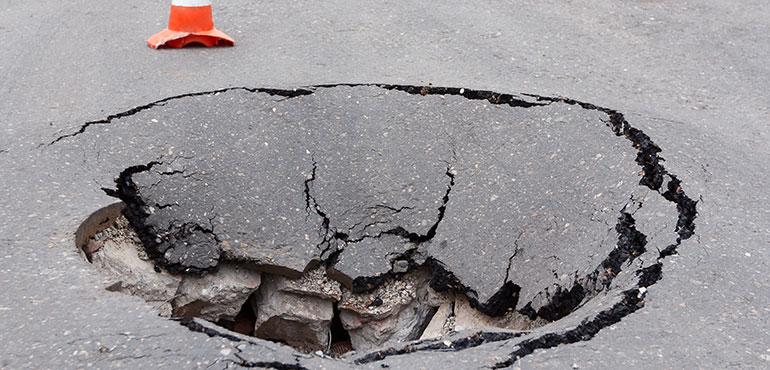
Have you ever thought about the background and dangers of sinkholes? This is a common phenomenon where rock below the land surface is limestone, salt beds, carbonate rock, or rocks that can be dissolved by groundwater circulating through them. As that rock dissolves, an area like a cavern opens up underneath. These are dramatic and unexpected because land typically stays intact for quite some time until the area underneath gets too large.
What is a “sinkhole”?
A sinkhole is an area of ground that has no natural external surface drainage. Hence, when it rains, the water stays inside the sinkhole and usually drains into the subsurface. The size of these sinkholes can range from a few feet to hundreds of acres. The shapes are also very unique, as some can be shallow bowls or saucers whereas others have vertical walls.
Where do these sinkholes occur most?
The most frequent damage from sinkholes tends to take place in Florida, Alabama, Missouri, Kentucky, Tennessee, and Texas.
What are the different types of sinkholes?
The first type of sinkhole is dissolution sinkholes. Dissolution of the limestone or dolomite is most intensive where water first contacts the rock surface. Aggressive dissolution also occurs where flow is focused in preexisting openings in the rock, such as along joints, fractures, and bedding planes.
Another type of sinkhole is cover-subsidence sinkholes. These tend to develop gradually where the covering sediments are permeable and contain sand. In areas where cover material is thicker, or sediments contain more clay, cover-subsidence sinkholes are relatively uncommon, are smaller, and may go undetected for long periods.
Cover-collapse sinkholes is the last type of sinkhole. They may develop abruptly (over a period of hours) and cause catastrophic damages. They occur where the covering sediments contain a significant amount of clay. Over time, surface drainage, erosion and deposition of sinkhole into a shallower bowl-shaped depression.
Can sinkholes be human-induced?
Yes! New sinkholes have been correlated to land-use practices, especially from groundwater pumping and from construction and development practices. Sinkholes can also form when natural water-drainage patterns are changed and new water-diversion systems are developed.
Source: USGS
Image Source: Deep sinkhole on a street city and orange traffic cone. (rbkomar via Shutterstock)
What is a “sinkhole”?
A sinkhole is an area of ground that has no natural external surface drainage. Hence, when it rains, the water stays inside the sinkhole and usually drains into the subsurface. The size of these sinkholes can range from a few feet to hundreds of acres. The shapes are also very unique, as some can be shallow bowls or saucers whereas others have vertical walls.
Where do these sinkholes occur most?
The most frequent damage from sinkholes tends to take place in Florida, Alabama, Missouri, Kentucky, Tennessee, and Texas.
What are the different types of sinkholes?
The first type of sinkhole is dissolution sinkholes. Dissolution of the limestone or dolomite is most intensive where water first contacts the rock surface. Aggressive dissolution also occurs where flow is focused in preexisting openings in the rock, such as along joints, fractures, and bedding planes.
Another type of sinkhole is cover-subsidence sinkholes. These tend to develop gradually where the covering sediments are permeable and contain sand. In areas where cover material is thicker, or sediments contain more clay, cover-subsidence sinkholes are relatively uncommon, are smaller, and may go undetected for long periods.
Cover-collapse sinkholes is the last type of sinkhole. They may develop abruptly (over a period of hours) and cause catastrophic damages. They occur where the covering sediments contain a significant amount of clay. Over time, surface drainage, erosion and deposition of sinkhole into a shallower bowl-shaped depression.
Can sinkholes be human-induced?
Yes! New sinkholes have been correlated to land-use practices, especially from groundwater pumping and from construction and development practices. Sinkholes can also form when natural water-drainage patterns are changed and new water-diversion systems are developed.
Source: USGS
Image Source: Deep sinkhole on a street city and orange traffic cone. (rbkomar via Shutterstock)