Back to forecast
Geminids Meteor Shower Peaks Early This Week
December 12, 2021 at 09:49 AM EST
By WeatherBug Meteorologist, John Benedict
Known as the “King of the meteor showers” the annual Geminids will peak Monday night into Tuesday this week, giving sky watchers one of the best shows of the year.
Whether you call them "shooting stars," or by their scientific name, meteors, they all begin the same way - as small particles of debris that burn up in the Earth`s atmosphere and emit a visible light trail. Most meteors range in size from a grain of sand to that of a pebble and streak across the sky at 40 miles per second. That`s more than 200 times faster than the speed of sound!
This week`s display is typically one of the favorites for stargazers as it consistently provides around 120 to 160 meteors per hour to viewers in rural locations. It is called the “Geminids” because the meteors will appear to radiate from the bright star Castor in the constellation of Gemini. The Geminids shower is a bit of an oddity though, as the meteors will at times tend to streak across other parts of the sky away from the constellation.
These meteors are also denser than others, so they shoot through the atmosphere at about 22 miles per second and burn up less quickly. Moreover, the Geminids shower tends to see higher frequencies of fireballs, which can last several seconds, light up the entire sky, and produce a wide range of colors including white, green and most commonly yellow.
The reason for these differences? Its origin. Almost all other meteor showers can attribute their meteors to pieces of comet debris that the Earth intersects during its yearly orbit around the sun, but the Geminids are different. For more than a century, in fact, there was no known reason for the Geminids meteors until an asteroid was discovered in 1983. It was named 3200 Phaethon and was found to be the parent object for the dust and debris that provide us with the meteor shower. The only other meteor shower not related to a comet are the Quadrantids which begins later this month and peaks in early January.
The Geminids meteor shower began on December 4, but it will peak on the morning of December 14. With the moon just passing the first-quarter phase this past Saturday, the moon will be a waxing gibbous and be around 77 percent illuminated. While this may dim some meteors during the early part of the night, the moon will dim as it sets between 3 and 4 am. The best opportunity for viewing meteors this year will be between 3 am and dawn.
Even with an illuminated moon, the Geminids are occasionally visible, especially the bright fireballs. Remember that for optimal viewing, you should get as far away from city lights as possible, let your eyes adjust to the darkness for at least a half hour and just use your naked eyes. Telescopes and binoculars will not help you see them brighter or clearer and will only limit your field of view.
Viewing conditions across the Western US will be poor as a storm system moving will lead to plenty of cloud cover west of the Rockies. Cloud cover will also be problematic across Texas and portions of the Lower Mississippi Valley and into parts of the Upper Midwest. High pressure sprawling across much of the Eastern US will produce clear or mostly clear skies that will be ideal for viewing.
Be sure to dress warmly as you`ll likely be spending an extended period of time outside in winterlike temperatures. With some help from Mother Nature, you will get to see one of the year`s greatest shows on (or above) Earth.
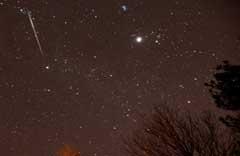
Image: In this Dec. 13, 2012, file photo, a meteor streaks across the sky during the annual Geminid meteor shower over Springville, Ala. (AP Photo/AL.com, Mark Almond)
Whether you call them "shooting stars," or by their scientific name, meteors, they all begin the same way - as small particles of debris that burn up in the Earth`s atmosphere and emit a visible light trail. Most meteors range in size from a grain of sand to that of a pebble and streak across the sky at 40 miles per second. That`s more than 200 times faster than the speed of sound!
This week`s display is typically one of the favorites for stargazers as it consistently provides around 120 to 160 meteors per hour to viewers in rural locations. It is called the “Geminids” because the meteors will appear to radiate from the bright star Castor in the constellation of Gemini. The Geminids shower is a bit of an oddity though, as the meteors will at times tend to streak across other parts of the sky away from the constellation.
These meteors are also denser than others, so they shoot through the atmosphere at about 22 miles per second and burn up less quickly. Moreover, the Geminids shower tends to see higher frequencies of fireballs, which can last several seconds, light up the entire sky, and produce a wide range of colors including white, green and most commonly yellow.
The reason for these differences? Its origin. Almost all other meteor showers can attribute their meteors to pieces of comet debris that the Earth intersects during its yearly orbit around the sun, but the Geminids are different. For more than a century, in fact, there was no known reason for the Geminids meteors until an asteroid was discovered in 1983. It was named 3200 Phaethon and was found to be the parent object for the dust and debris that provide us with the meteor shower. The only other meteor shower not related to a comet are the Quadrantids which begins later this month and peaks in early January.
The Geminids meteor shower began on December 4, but it will peak on the morning of December 14. With the moon just passing the first-quarter phase this past Saturday, the moon will be a waxing gibbous and be around 77 percent illuminated. While this may dim some meteors during the early part of the night, the moon will dim as it sets between 3 and 4 am. The best opportunity for viewing meteors this year will be between 3 am and dawn.
Even with an illuminated moon, the Geminids are occasionally visible, especially the bright fireballs. Remember that for optimal viewing, you should get as far away from city lights as possible, let your eyes adjust to the darkness for at least a half hour and just use your naked eyes. Telescopes and binoculars will not help you see them brighter or clearer and will only limit your field of view.
Viewing conditions across the Western US will be poor as a storm system moving will lead to plenty of cloud cover west of the Rockies. Cloud cover will also be problematic across Texas and portions of the Lower Mississippi Valley and into parts of the Upper Midwest. High pressure sprawling across much of the Eastern US will produce clear or mostly clear skies that will be ideal for viewing.
Be sure to dress warmly as you`ll likely be spending an extended period of time outside in winterlike temperatures. With some help from Mother Nature, you will get to see one of the year`s greatest shows on (or above) Earth.
Image: In this Dec. 13, 2012, file photo, a meteor streaks across the sky during the annual Geminid meteor shower over Springville, Ala. (AP Photo/AL.com, Mark Almond)