


Back to forecast
The June Bootids Meteor Shower Peaks on June 27th
June 26, 2023 at 01:43 AM EDT
By Weatherbug Meteorologist John Benedict
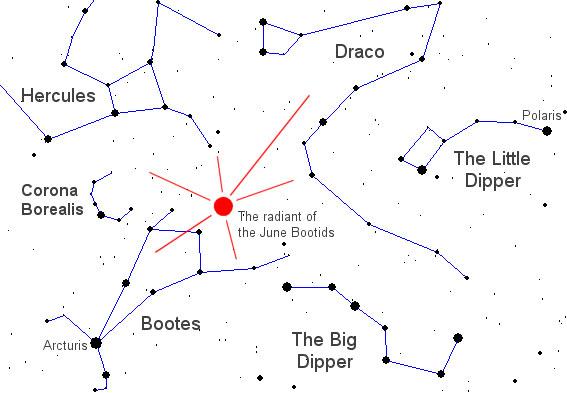
The June Bootid meteor shower is active this year between June 22nd and July 2nd and is set to peak on June 27th. This meteor shower is one that is lesser known as it generally only produces a few meteors per hour. On a few occasions this shower has produced outbursts in 1916, 1921, 1927 and 1998 when the Bootids produced around 100 meteors per hour.
The Bootids radiant point, the point in the sky where meteors appear to originate from, is in the constellation Boötes. Boötes is one of the larger constellations in the night sky, its name is Greek for ox driver, plowman, or most commonly herdsman. This constellation is also home to one of the brightest stars, Arcturus. Boötes is located in the northwestern sky adjacent to the Big Dipper and Draco.
The radiant point is above the horizon throughout the night but is highest in the sky around 10 p.m. local time. This year the moon will be just past first quarter in nearby Virgo which could dim some of the meteors. The Meteors associated with the June Bootids enter Earth’s atmosphere at an oblique angle which produces long lived, and relatively slow meteors. The average velocity of the Bootids is only 18 km/s which is slow compared to other meteor showers like the Leonids which have a velocity of 71 km/s.
The source of the June Bootid meteor shower is from comet 7P/Pons-Winnecke. This comet orbits between the Sun once every 6.37 years and follows an elliptical path just beyond the orbit of Jupiter. The comet was originally discovered by Jean Louis Pons in 1819 and was then rediscovered by Friedrich August Theodor Winnecke in 1858. It last passed the sun back on May 27, 2021.
A few tips for optimal viewing:
The Bootids radiant point, the point in the sky where meteors appear to originate from, is in the constellation Boötes. Boötes is one of the larger constellations in the night sky, its name is Greek for ox driver, plowman, or most commonly herdsman. This constellation is also home to one of the brightest stars, Arcturus. Boötes is located in the northwestern sky adjacent to the Big Dipper and Draco.
The radiant point is above the horizon throughout the night but is highest in the sky around 10 p.m. local time. This year the moon will be just past first quarter in nearby Virgo which could dim some of the meteors. The Meteors associated with the June Bootids enter Earth’s atmosphere at an oblique angle which produces long lived, and relatively slow meteors. The average velocity of the Bootids is only 18 km/s which is slow compared to other meteor showers like the Leonids which have a velocity of 71 km/s.
The source of the June Bootid meteor shower is from comet 7P/Pons-Winnecke. This comet orbits between the Sun once every 6.37 years and follows an elliptical path just beyond the orbit of Jupiter. The comet was originally discovered by Jean Louis Pons in 1819 and was then rediscovered by Friedrich August Theodor Winnecke in 1858. It last passed the sun back on May 27, 2021.
A few tips for optimal viewing:
- Remember that for optimal viewing, you should get as far away from city lights as possible, and let your eyes adjust to the darkness for at least a half hour.
- Just use your naked eyes - telescopes and binoculars will not help you see them better and will only limit your field of view.
- Prepare for cool temperatures by wearing layers and taking a blanket.