Back to forecast
This Day in History -- The Great 1896 St. Louis Tornado
May 18, 2020 at 06:50 PM EDT
By WeatherBug's Brandon Bush and Christopher Smith
120 years ago today, the Gateway to the West, St. Louis, would see its deadliest tornado and the third deadliest tornado in U.S. history. This tornado resulted in the deaths of 255 people and left more than a thousand injured. In addition, it caused approximately $10 million in damages; an equivalent to $309 million in 2019.
By the spring of 1896, St. Louis had become a manufacturing powerhouse and one of the top five largest cities in the U.S. with a population of around 500,000. The city was complete with its Lafayette Square, Compton Heights and Mill Creek Valley neighborhoods, as well as the Eads Bridge. The city hadn’t had a major weather event in nearly 25 years, so the tornado appeared as a surprise to the booming population.
The storm would first strike the Compton Heights neighborhood around 5 p.m. before continuing on a devastating track through the Mill Creek Valley. More than 5,000 people lost their homes and their possessions during this storm.
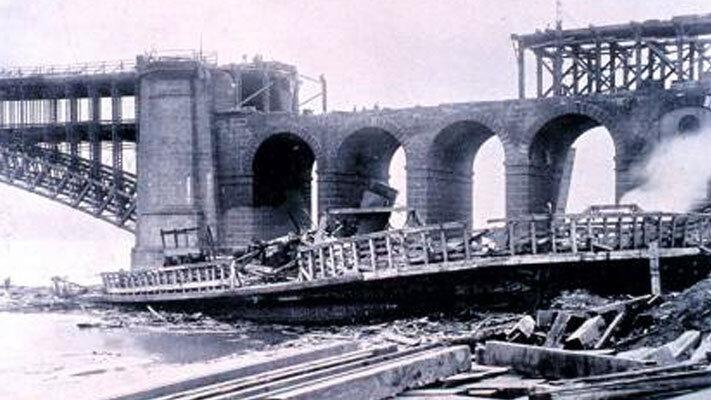
The storm continued past Mill Creek Valley toward the Mississippi River, where it decimated steamboats and other watercraft, scattering their pieces across the river to the Illinois shore. At this point, 300 feet of the eastbound side of the Eads Bridge was destroyed. It was constructed from steel and was touted as being ‘tornado proof’, much like how the Titanic was ‘sink-proof'.
In just under half an hour, the tornado carved a three-mile-wide path of carnage through St. Louis. Along the way, century old trees, heavy metal fences and houses were ripped out of the ground, flung several blocks and bent into unrecognizable forms. Immediately after the tornado, volunteers gathered from all over the city and helped clean up debris and assist the wounded. Telegraph and telephone poles had to be rebuilt to establish communications again.
Experts, using the Enhanced Fujita Scale first invented in 1971 and updated in 2007, estimated the 1896 tornado was an EF-4. An EF-4 tornado is the second highest on the scale, packing winds between 166 and 200 miles per hour.
The 1896 Republican National Convention was supposed to be held in St. Louis in June and fears of its movement arose due to the extensive tornado damage. However, after a massive cleanup effort, the convention was held. St. Louis would return to its full hustle and bustle a few years later and would go on to host the 1904 World’s Fair and the Summer Olympics.
The tornado was part of the historic outbreak sequence of May 1896 and it is considered to be one of the most violent tornado outbreaks in U.S. history. In total, 484 people were killed across nine states: Texas, Oklahoma, Missouri, Illinois, Michigan, Iowa, Nebraska, Kansas and Kentucky. At least 38 different tornadoes struck those states during the week of May 24 – 28.
Since that fated day in 1896, three tornadoes have touched down in St. Louis, though none have been as deadly. The three storms occurred in 1904, 1927 and 1959, with the 1927 tornado being the second deadliest tornado for St. Louis when 72 fatalities occurred.
Sources: ncdc.noaa.gov, tornadoproject.com, Boston University
----------
Story Image: Destruction of the Eads Bridge in St. Louis. (Credit: NOAA Photo Library)
By the spring of 1896, St. Louis had become a manufacturing powerhouse and one of the top five largest cities in the U.S. with a population of around 500,000. The city was complete with its Lafayette Square, Compton Heights and Mill Creek Valley neighborhoods, as well as the Eads Bridge. The city hadn’t had a major weather event in nearly 25 years, so the tornado appeared as a surprise to the booming population.
The storm would first strike the Compton Heights neighborhood around 5 p.m. before continuing on a devastating track through the Mill Creek Valley. More than 5,000 people lost their homes and their possessions during this storm.
The storm continued past Mill Creek Valley toward the Mississippi River, where it decimated steamboats and other watercraft, scattering their pieces across the river to the Illinois shore. At this point, 300 feet of the eastbound side of the Eads Bridge was destroyed. It was constructed from steel and was touted as being ‘tornado proof’, much like how the Titanic was ‘sink-proof'.
In just under half an hour, the tornado carved a three-mile-wide path of carnage through St. Louis. Along the way, century old trees, heavy metal fences and houses were ripped out of the ground, flung several blocks and bent into unrecognizable forms. Immediately after the tornado, volunteers gathered from all over the city and helped clean up debris and assist the wounded. Telegraph and telephone poles had to be rebuilt to establish communications again.
Experts, using the Enhanced Fujita Scale first invented in 1971 and updated in 2007, estimated the 1896 tornado was an EF-4. An EF-4 tornado is the second highest on the scale, packing winds between 166 and 200 miles per hour.
The 1896 Republican National Convention was supposed to be held in St. Louis in June and fears of its movement arose due to the extensive tornado damage. However, after a massive cleanup effort, the convention was held. St. Louis would return to its full hustle and bustle a few years later and would go on to host the 1904 World’s Fair and the Summer Olympics.
The tornado was part of the historic outbreak sequence of May 1896 and it is considered to be one of the most violent tornado outbreaks in U.S. history. In total, 484 people were killed across nine states: Texas, Oklahoma, Missouri, Illinois, Michigan, Iowa, Nebraska, Kansas and Kentucky. At least 38 different tornadoes struck those states during the week of May 24 – 28.
Since that fated day in 1896, three tornadoes have touched down in St. Louis, though none have been as deadly. The three storms occurred in 1904, 1927 and 1959, with the 1927 tornado being the second deadliest tornado for St. Louis when 72 fatalities occurred.
Sources: ncdc.noaa.gov, tornadoproject.com, Boston University
----------
Story Image: Destruction of the Eads Bridge in St. Louis. (Credit: NOAA Photo Library)