


Tuesday's Weather Outlook
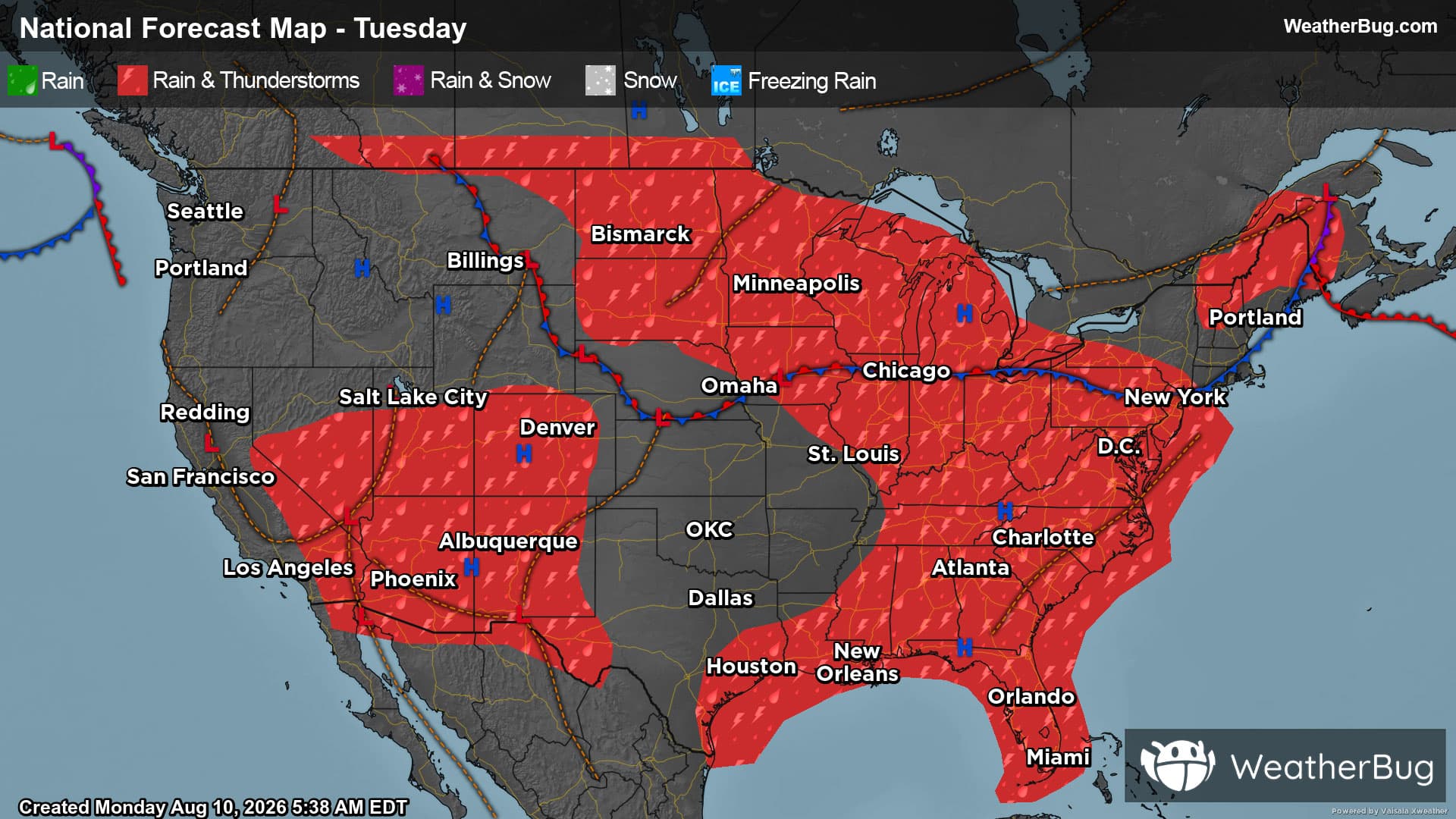
The dog days of summer persist on Tuesday as hot weather dominates most of the U.S. The West remains dry, while showers and thunderstorms continue to develop east of the Rockies.
A cold front will remain nearly stationary over the north-central and northeastern U.S. on Tuesday. This will allow rounds of moisture and atmospheric moisture to move along the front. There will also be two good surges of moisture – one from the Atlantic and Gulf into the Southeast and the other from monsoonal moisture in the Southwest and Mountain West.
Showers and thunderstorms will be in the forecast for most of the U.S. as a result. This includes the entire Eastern Seaboard into the Midwest, Four Corners states and Great Basin. The best timing will occur in the morning and afternoon across most of the Midwest, while all other spots have a better chance in the afternoon and evening.
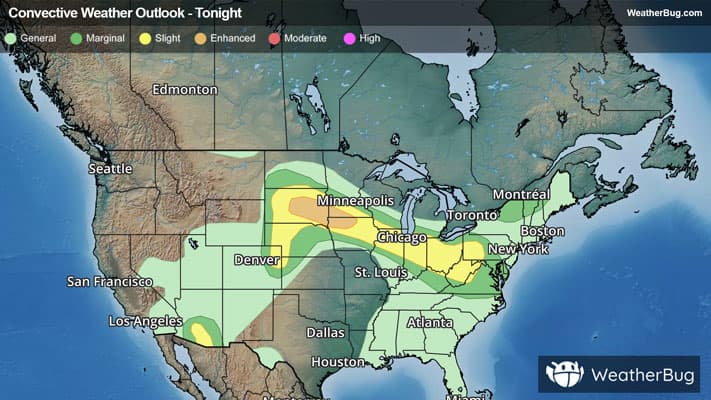
Any thunderstorms that develop across the northern Plains, Ohio Valley and into the Mid-Atlantic will have the potential to strengthen and become severe. This will be especially true across the Ohio Valley and central Appalachia. Destructive winds will be the greatest concern for all regions, with winds of 60 to 70 mph. There could also even be some wind gusts up to or exceeding 75 mph. Large hail could be a possibility as well in the northern Plains, while tornadoes could develop in the Ohio Valley.
Along the stalled cold front, repeated and slow-moving rounds of moderate to heavy rain will be likely. Rainfall amounts of 1 to 3 inches will be common here. Given saturated soils and the possibility of repetitive downpours, flooding concerns will be elevated. The greatest concern of flooding will be found in central Appalachia, especially near rivers, creeks and streams as well as urban, low-lying and other more flood-prone areas. If you approach a flooded roadway, remember it is always best to “Turn Around, Don’t Drown!”
Torrential downpours will also be possibility across the Southeast and the Southwest, and there could be some flooding.
A few spots will stay out of the soggy, stormy weather thanks to high pressure. Dry weather is expected for the Northwest and California along with the south-central U.S.
Temperatures will remain near to above average for most of the U.S. Isolated areas could end up unseasonably cool, mainly due to cloud cover and rain chances. This would include the Pacific Northwest, Ohio Valley and interior Northeast.
The Pacific Northwest, Rocky Mountains, northern Plains, Great Lakes, Ohio Valley and Northeast will all end up with highs in the 70s and 80s. However, the immediate Northwest coast and the tallest peaks in the Rockies could only see the mercury climb into the 50s and 60s. Nineties and 100s will be most widespread across the nation, including the interior Northwest, California, Great Basin and Southwest into the central/southern Plains, Lower Mississippi Valley, Deep South and Southeast. The hottest spot will once again be California’s Central Valley into the Mojave Desert, where highs could peak around 105 to 115 degrees!