


Today's Weather Outlook
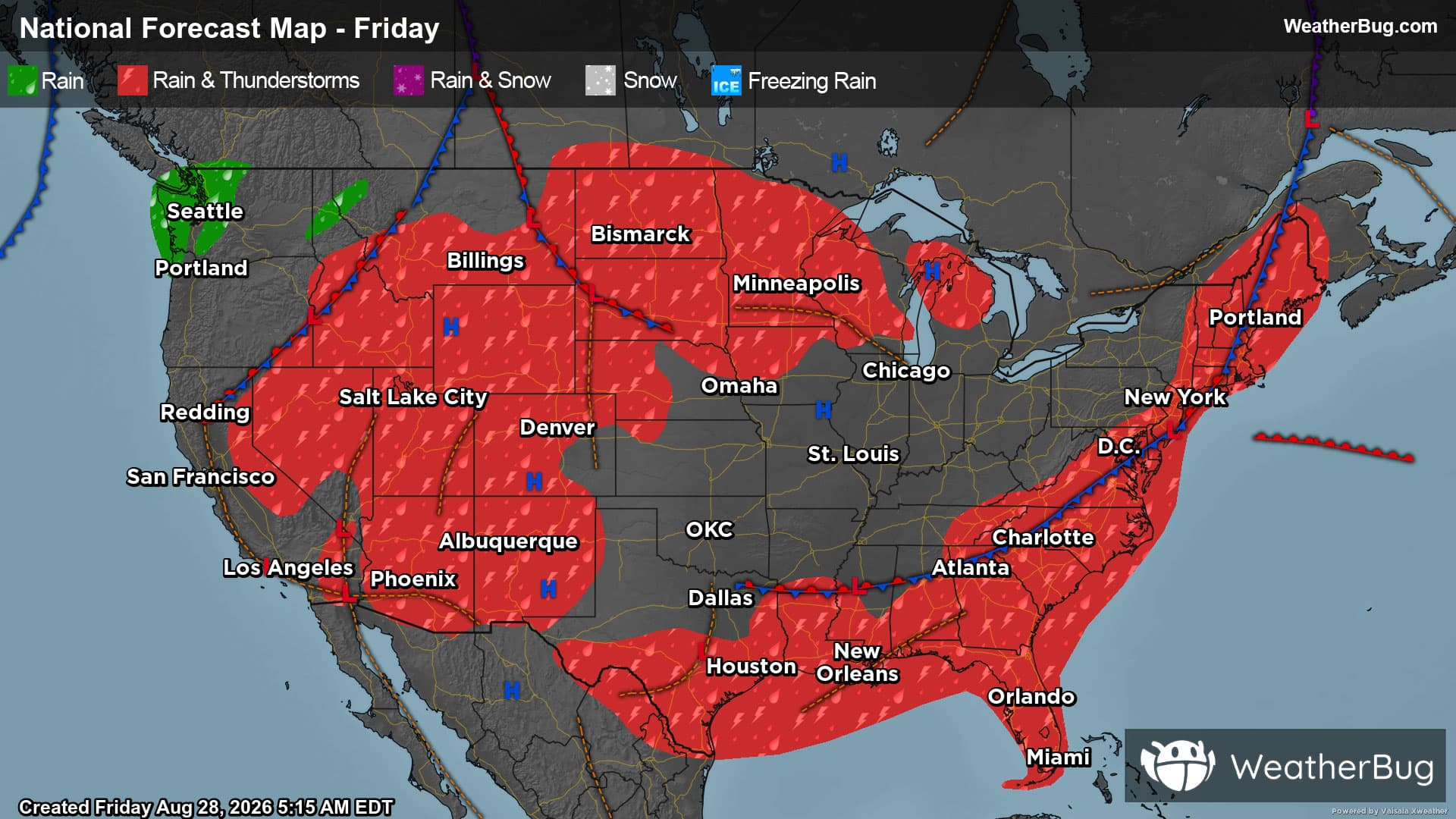
Across the country, many are in for a rainy day to round off the workweek.
Multiple frontal systems, along with an unstable, moisture-rich environment will help to fuel several areas of active weather today. The first of which extends from the Deep South through New England, bringing a chance of showers and storms throughout the day, with the greatest possibility of facing thunder in the afternoon and evening hours as activity becomes more widespread.
Repeated rounds of heavy rainfall could lead to localized totals of 1 to 3 inches along with the threat of dangerous flash flooding. Areas near creeks, rivers, streams, and low-lying or urban locations are especially vulnerable. If you do approach a flooded roadway, remember that it is always best to “Turn Around, Don’t Drown!”
Meanwhile, an influx of monsoonal moisture continues to flow into the Southwest, helping to spark scattered storms throughout the Desert Southwest, Mountain West, and into the Plains late in the day.
Additionally, low pressure will bring some rain to the Great Basin region and the Sierra Nevada in eastern California, once again with the greatest chance of showers and storms in the afternoon and evening. Western Washington could also see showers over the day.
Otherwise, the rest of the U.S. can expect clear conditions, as high pressure takes hold of much of the remaining West, along with the eastern Plains, lower Midwest, and the northern South-Central U.S.
In the Northeast, high temperatures will range from the upper 60s through the low 80s. Meanwhile, the Midwest can expect highs to be in the 70s and 80s. In Northern and Central Plains, along with in Mid-Atlantic and the Southeast, temperatures will peak in the 80s and 90s. Temperatures heat up in the South-Central U.S., where highs will be in the 90s and 100s.
The Desert Southwest and California’s Central Valley are also anticipated to continue to scorch, with widespread temperatures soaring into the 90s and triple digits, where some spots could approach 120 degrees! The higher elevations and coastal areas of the West can expect highs in the 50s and 60s, while the rest of the region will see high temperatures ranging from the 70s to the 90s.