Weekend Weather Outlook
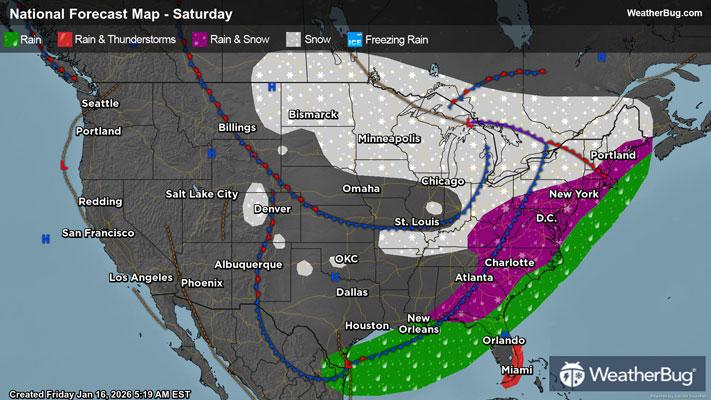
A clipper system will make its way across the Great Lakes this weekend, bringing continued wintry weather to the East Coast. Meanwhile, the western half of the nation enjoys dry weather bliss.
Today
In the Northeast, a clipper system will follow a similar path to past clippers of this winter. This will bring snow showers and a rain/snow mix to the area. Bands of lake-effect snow are possible throughout states bordering Lake Erie and Lake Ontario, bringing higher snowfall amounts to areas impacted by potential snow bands. Coastal areas will not see significant snowfall amounts, as the snow will turn into a cold rain east of the Appalachians, where temperatures will warm up to above freezing.
Snowfall will continue to cling to the Appalachian Spine in the Mid-Atlantic region, with a cold rain falling on lowland and coastal areas from Virginia southward. Rainfall will trail down the East Coast into the Southeast, with North Carolina, South Carolina, and Georgia coasts having drier weather during the day. Florida’s Peninsula will also remain mostly dry, except for the eastern coast from Miami southward.
The Deep South will also have some rain showers because of this clipper system, mainly extending from the Tennessee Valley through the Gulf Coast. Alabama, Mississippi, and Louisiana should take on most of the wet weather, with only coastal areas of Texas seeing rainy weather.
The Midwest will be wet and wintry today during the passing of a second clipper system this week as moderate snowfall is expected among the states bordering the Great Lakes. Accompanying this snowfall will be bands of lake-effect snow, which will come downwind of the lakes, allowing significantly higher snowfall amounts in their paths.
The Mountain West will experience some relatively dry weather, with lowland areas being dry and higher mountainous peaks receiving some added snowfall. Areas that receive snowfall will not be particularly hazardous with snow amounts; therefore, the day appears to be optimal for another ski-friendly weekend.
The West Coast will experience fair-weather bliss as conditions are expected to be dry from northern Washington down to southern California. This weekend should offer a prime opportunity to enjoy the green scenery provided by California’s drought improvement.
Frigid temperatures will creep over the U.S.-Canada border as single digits and a few negative temperatures plague Minnesota and eastern North Dakota. Spreading out from there will be temperatures in the teens across the remainder of the northern Plains and areas surrounding the Great Lakes. These areas will gradually spread to 20-degree temperatures outward. The Northeast down through the Tennessee Valley will see temperatures in the 30s, in addition to higher elevations in the Mountain West. Temperatures in the 40s will hug Northeastern and Mid-Atlantic coasts as well as some low-land areas in the Rockies.
Fifty-degree temperatures can be expected in various locations nationwide, as most of the Deep South, lowland areas of the Rockies, and Pacific Northwest will see these temperatures. The 60s will also not be an uncommon temperatures trend for many as Southeastern coasts, southern Texas, and the west coast of California will experience these temperatures. Seventies are in store for southern Florida, the Rio Grande Valley, and the Desert Southwest.
Sunday
A coastal system will move into the Northeast late Sunday, dropping a few inches of snow in the New Jersey, New York, and southern New England coasts. Confidence is not high on more than a few inches but Cape Cod could see the greatest totals.
The Mid-Atlantic will see some snowfall in the DMV region Sunday in eastern sections of Virginia, Maryland, and Delaware. A rain/snow mix will likely dominate further south into southeast Virginia and much of North Carolina, but it is possible for snow to fall through the rain from time to time.
Rain and perhaps even some light snow will trickle down the East Coast into the Southeast, bringing showers into the Deep South as well. Rain showers will hover along the coastal areas of the Gulf Coast states. Along the western edge of precipitation, light snow will be possible laying down a coating to an inch of snow in northern Florida, southern Georgia, and central South Carolina. As the precipitation moves towards the east, the western Gulf Coast will see relief with some dry weather near the end of the day Sunday.
The Midwest will see continued snowfall, with a new push of moisture bringing snowfall to the U.S.-Canada border in North Dakota and Minnesota. This moisture will then push into the Great Lakes region once again. The Great Lakes will see residual snowfall from the clipper system moving through today, but moisture will be replenished into the area Sunday, continuing to keep the weekend snowy.
The Mountain West will end the weekend on a mostly dry note, with some snow possible at higher mountainous peaks, but remaining dry for highly populated areas. The West Coast will also end their dry weekend with more fair-weather bliss, as Sunday will hold dry weather conditions throughout the day.
A slightly cooler temperature trend will settle into the nation this Sunday. Single digit temperatures will plague most of Minnesota and Wisconsin, with temperatures in the teens spreading outward into areas surrounding the Great Lakes. Twenty-degree temperatures will flow outward from this cold, Arctic air in the Midwest into the Northeast, following along the Appalachian spine through North Carolina. Areas in the 30s will continue from Maine’s coast down the East Coast through coastal areas until North Carolina’s southern half of the state’s coast. Higher elevated areas in the Rockies will also see 30-degree temperatures.
Forty-degree temperatures will be a commonality for much of the nation on Sunday, as a majority of the Southeast, the Central Plains, lowland areas in the Rockies, and the Pacific Northwest will see these temperatures. Areas in the 50s will be central Florida, most of Texas, and most of California. The Rio Grande Valley and the Desert Southwest will see temperatures in the 60s, and southern Florida will have some of the highest temperatures, with temperatures in the 70s.