


Wednesday's Weather Outlook
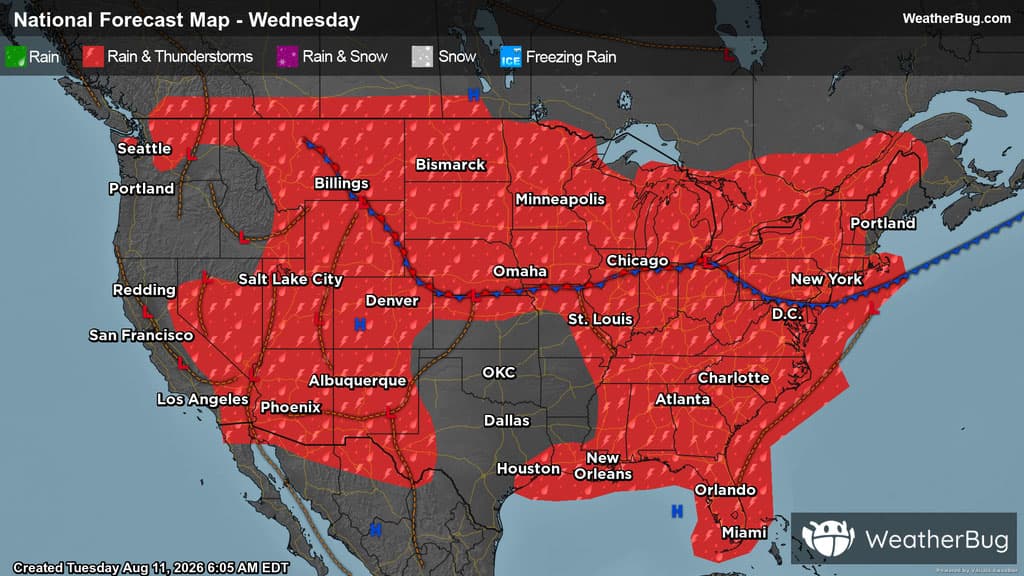
A stormy setup extends across the country this Wednesday, leaving clear skies few and far between.
This Wednesday, the atmosphere over the U.S. will be warm, wet, and wild, as moisture moves along an extended slow-moving cold front stretching from the High Plains to the Mid-Atlantic.
Scattered to widespread showers and thunderstorms can be expected throughout the day from the High and Central Plains into the Midwest, Mid-Atlantic, and Northeast U.S. In the afternoon and evening, daytime heating will help spark and organize additional showers and thunderstorms, with activity becoming more widespread throughout the Plains and along the East Coast.
The storms seen in the Plains along with the Midwest may also be severe. Gusty winds, large hail, and even an isolated tornado or two cannot be ruled out. Remember, the best way to remain safe is to stay informed and prepared regarding your local weather and that "When Thunder Roars, Go Indoors!"
Additionally, moisture flowing into the country from the Gulf will fuel scattered cells in the Southeast late in the day.
Meanwhile, monsoonal moisture in the West will bring scattered showers and thunderstorms to the Desert Southwest, Great Basin, and the Mountain West in the afternoon and evening hours.
Throughout the country, repeated rounds of heavy rainfall could lead to localized totals of 1 to 3 inches. With the ground becoming increasingly saturated after days of rain, dangerous flash flooding isn’t out of the picture. Areas near creeks, rivers, streams, and low-lying or urban locations are especially vulnerable. If you do approach a flooded roadway, remember that it is always best to “Turn Around, Don’t Drown!”
A few areas will stay high and dry, including much of the South-Central U.S. and the Pacific Northwest thanks to high pressure.
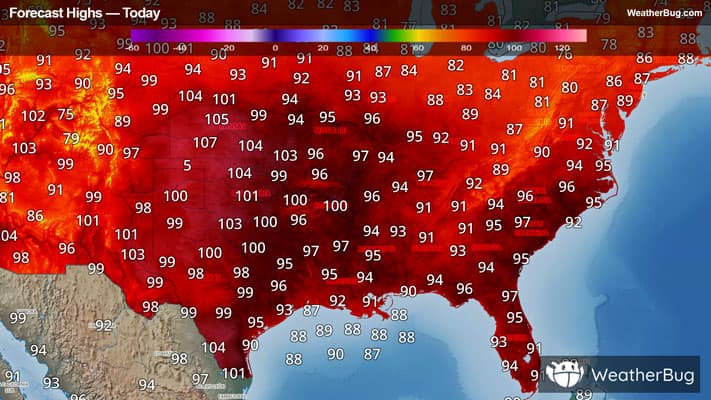
Much of the Northeast, Midwest, and High Plains will see unseasonably cool high temperatures in the 70s and 80s. In the Mid-Atlantic, highs will be in the 80s and 90s, while in the South, highs will be in the 90s and could enter the low 100s. The exception will be the Appalachian Spine, where temperatures will peak in the 80s.
Meanwhile, the South-Central U.S. along with the Low Plains will be very hot, with highs in the 90s and 100s. Most of the West will see highs in the 70s and 80s, however, higher elevations will be significantly cooler, with highs in the 50s and 60s. On the other hand, southwestern Arizona along with California’s Central Valley will be warmer, with highs in the 90s and entering the triple digits.