


Back to forecast
What is a Solar Eclipse?
April 3, 2024 at 12:45 PM EDT
By WeatherBug's Domenic Brooks
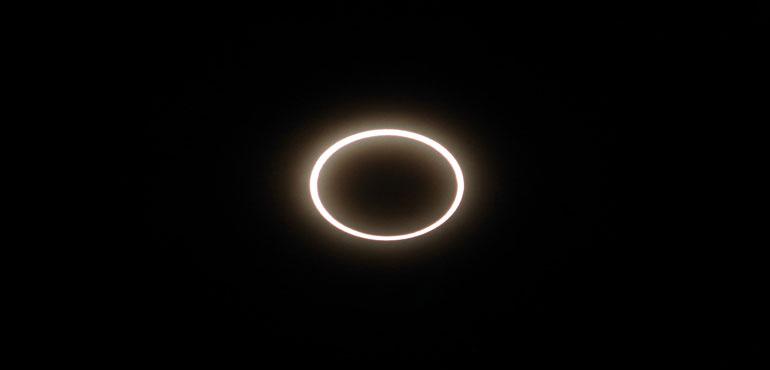
A solar spectacle is on the horizon next week, that being this year’s total solar eclipse. Let’s discuss what a solar eclipse is and what are the different types of this celestial phenomenon.
In the simplest explanation, a solar eclipse occurs when the moon travels between the Earth and the Sun, therefore “eclipsing” the two celestial bodies. When this occurs, it produces a shadow on the Earth which results in either partial darkness or total darkness for those in the path. However, just because a solar eclipse is occurring it does not mean that everyone on the planet will be able to see it take place. Only those along or near the path of the shadow will be able to see this solar phenomenon.
The next solar eclipse will take place on April 8, 2024, and this one will be a total solar eclipse. In these types of eclipses, the sky will completely darken as the moon completely blocks out the sun in a phenomenon known as totality. During totality, which only lasts about 3 to 4 minutes for a given location in the eclipse’s path, the moon will appear as a black circle outlined by the glow of the sun’s corona.
So, who will be able to view the total solar eclipse that takes place on April 8, 2024? Well, those located in North America are in a prime position to gaze upon this celestial showing. However, most people will experience a partial solar eclipse when the Sun is only partially obscured from the Moon’s passing. The path of the totality will stretch along a narrow corridor from Texas up through the Mid-Mississippi and Ohio valleys and into the interior Northeast, with northern Mexico and southeastern Canada also getting in on the action. The closer you are to this path, the more obscured the sun will become.
If you are going to view this eclipse and any solar eclipse in the future, you will want to wear the right protective solar lenses while the eclipse is taking place. Staring at the solar eclipse at any time other than during totality can cause serious and permanent damage to your eyes if the right protection is not worn. Regular sunglasses will not protect your eyes from the sun’s harmful ultraviolent (UV) and infrared (IR) rays.
You will want to purchase and wear solar filters which have been embedded into solar eclipse glasses and/or telescopes and binoculars. An easy way to tell if your solar filters are safe to use for viewing the eclipse is by looking for the certification ISO 12312-2 which is approved by NASA.
--------
Source(s): NASA, Space.com, Great American Eclipse
(Image provided by Pixabay.com)
In the simplest explanation, a solar eclipse occurs when the moon travels between the Earth and the Sun, therefore “eclipsing” the two celestial bodies. When this occurs, it produces a shadow on the Earth which results in either partial darkness or total darkness for those in the path. However, just because a solar eclipse is occurring it does not mean that everyone on the planet will be able to see it take place. Only those along or near the path of the shadow will be able to see this solar phenomenon.
The next solar eclipse will take place on April 8, 2024, and this one will be a total solar eclipse. In these types of eclipses, the sky will completely darken as the moon completely blocks out the sun in a phenomenon known as totality. During totality, which only lasts about 3 to 4 minutes for a given location in the eclipse’s path, the moon will appear as a black circle outlined by the glow of the sun’s corona.
So, who will be able to view the total solar eclipse that takes place on April 8, 2024? Well, those located in North America are in a prime position to gaze upon this celestial showing. However, most people will experience a partial solar eclipse when the Sun is only partially obscured from the Moon’s passing. The path of the totality will stretch along a narrow corridor from Texas up through the Mid-Mississippi and Ohio valleys and into the interior Northeast, with northern Mexico and southeastern Canada also getting in on the action. The closer you are to this path, the more obscured the sun will become.
If you are going to view this eclipse and any solar eclipse in the future, you will want to wear the right protective solar lenses while the eclipse is taking place. Staring at the solar eclipse at any time other than during totality can cause serious and permanent damage to your eyes if the right protection is not worn. Regular sunglasses will not protect your eyes from the sun’s harmful ultraviolent (UV) and infrared (IR) rays.
You will want to purchase and wear solar filters which have been embedded into solar eclipse glasses and/or telescopes and binoculars. An easy way to tell if your solar filters are safe to use for viewing the eclipse is by looking for the certification ISO 12312-2 which is approved by NASA.
--------
Source(s): NASA, Space.com, Great American Eclipse
(Image provided by Pixabay.com)