
Wind: A Big Contributor to Microclimates
We’ve all heard the television meteorologist mention “a warm southerly flow” or “a frigid northwest wind,” but there are other components of the wind that are key to an accurate forecast.
What about an “upslope wind?” The term is exactly what it states…a wind that blows up a slope or mountain. How can it impact the weather? Even under high pressure without a weather system around, especially during the summer, there can be cotton-ball-like clouds or cumulus clouds that develop on a mountainside. This is a result of the adjacent valley heating rapidly, the air rising and then being forced even more up into the atmosphere by the adjacent steep terrain. The air can’t move through a mountain, so it moves up the slope. Anytime air is forced to rise, it cools, condenses, and eventually forms clouds.
If the atmosphere is moisture-laden, cloud cover over the mountain will be more extensive. Also, if the wind is strong from a prevailing pressure gradient produced by an approaching low pressure, then a mountain-wave pattern will form.
What is a mountain-wave pattern? A cloud pattern that develops, usually when winds a few thousand feet above us are strong. As the air ascends over one side of the mountain range, clouds form. Then, as the air descends on the other side of the mountain, it “downslopes” or moves down the opposite side of the mountain, dries out, and the cloud dissipates. This is where the term “downslope wind” comes into play.
Since mountain ranges are usually north to south oriented, the cloud pattern will follow the same pattern and be oriented north to south. A line of clouds will be surrounded by blue sky on the downwind side.
For instance, in the East, a westerly wind will produce a bank of clouds along and west of the Appalachian ridge, and then on the eastern flank, the sky will be completely clear. A motorist traveling west into the Appalachians will see dark, billowing clouds on the western horizon, and then once they get to the top of the mountain, the sun will immediately fade behind the clouds.
Upslope winds contribute to rain and thunderstorms. Take the mountains around northern Colombia and Venezuela, for instance. During a typical day, the sun heats the valley floor, air rises, and then is forced to accelerate into the atmosphere by the adjacent mountain slopes. Clouds form, and then showers and thunderstorms can develop because of the tropical nature of the air. The timing of the rain and storms is usually on point each day in a persistent weather pattern, occurring late in the morning to early in the afternoon.
Another example of an upslope wind flow is in the West. Early morning fog can happen in the Redwood Creek Valley of California. The fog typically clears first in the center of the valley because air coming down the adjacent mountains after sunrise downslopes or dries out as it descends into the valley. Therefore, when the air reaches the center of the valley, it has a very low humidity and can easily zap away or evaporate the fog. As time goes on, the dry air eats away at the fog adjacent to the mountain slope, and eventually the entire valley is free of fog.
Upslope winds can be the reason for enhanced precipitation amounts on the windward side of mountains, or the side from which the prevailing wind is coming. On the contrary, an adjacent downsloping wind is often the rip-off zone where the air dries out, and rain or snowfall is far less than expected.
Be sure to check the WeatherBug phone app for the latest forecast and pay particular attention to the wind direction and speed, especially if you live in an area with mountainous terrain. Perhaps you can challenge yourself by anticipating if cloud cover will be more extensive and precipitation amounts higher than forecast based on the wind direction and speed for your location!
---
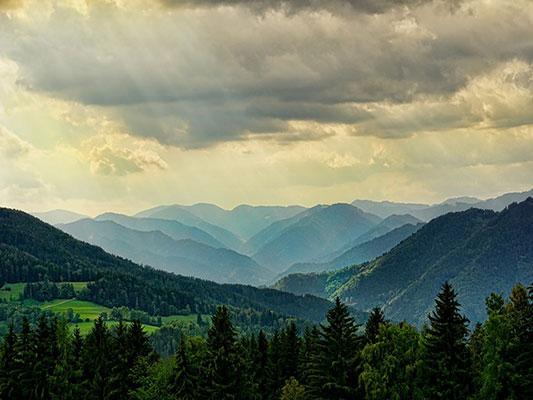
Story Image: Clouds are seen over mountains. (Courtesy of Pixabay.com)