Weather Alerts For Honey Creek, WI
Extreme Heat Warning
-# HEADLINE -------------------- EXTREME HEAT WARNING REMAINS IN EFFECT UNTIL 10 PM CDT THIS EVENING # DETAILS -------------------- WHAT Very warm conditions continue through this morning with heat index values remaining over 75 degrees. Dangerously hot conditions with heat index values up to 100 degrees then develop this afternoon and continue through this evening. WHERE Portions of east central, south central, and southeast Wisconsin. WHEN Until 10 PM CDT this evening. IMPACTS Heat related illnesses increase significantly during extreme heat and high humidity events. ISSUED AT Thursday, July 2, 2026 at 5:36 AM CDT ISSUED BY National Weather Service Milwaukee/Sullivan WI HEADER URGENT - WEATHER MESSAGE # PRECAUTIONARY/PREPAREDNESS ACTIONS -------------------- Drink plenty of fluids, stay in an air-conditioned room, stay out of the sun, and check up on relatives and neighbors. Take extra precautions when outside. Wear lightweight and loose fitting clothing. Try to limit strenuous activities to early morning or evening. Take action when you see symptoms of heat exhaustion and heat stroke. Stay cool, stay hydrated, stay informed. # AREAS AFFECTED -------------------- Lafayette, Washington, Columbia, Dane, Dodge, Fond du Lac, Green, Green Lake, Iowa, Jefferson, Kenosha, Marquette, Milwaukee, Ozaukee, Racine, Rock, Sauk, Sheboygan, Walworth, Waukesha Including the cities of West Bend, Reedsburg, Benton, Endeavor, Neshkoro, Cedarburg, Waupun, Belmont, Oostburg, Argyle, Milwaukee, Blanchardville, Baraboo, Lodi, Delavan, Hartford, Fond Du Lac, Plymouth, Menomonee Falls, New Berlin, Mineral Point, Columbus, Grafton, Lake Geneva, Mayville, Watertown, Racine, Lake Wisconsin, Dodgeville, East Troy, Monroe, Muskego, Waukesha, Brookfield, Elkhorn, Janesville, Howards Grove, Fort Atkinson, Madison, Kenosha, Prairie Du Sac, Darlington, Berlin, Jefferson, Oxford, Sheboygan Falls, Beaver Dam, Markesan, Portage, Germantown, Montello, Princeton, Sauk City, Mequon, Whitewater, Barneveld, Westfield, Shullsburg, Beloit, and Brodhead
Severe Storm Risk
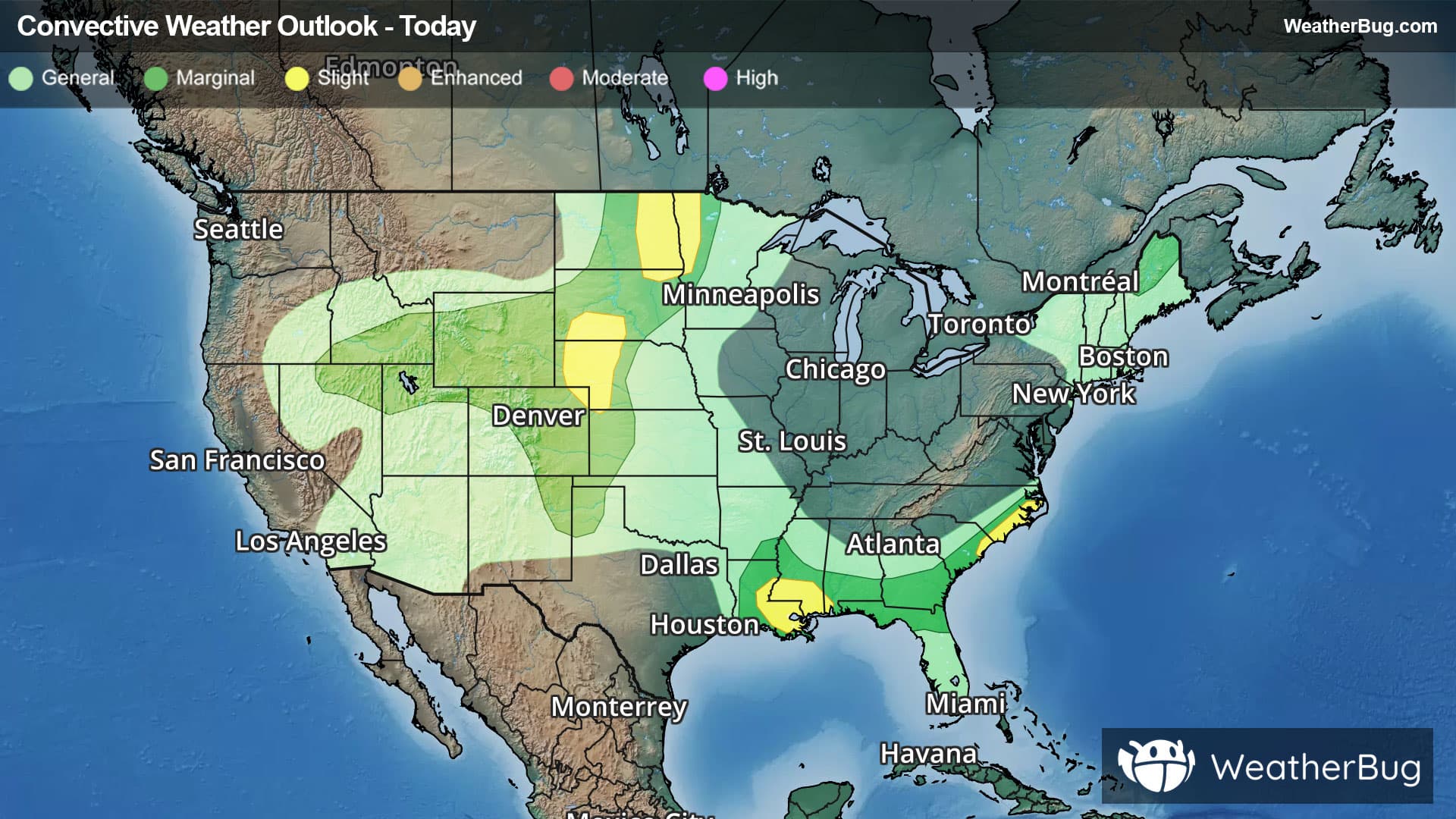
-There is a Slight Severe Storm Risk for your location. Continue reading for today's outlook from the National Weather Service's Storm Prediction Center. -------------------- National Severe Storm Outlook THERE IS AN ENHANCED RISK OF SEVERE THUNDERSTORMS FOR PORTIONS OF THE UPPER MIDWEST THERE IS A SLIGHT RISK OF SEVERE THUNDERSTORMS FROM THE DAKOTAS INTO THE WESTERN GREAT LAKES AND OVER THE SOUTHERN APPALACHIANS AND TENNESSEE VALLEY SUMMARY Scattered to numerous severe storms will be possible from the northern Plains into the Midwest and Great Lakes regions today into tonight, as well as across the southern Appalachians and Tennessee Valley this afternoon and early evening. Northern High Plains into the Great Lakes and Midwest A belt of moderate southwesterly flow will extend across the north-central states through the period. A few ongoing clusters of showers/thunderstorms extend along residual outflow from WI to along the MN-IA border vicinity. Farther west, a weak low analyzed near the Black Hills and associated lee trough will aid in maintaining southerly flow to the south of a residual frontal zone draped over SD east-northeastward to near Lake Superior. Some isolated severe risk may continue this morning with a small cluster along the Dakotas border primarily to the north of the front. Heating of a seasonably moist airmass (60s deg F north and 70s across eastern NE into IA) will contribute to moderate to strong instability by late afternoon. Afternoon thunderstorm development is expected near the surface low and in the vicinity of the surface boundary/residual outflow across the Dakotas. Forecast model data indicates deep-layer shear around 40-45 kts which will support initial supercells capable of large to very large hail and severe gusts. As additional storms develop and cold pools merge and result in a few clusters evolving with time, the wind threat will likely increase with stronger gusts associated with bowing segments. This activity will likely persist well into the evening with some lingering severe potentially into the overnight over the MN-IA vicinity late. Southern Appalachians into the Tennessee/Ohio Valleys A seasonably moist boundary layer is evident in surface observations (lower 70s F surface dewpoints) this morning. Relatively cool 500-mb temperatures around -9 deg C (reference the 12 UTC Nashville, TN raob) and strong heating will result in fairly steep lapse rates across this region by early to mid afternoon. Scattered thunderstorms are likely and a few stronger clusters will probably evolve within a weak easterly flow regime to the southwest of an mid-level anticyclone centered over southwest VA. The steepened 0-2 km lapse rates and high PW (1.5-1.75 inches) will support wet microbursts capable of strong to severe gusts (locally 60-70 mph) with the more intense water-loaded downdrafts. Modifying the Nashville raob for forecast afternoon high temperatures in the upper 90s deg F yields extreme MLCAPE (4000+ J/kg). Due to the magnitude of buoyancy, have highlighted higher probabilities to account for increased confidence in a wet microburst threat. Isolated hail may also accompany the more intense updrafts. This activity will probably coalesce into a few clusters that gradually weaken during the evening as the wind-damage threat subsides. Central High Plains Isolated thunderstorms are expected to develop within the lee trough across the central High Plains this afternoon. Moderate instability overlapping with around 25-30 kts of deep-layer shear will support potential for a mix of supercells and multicell clusters. Steep low- to mid-level lapse rates and large temperature/dew point spreads will support potential for severe gusts. Initial supercells will pose potential for large hail. Northeast Northeasterly flow within the northern periphery of the eastern ridge will allow for thunderstorm activity to track southward out of Quebec/Ontario across portions of the Northeast this afternoon. Uncertainty remains regarding details of convective evolution and potential corridors of greater threat. Nonetheless, moderate to strong instability and 30-40 kt of deep-layer shear will support storm organization, with damaging gusts being the primary hazard with the stronger storms.