Severe Storm Risk - Lansing, MI
Severe Storm Risk
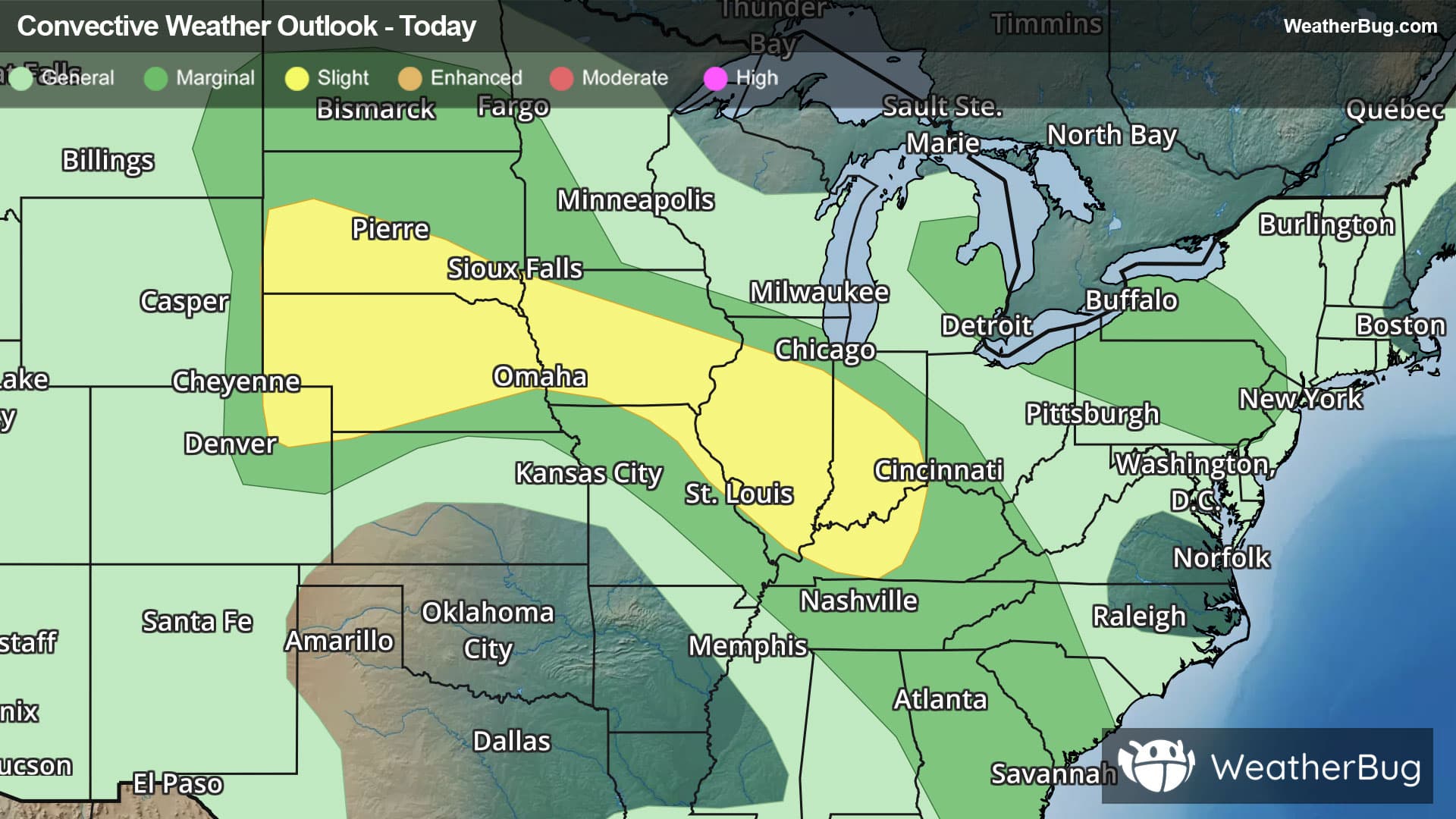
-There is a Marginal Severe Storm Risk for your location. Continue reading for today's outlook from the National Weather Service's Storm Prediction Center. -------------------- National Severe Storm Outlook THERE IS AN ENHANCED RISK OF SEVERE THUNDERSTORMS ACROSS THE CENTRAL PLAINS/MIDDLE MISSOURI VALLEY SUMMARY Severe storms are expected this afternoon into tonight across the central Plains to the Upper Midwest. Supercells with very large hail and strong tornadoes are possible, before one or more linear clusters of storms leads to an increase in wind-damage potential by evening. Colorado/Central Plains to Upper Midwest An active severe-weather day is expected regionally. A consequential late-evening/overnight MCS and related outflow across Nebraska/northern Kansas to southern Iowa and northern Missouri will likely be a lingering factor for later today. For one, this includes some southeastward regional adjustment in severe probabilities across areas such as eastern Nebraska/western Iowa and northeast Kansas/far northwest Missouri. One or more embedded disturbances will emerge this afternoon from the central Rockies amid increasingly prevalent cyclonic flow aloft in advance of an amplifying large-scale trough over the West. Lee cyclogenesis will occur across the central High Plains, with a northward advection of moisture, and post-MCS-related air mass recovery across eastern portions of Kansas/Nebraska into Iowa through late afternoon in association with a warm front, and ahead of a southeast-progressing cold front across the north-central High Plains. Initial thunderstorm development is expected across northeast Colorado into southwest Nebraska within a low-level upslope flow regime ahead of the approaching synoptic cold front. These storms will be capable of large hail given very steep lapse rates, strong vertical shear and elongated/straight hodographs. By late afternoon/early evening, quickly intensifying deep convection is expected farther east within the warm sector and near and east/northeast of a surface triple point across parts of eastern Nebraska and far southeast South Dakota/northwest Iowa, initially including intense supercells capable of very large hail and tornadoes, some of which could be strong. Backed low-level winds within the warm sector, veering with height, will contribute to increasing low-level SRH and favorably curved low-level hodographs. While the corridor for discrete supercells will be narrow, partly due to capping as well as the advancing cold front resulting in upscale growth, the expectation is for a few supercells capable of producing strong tornadoes and large to very large hail, with a somewhat longer duration for more discrete storms with southward extent across eastern Nebraska into northeast Kansas. With time, one or more linear/bowing segments is expected to develop near the east/southeast-advancing cold front and as the low-level jet significantly increases during the evening. An attendant risk of severe wind gusts will accompany this activity. The severe risk will diminish with time and eastward extent during the nighttime hours as instability weakens and capping increases. Kansas/Oklahoma and North Texas While there are some uncertainties related to capping, particularly with southward extent, at least isolated high-based convection is expected regionally late in the afternoon, particularly for the Kansas and western Oklahoma/eastern Texas Panhandle portion of the dryline. Given very steep low to mid-level lapse rates, moderate instability, and supercell-supportive wind profiles, large to very large hail and strong/severe wind gusts will be possible. Northern Illinois and Wisconsin to Lower Michigan While the influences of the early morning MCS across the Corn Belt are not certain, potentially including lingering cloud cover, there is some potential for at least isolated strong/severe storm development near the northward-shifting warm front. This could potentially include a few supercells and related hazards through the afternoon/early evening. Southeast/Florida Peninsula On the western periphery of the western Atlantic anticyclone, diurnally maximized thunderstorm development should focus from the southern Appalachians across Georgia and interior/western Florida Peninsula. Thermodynamic environment should be supportive of strong/locally severe storms capable of wind damage/downbursts, and possibly some hail.