Severe Storm Risk - Manitowoc, WI
Severe Storm Risk
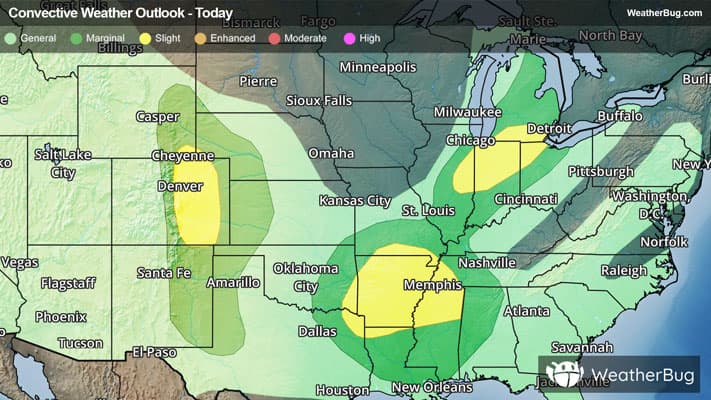
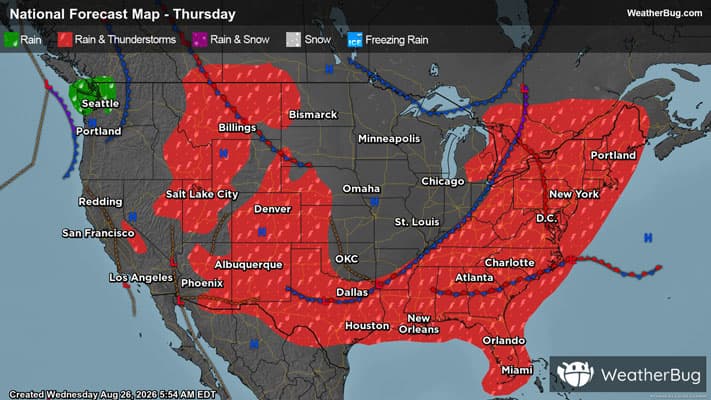
-There is a Marginal Severe Storm Risk for your location. Continue reading for today's outlook from the National Weather Service's Storm Prediction Center. -------------------- National Severe Storm Outlook THERE IS AN ENHANCED RISK OF SEVERE THUNDERSTORMS FOR WESTERN KANSAS THERE IS A SLIGHT RISK OF SEVERE THUNDERSTORMS SURROUNDING THE ENHANCED RISK AND OVER THE UPPER GREAT LAKES AND PARTS OF THE NORTHEAST SUMMARY Scattered severe thunderstorms are probable over parts of the central High Plains, with severe wind gusts (60 to 85 mph) being the primary hazard during the late afternoon and evening. Synopsis Water-vapor imagery this morning shows a mid- to upper-level low near the ND/Canadian border and a weak disturbance cresting a mid-level ridge over southeastern ON and moving towards NY. Downstream of a mid-level trough over the Southwest, a couple of weak mid-level vorticity maxima over the southern and central High Plains will slowly migrate northeast around the periphery of a mid-level anticyclone centered over TN. A front will push east across parts of the Upper Midwest and extend southwestward into the central High Plains near a weak low. A weak lee trough/dryline will focus storm development from western KS southward into the southern High Plains. Southern/Central High Plains Perhaps associated with a weak disturbance, scattered thunderstorms are forecast later this afternoon over the High Plains on the western rim of richer low-level moisture and strong insolation. Model guidance shows considerable erosion of the capping layer by mid afternoon with MLCAPE ranging from 1500 J/kg over the TX South Plains to 3500 J/kg over western KS. Initially higher-based convection will gradually move east into richer moisture and promote larger thunderstorm cores and increased potential for storm clusters to develop. Large hail will be possible with any supercell activity (i.e., most probable from the northern TX Panhandle into KS; 25-40 kt effective shear). However, very steep surface to 300-mb lapse rates will favor strong evaporative cooling with the more intense cores. Ample deep-layer shear for organized storms but veering/backing of flow with height will aid in storm outflow aggregating as linear clusters become the primary storm mode with time. These organized but linear clusters will likely be efficient in promoting severe wind gusts (60-85 mph) during the early evening, coincident with a strengthening LLJ and WAA before this threat wanes by late evening. Weaker deep-layer shear farther south in the southern High Plains will likely limit both storm organization and overall coverage of the wind risk. Upper Midwest/Great Lakes An ongoing area of showers and isolated thunderstorms over the upper MS Valley will likely translate east-northeast today in conjunction with a convectively augmented mid-level disturbance over southern MN this morning. Ahead of this activity, a fetch of very rich moisture will be maintained within south-southwesterly low-level flow. As the boundary layer destabilizes ahead of this disturbance, additional storms are forecast to develop later today within a very to extremely unstable airmass. Ample tropospheric flow will support organized storms, including supercells capable primarily of a hail/wind risk and perhaps a tornado. By late evening, strengthening WAA across NE and the mid MO Valley implies widely scattered storms developing during the mid-late evening, with this activity shifting northeast during the overnight. Isolated hail/wind are the main threats with the stronger storms. Northeast A belt of 30-40 kt 500-mb northwesterly flow will reside across the Northeast today. There is uncertainty regarding boundary layer destabilization over portions of this region. Nonetheless, weak to moderate destabilization is progged by model guidance with isolated to scattered storms developing by early afternoon. A couple of short-lived supercells are possible before one or more clusters/bowing segments develop and spread south and eastward with damaging wind potential. Southeastern US Located to the south of an upper high centered over the OH/TN Valley, a very moist air mass will be present across much of the region. Strong heating will yield moderate buoyancy by early afternoon. Forecast soundings depict around 20-kt effective shear which will aid in minor multicellular organization. Localized 50-60 mph gusts capable of isolated wind damage will probably accompany the stronger storms.