Severe Storm Risk - Rogers, AR
Severe Storm Risk
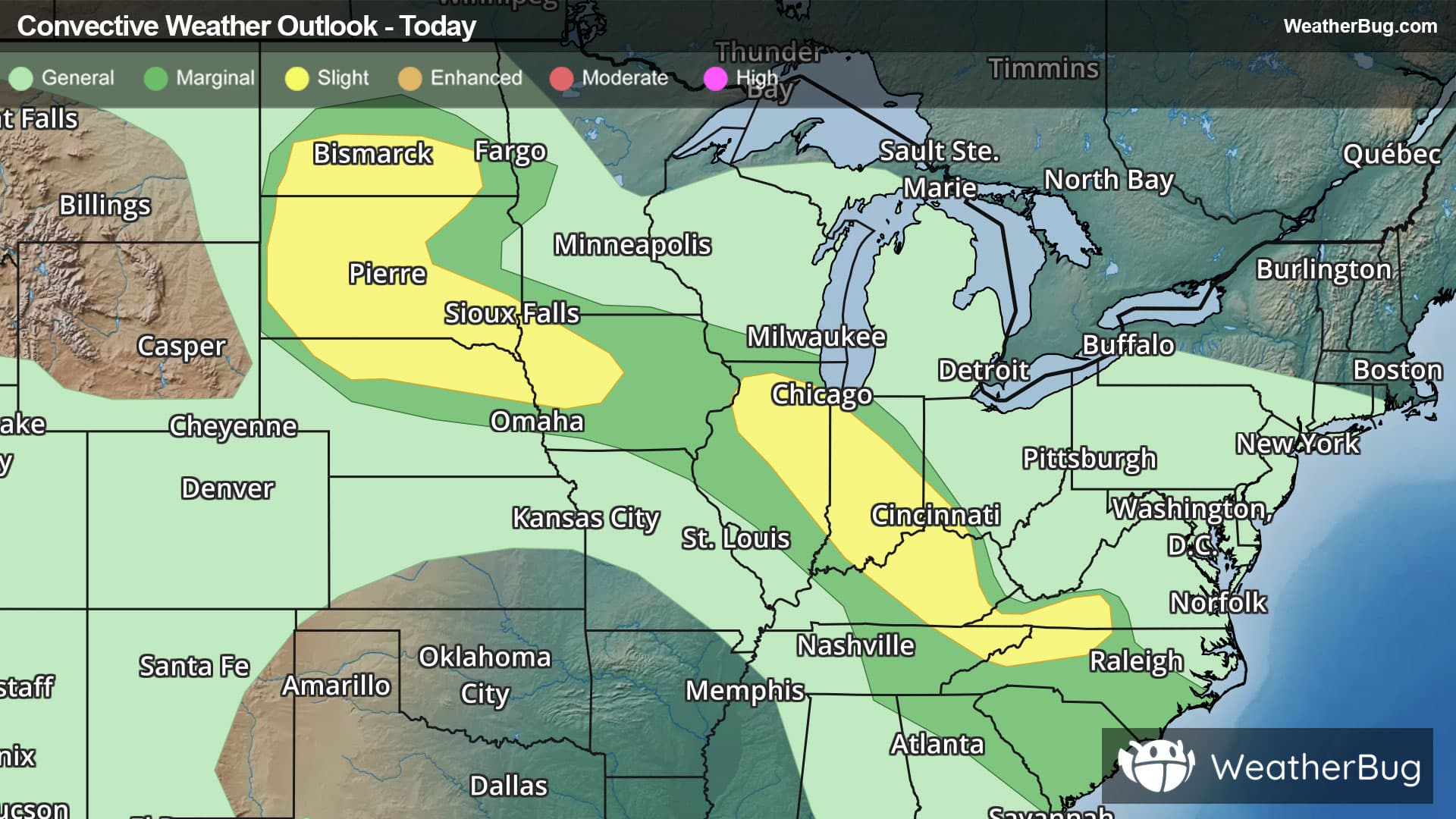
-There is a Slight Severe Storm Risk for your location. Continue reading for today's outlook from the National Weather Service's Storm Prediction Center. -------------------- National Severe Storm Outlook THERE IS AN ENHANCED RISK OF SEVERE THUNDERSTORMS ACROSS KANSAS AND NORTHERN OKLAHOMA TO WESTERN MISSOURI SUMMARY Scattered severe thunderstorms with large to very large hail, damaging winds and tornadoes are expected this afternoon through tonight across parts of the southern/central Plains to Lower Missouri Valley. A couple of strong tornadoes and hailstones up to 2-3 inches in diameter are possible. Southern/Central Plains to the Mid Mississippi Valley Appreciable severe potential is still readily apparent especially later this afternoon into tonight, although sub-regional details remain quite complex, particularly regarding the southern extent of deep convective initiation southward along the dryline. A weak lead mid-level vorticity maximum over the central High Plains early today will continue to aid elevated thunderstorm development across Kansas through the afternoon. See Mesoscale Discussion 547 for short-term details. Increasing MUCAPE with persistent low-level warm/moist advection and steepening mid-level lapse rates combined with strong deep-layer shear will support organized updrafts, including the potential for supercells. This convection will probably tend to remain elevated to the north of a front as it spreads east-northeastward over the central Plains, but scattered large hail may occur given the overall favorable environment. Isolated 2+ inch diameter hail also appears possible with the strongest cores. Eventually, this activity may pose a greater threat for damaging winds across eastern Kansas into western Missouri by late afternoon/early evening. A more notable mid-level shortwave trough is expected to eject northeastward across the Southwest and southern/central High Plans today, accompanied by a 50-60 kt southwesterly mid-level jet. Weak lee cyclogenesis is forecast to occur across the southeast Colorado/northeast New Mexico vicinity in response, with the surface low developing into the Oklahoma Panhandle and southwest Kansas by this evening. Strong to locally extreme instability is forecast to develop east of a sharpening dryline across western/central Oklahoma as daytime heating of a moist airmass occurs. There is still a fair amount of uncertainty with the placement of an effective warm front by late afternoon/early evening, but current expectations are for this boundary to be draped somewhere near north-central Oklahoma by peak afternoon heating. The surface triple point may serve as a focus for convective initiation later today into this evening, although better large-scale ascent associated with the mid-level shortwave trough overspreading the warm sector will be delayed until this evening and past peak diurnal heating. Greater than average uncertainty exists regarding the potential for surface-based convective initiation today in Oklahoma/north Texas, but the volatile environment and ample conditional-type potential is concerning. It appears possible that multiple supercells may develop with gradual erosion of lingering MLCIN and weak ascent preceding the ejecting shortwave trough. Any supercells that can root and ingest the ample low-level moisture will be capable of producing very large hail (2-3+ inches in diameter) given a overall rather favorable environment. The tornado potential is less clear through the day, but a southerly low-level jet will quickly strengthen this evening and aid curved/elongated hodographs with strong effective SRH. A somewhat conditional/uncertain threat for a couple of strong tornadoes remains apparent, especially if any supercells that can form this afternoon persist into the evening. Additional, somewhat elevated supercells may form this evening into tonight along/north of the warm front from northern Oklahoma near the triple point into Kansas. This activity will also pose a threat for large to very large hail and possibly an increasing tornado/damaging wind risk. Farther south into Texas, the forcing for ascent will remain weak/nebulous along the dryline. Still, some potential for a few supercells is apparent across north-central Texas where the greatest heating and minimal MLCIN is forecast to exist. Large to very large hail should be the main threat with any splitting supercells that can develop this afternoon along/east of the dryline and be sustained.