Severe Storm Risk - Sugar Hill, GA
Severe Storm Risk
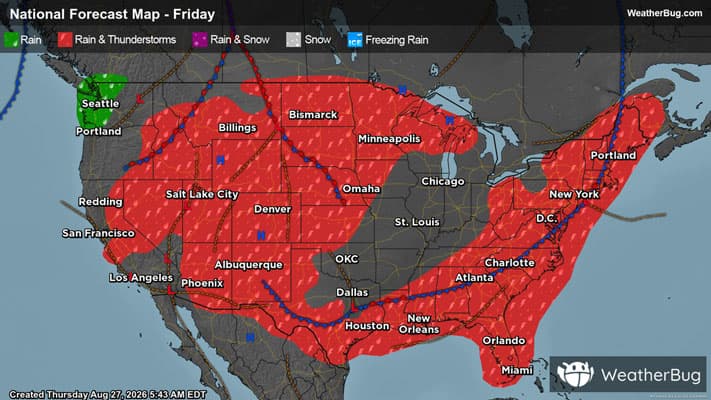
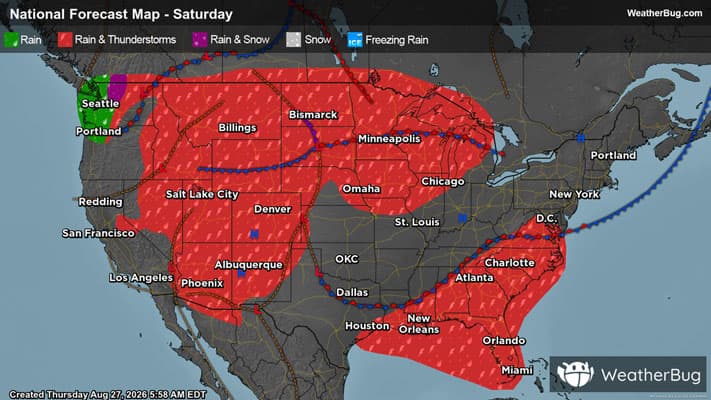
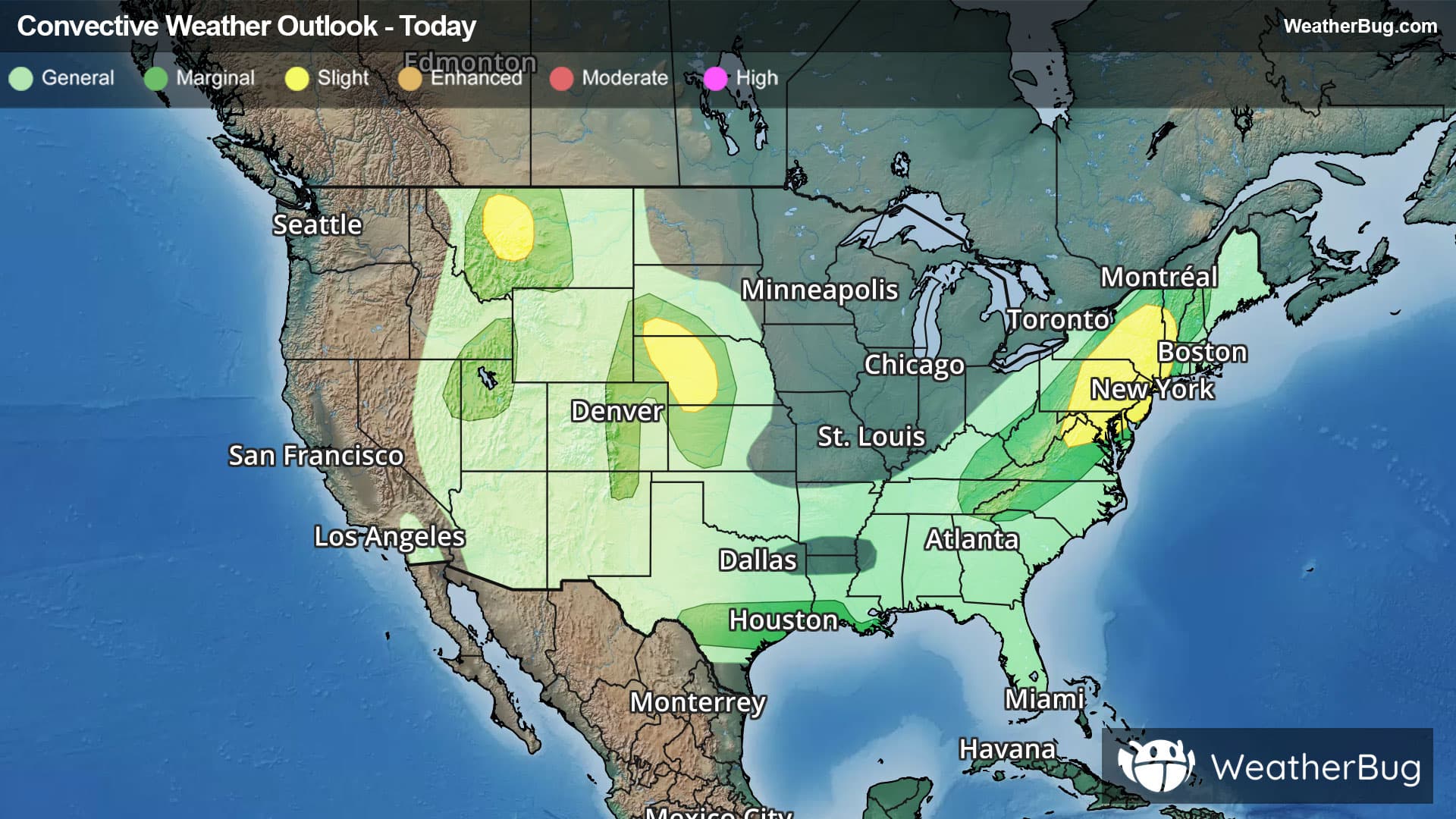
-There is a Marginal Severe Storm Risk for your location. Continue reading for today's outlook from the National Weather Service's Storm Prediction Center. -------------------- National Severe Storm Outlook THERE IS AN ENHANCED RISK OF SEVERE THUNDERSTORMS ACROSS PORTIONS OF THE MIDWEST INTO THE UPPER GREAT LAKES THERE IS A SLIGHT RISK OF SEVERE THUNDERSTORMS ACROSS PORTIONS OF THE CENTRAL HIGH PLAINS AND THE NORTHEAST SUMMARY Scattered severe thunderstorms are forecast across the Upper Midwest/Great Lakes today and tonight. A couple of tornadoes are possible but damaging wind gusts are expected to be the more widespread hazard, in addition to isolated large to very large hail. Additional severe storms are possible across parts of the central High Plains and Northeast. Midwest and Upper Great Lakes Showers and thunderstorms this morning are moving east over the Upper Midwest and are associated with a couple of MCVs over northwest IA and the SD-MN border. The ongoing strong to locally severe thunderstorm activity is situated in the vicinity of a west-east oriented frontal zone draped from MN east across WI and into the U.P. of MI. (see MCD #1413 for short-term details). The airmass south of the boundary is very moist with lower to mid 70s F surface dewpoints. The Sioux Falls, SD (KFSD), Minneapolis, MN (KMPX), and the La Crosse, WI (KARX) VAD this morning are sampling a belt of strong southwesterly mid- to high-level flow (50+ kt in the 5-9km ARL layer). KARX has recently sensed an intensification of flow in the 3-6 km layer, which may influence the threat for wind damage/large hail beyond an isolated basis and beginning as early as late morning. Furthermore, it seems the strengthening of flow as depicted in some model guidance (upwards of 40-45 kt at 700 mb) may be of consequence for organizing multicells but also supercells during the day. The details concerning the tornado risk remain unclear and will likely remain mesoscale dependent and related to the persistence of morning convection and the airmass recovery, but it seems plausible the threat for supercell tornadoes would perhaps focus over WI and possibly extend into southern MN/northern IA this afternoon in wake of this morning's WAA-driven activity. Large to very large hail will be possible with the more intense storms in addition to wind, which may become more prevalent of a hazard (60-75 mph) as storm mergers lead to a couple of strong to severe clusters developing. Central and southern High Plains High-based thunderstorm development is expected along a north/south-oriented lee trough/dryline during the afternoon and evening. Despite modest deep-layer shear (around 25-30 kt), steep low/mid-level lapse rates will contribute to a strongly unstable airmass. A mix of loosely organized clusters and possibly some supercell structures will be capable of producing severe wind gusts and large hail. Farther south, weaker flow will limit overall storm organization, but steep lapse rates will support severe gusts with the more intense downdrafts. Northeast Enhanced west-northwesterly midlevel flow will persist across the Northeast, where a warm/moist air mass will contribute to around 3000 J/kg MLCAPE. While nebulous mesoscale forcing for ascent casts uncertainty on overall convective coverage and evolution, the strong buoyancy and a veering wind profile (albeit modest deep-layer shear) will favor east-southeastward-spreading convection capable of damaging wind gusts and isolated hail during the afternoon and again during the evening/nighttime hours. Southeast Along the southern periphery of a midlevel anticyclone centered over the central Appalachians, weak easterly flow through much of the troposphere will overspread a hot/moist air mass with 3000-4000 J/kg MLCAPE during the afternoon. Strong to severe pulse thunderstorms are forecast. The stronger water-loaded wet microbursts will yield localized gusts of 50-65 mph and be capable of wind damage. MT into the northern Great Basin Isolated to widely scattered thunderstorms are expected ahead of a slow-moving midlevel trough moving across the Northwest. Preceding the trough, around 40 kt of midlevel southwesterly flow and a weakly unstable air mass will support a couple loosely organized clusters capable of producing severe wind gusts during the afternoon and evening. Have extended low-severe probabilities farther south into ID/NV/UT where inverted-V profiles will support isolated severe gusts.