Weather Alerts For Winters, CA
High Wind Warning
-URGENT - WEATHER MESSAGE National Weather Service Sacramento CA 133 PM PST Tue Dec 23 2025 Northern Sacramento Valley-Central Sacramento Valley-Southern Sacramento Valley-Carquinez Strait and Delta-Northern San Joaquin Valley-Northeast Foothills/Sacramento Valley-Motherlode- Including the cities of Paradise, Modesto, Jackson, Redding, Marysville/Yuba City, Red Bluff, Sacramento, Fairfield/Suisun, Oroville, Grass Valley, Stockton, and Chico 133 PM PST Tue Dec 23 2025 ...HIGH WIND WARNING REMAINS IN EFFECT UNTIL 4 PM PST THURSDAY... * WHAT...South winds 25 to 35 mph with gusts up to 60 mph expected. * WHERE...Carquinez Strait and Delta, Sacramento Valley, Motherlode, Northeast Foothills, and Northern San Joaquin Valley. * WHEN...Until 4 PM PST Thursday. * IMPACTS...Strong winds and saturated soils could blow down trees and power lines resulting in widespread power outages. Strong winds will cause impacts to loose and unsecured items, including temporary structures and holiday decorations. Difficult travel conditions are expected, especially for high profile vehicles. * ADDITIONAL DETAILS...Two periods of strong wind gusts expected tonight into Wednesday morning and again Wednesday night into Thursday, with a lull during the day on Wednesday. PRECAUTIONARY/PREPAREDNESS ACTIONS... Watch for falling debris and tree limbs. Use caution if you must drive. Take time now to prepare for potential power outages. &&
Flood Watch
-Flood Watch National Weather Service Sacramento CA 1134 AM PST Tue Dec 23 2025 Shasta Lake Area / Northern Shasta County-Burney Basin / Eastern Shasta County-Northern Sacramento Valley-Central Sacramento Valley-Southern Sacramento Valley-Carquinez Strait and Delta- Northern San Joaquin Valley-Mountains Southwestern Shasta County to Western Colusa County-Northeast Foothills/Sacramento Valley- Motherlode-Western Plumas County/Lassen Park-West Slope Northern Sierra Nevada- Including the cities of Blue Canyon, Paradise, Modesto, Jackson, Redding, Marysville/Yuba City, Alder Springs, Quincy, Shasta Dam, Red Bluff, Sacramento, Fairfield/Suisun, Oroville, Burney, Grass Valley, Stockton, Chester, and Chico 1134 AM PST Tue Dec 23 2025 ...FLOOD WATCH REMAINS IN EFFECT THROUGH FRIDAY AFTERNOON... * WHAT...Flooding caused by excessive rainfall continues to be possible. * WHERE...A portion of northern California, including the following areas, the Sacramento Valley, northern San Joaquin Valley, Delta region, Sierra Nevada and adjacent foothills, and Coastal Range. * WHEN...Through Friday afternoon. * IMPACTS...Excessive runoff will result in rises along area rivers, creeks, streams. Small streams and creeks may rise out of their banks. Flooding may occur in low-lying, poor drainage, and urban areas. Mudslides and rockslides may occur in mountain and foothill areas. * ADDITIONAL DETAILS... - Periods of moderate to heavy rain are forecast the week of Christmas. Debris flows are not expected over recent burn scars in northern California, but do anticipate enhanced runoff in/below scars. - http://www.weather.gov/safety/flood PRECAUTIONARY/PREPAREDNESS ACTIONS... You should monitor later forecasts and be alert for possible Flood Warnings. Those living in areas prone to flooding should be prepared to take action should flooding develop. &&
Severe Storm Risk
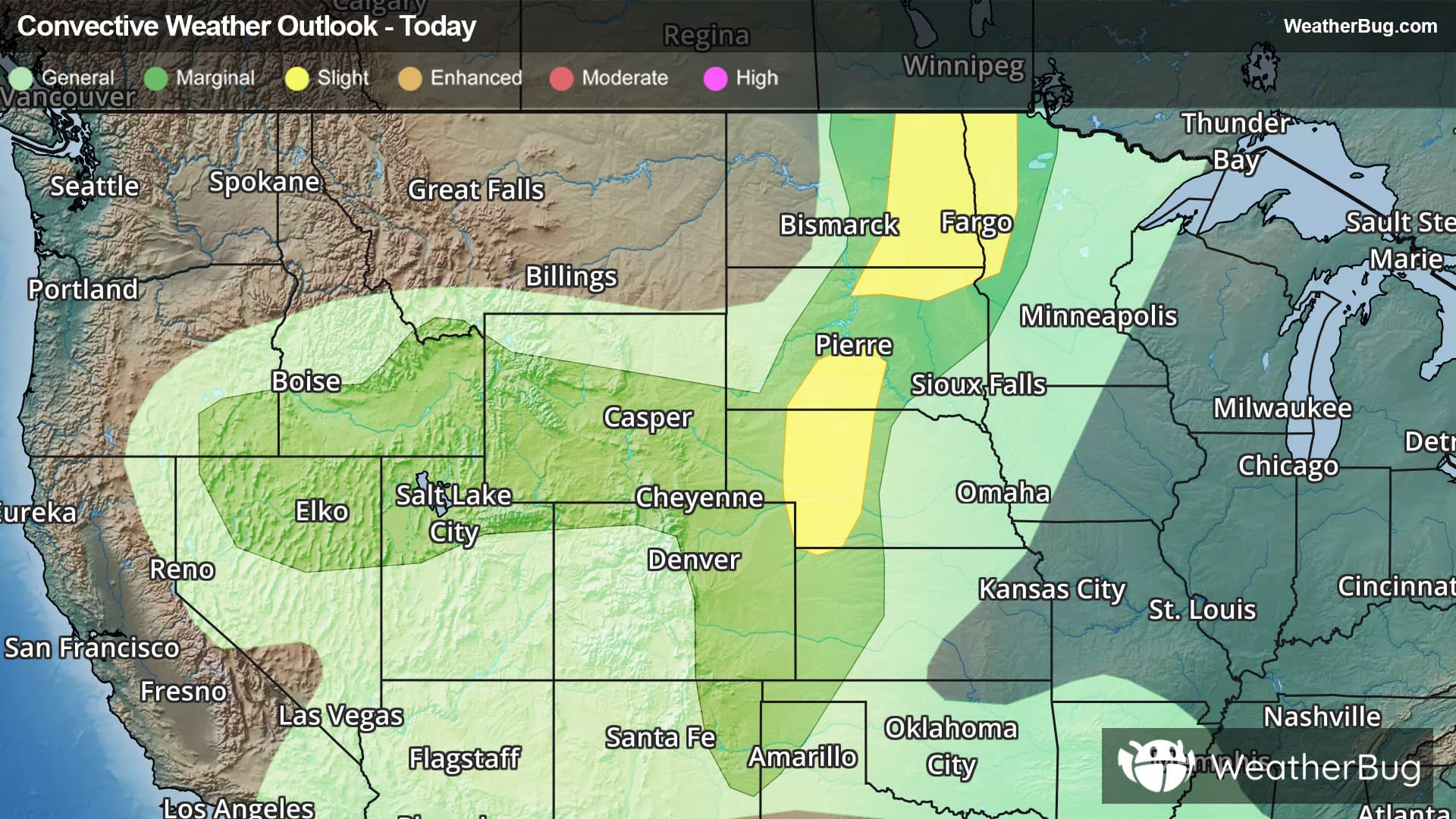
-There is a Marginal Severe Storm Risk for your location. Continue reading for today's outlook from the National Weather Service's Storm Prediction Center. -------------------- National Severe Storm Outlook THERE IS A MARGINAL RISK OF SEVERE THUNDERSTORMS ACROSS COASTAL CALIFORNIA AND THE CENTRAL VALLEY SUMMARY Thunderstorms with marginally severe wind gusts, small hail and potentially a brief tornado will be possible from Wednesday into Wednesday night along parts of the California coast, and inland across the San Joaquin Valley. Synopsis A high-amplitude midlevel pattern will persist on Wednesday, characterized by a deep trough across the eastern Pacific and a building ridge across the Plains. This pattern will maintain a broad belt of intense cyclonic flow across California into the Interior West. Throughout the day, an initial shortwave trough will continue lifting northeast from the eastern Pacific into the Pacific Northwest, while the attendant surface low lifts more northward along the coast toward Washington. Late on Wednesday a second, more potent trough will approach central and northern California -- primarily after dark. This setup will facilitate a prolonged period rain and embedded thunderstorms across California and portions of the Interior West into Thursday. California Coast Strong ascent and strengthening onshore flow will aid in modest destabilization Wednesday morning ahead of a surface cold front. An ongoing band of convection is expected across the central and southern coastal areas associated with the strongly forced ascent along the advancing cold front. Given the presence of a strong low-level jet (locally exceeding 50 knots at 1 km AGL), there is a risk that these strong winds will mix to the surface within the strongest convection resulting in damaging wind gusts. Forecast soundings across the area do maintain some low-level curvature ahead of the convective line, such that any convective element able to interact with true surface-based buoyancy would have the potential for a brief tornado. In the wake of the morning convection, a secondary surface low will intensify during the afternoon and overnight as it approaches the northern California coast. This will likely trigger another round or two of broken, low-topped convection along a second cold front. Despite weaker instability than with the morning convection, the strength of the wind fields would suggest an ongoing risk for isolated wind damage as this convection moves inland. Central Valley Cold midlevel temperatures and increasing height falls will overspread surface dewpoints in the 40s to perhaps low 50s. Although buoyancy will remain modest (MUCAPE at or below 500 J/kg), the presence of a powerful midlevel jet in excess of 100 knots will support long hodographs. This combination of modest instability and large/long hodographs may support a threat for semi-organized convection, including some potential for supercells. The strongest storms will be capable of producing damaging gusts, hail, and a brief tornado before the convection shifts east into the higher terrain and weakens.