Back to 10 Day Forecast
Did Weather Play A Large Role in the Course of World War I?
November 11, 2025 at 07:28 AM EST
By WeatherBug Meteorologist, Andrew Rosenthal
An unusual weather pattern may have played an impact in some of the most decisive battles of World War I and may have exacerbated the pandemic that followed the war.
The authors, publishing in GeoHealth magazine in 2020, extracted ice cores from a glacier in the Alps near the France-Switzerland-Italy border. They then chemically analyzed these ice cores, gaining a peek at the structure of the air in place down to the level of days or weeks. Then, after undertaking a meteorological analysis of weather conditions at this time, they were able to reconstruct the weather pattern over Europe.
The results were quite interesting. Between 1912 and 1918, a broad upper-level low pressure system became locked in place between Iceland and Scandinavia. Coupled with high pressure over the western parts of north Africa, this produced a pattern of strong westerly winds that drove cold Atlantic moisture across France and northern Europe.
The study also found that increases in the concentrations of sodium and chlorine in the ice core – which were seen as an indicator of intense pushes of marine air inland – coincided with some of the deadliest battles of the so-called “trench war” period of World War I. For example, one of these cold, wet periods pushed as far east as Turkey, in November 1915. The authors theorized that this may have greatly impacted the already six-month-old Gallipoli campaign for the Allies, which ultimately ended in defeat in January 1916 and prolonged the war another three years. Likewise, precipitation increased in western Europe throughout 1916, peaking in December with the battles of the Somme and Verdun.
As the soggy, colder-than-average weather filled trenches with rainwater, the battlefields were reduced to mud-covered messes, which slowed the military operations greatly and led to vastly increased casualties. Bitterly cold temperatures due to this weather pattern also led to crop failures in Germany that likely hampered the war effort.
As if the weather’s impact on the war wasn’t enough by itself, the authors theorized that the soggy weather pattern may have helped to develop and spread the H1N1 flu virus, responsible for the 1917-18 “Spanish Flu” pandemic that killed more than 50 million people worldwide.
The wet weather combined with the battlefield to produce less-than-sanitary conditions, perfect for viral spread. In addition, the theory is that the weather pattern greatly disrupted the migration of mallard ducks in 1918, with the ducks having been a primary reservoir of the virus. As the war wound down ahead of its end on November 11, 1918 – Armistice Day, now celebrated as Veterans Day – returning troops spread the flu like wildfire across their native countries, leading to immense death tolls around the world.
While the weather has often been cited for impacting individual battles, it is fascinating to see how a weather pattern may have changed the entire course of a war, and with it world history.
Source: More, A. F., Loveluck, C. P., Clifford, H., Handley, M. J., Korotkikh, E. V., Kurbatov, A. V., et al. (2020). The impact of a six-year climate anomaly on the “Spanish flu” pandemic and WWI. GeoHealth, 4, e2020GH000277. https://doi.org/10.1029/2020GH000277
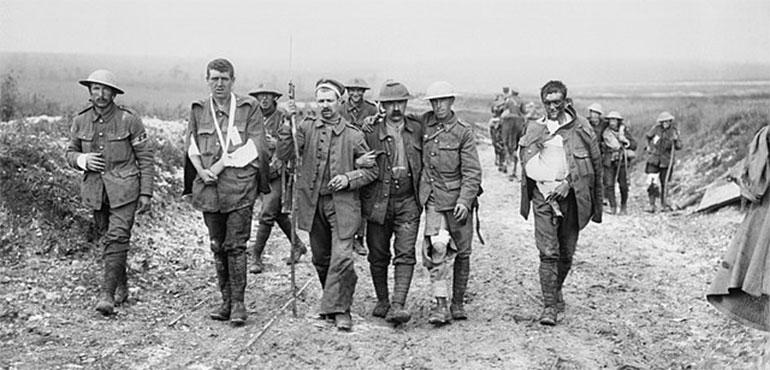
Image: A German prisoner helps British wounded make their way to a dressing station near Bernafay Wood during the Battle of the Somme (Wikimedia Commons).
The authors, publishing in GeoHealth magazine in 2020, extracted ice cores from a glacier in the Alps near the France-Switzerland-Italy border. They then chemically analyzed these ice cores, gaining a peek at the structure of the air in place down to the level of days or weeks. Then, after undertaking a meteorological analysis of weather conditions at this time, they were able to reconstruct the weather pattern over Europe.
The results were quite interesting. Between 1912 and 1918, a broad upper-level low pressure system became locked in place between Iceland and Scandinavia. Coupled with high pressure over the western parts of north Africa, this produced a pattern of strong westerly winds that drove cold Atlantic moisture across France and northern Europe.
The study also found that increases in the concentrations of sodium and chlorine in the ice core – which were seen as an indicator of intense pushes of marine air inland – coincided with some of the deadliest battles of the so-called “trench war” period of World War I. For example, one of these cold, wet periods pushed as far east as Turkey, in November 1915. The authors theorized that this may have greatly impacted the already six-month-old Gallipoli campaign for the Allies, which ultimately ended in defeat in January 1916 and prolonged the war another three years. Likewise, precipitation increased in western Europe throughout 1916, peaking in December with the battles of the Somme and Verdun.
As the soggy, colder-than-average weather filled trenches with rainwater, the battlefields were reduced to mud-covered messes, which slowed the military operations greatly and led to vastly increased casualties. Bitterly cold temperatures due to this weather pattern also led to crop failures in Germany that likely hampered the war effort.
As if the weather’s impact on the war wasn’t enough by itself, the authors theorized that the soggy weather pattern may have helped to develop and spread the H1N1 flu virus, responsible for the 1917-18 “Spanish Flu” pandemic that killed more than 50 million people worldwide.
The wet weather combined with the battlefield to produce less-than-sanitary conditions, perfect for viral spread. In addition, the theory is that the weather pattern greatly disrupted the migration of mallard ducks in 1918, with the ducks having been a primary reservoir of the virus. As the war wound down ahead of its end on November 11, 1918 – Armistice Day, now celebrated as Veterans Day – returning troops spread the flu like wildfire across their native countries, leading to immense death tolls around the world.
While the weather has often been cited for impacting individual battles, it is fascinating to see how a weather pattern may have changed the entire course of a war, and with it world history.
Source: More, A. F., Loveluck, C. P., Clifford, H., Handley, M. J., Korotkikh, E. V., Kurbatov, A. V., et al. (2020). The impact of a six-year climate anomaly on the “Spanish flu” pandemic and WWI. GeoHealth, 4, e2020GH000277. https://doi.org/10.1029/2020GH000277
Image: A German prisoner helps British wounded make their way to a dressing station near Bernafay Wood during the Battle of the Somme (Wikimedia Commons).