


Today's Weather Outlook
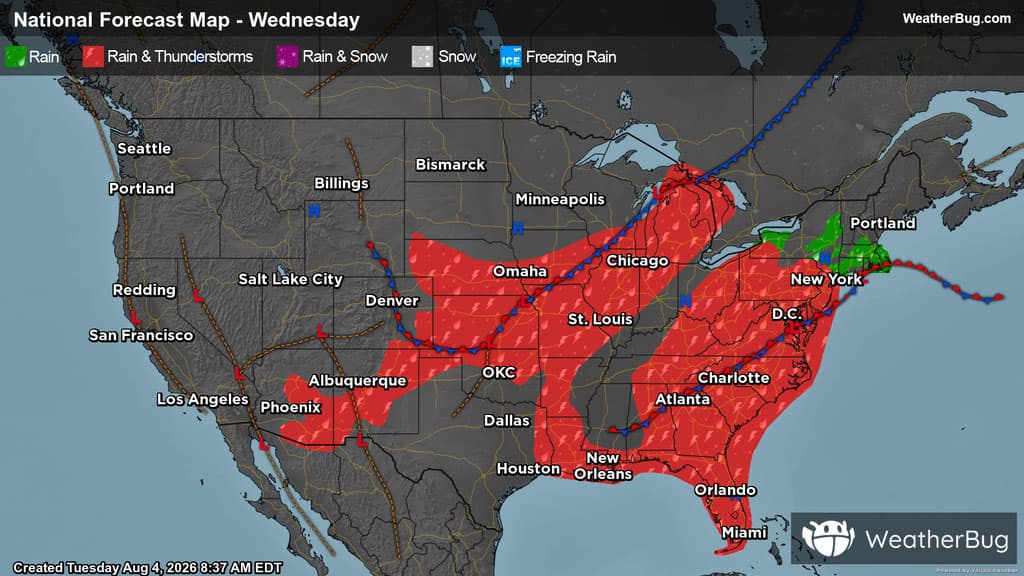
A stormy day is in store for much of the Eastern half of the U.S., while the Western U.S. sizzles in the heat.
A low pressure system hanging over Washington, DC, along with a cold front draped over the East Coast bring scattered showers and thunderstorms to the Gulf Coast, Southeast, Tennessee and Ohio Valleys, and up through the northern Mid-Atlantic. While possible throughout the day, the best chance for active weather will be in the afternoon and evening hours.
Meanwhile, another cold front extending from the Central Plains through the Midwest will fuel widespread showers and thunderstorms in the region. Earlier in the day, lingering storms from Tuesday will persist in the Central Plains and the Upper Midwest, while a new round of storms will spark in the Lower Midwest later in the day. The Lower Midwest in particular could see repeated rounds of heavy downpours where local rain totals of 1 to 3 inches will be common, which could cause dangerous flash-flooding. This is especially the case near creeks, rivers and streams as well as urban, low-lying areas. If you do approach a flooded roadway, remember that it is always best to “Turn Around, Don’t Drown!”
In the Desert Southwest, monsoonal moisture, low pressure, and daytime heating will trigger scattered showers and storms in the evening. In the meantime, expansive high pressure will keep the rest of the Western U.S. and the High Plains quiet, with clear or partly cloudy skies.
High temperatures east of the Mississippi River and in the Lower Midwest will be in the 80s and 90s, except for portions of the Appalachian Spine which will see highs in the 70s. The Upper Midwest, along with the Central and High Plains will be cooler, with high temperatures in the 70s and 80s. Meanwhile, high temperatures in the 90s cover much of the Deep South, Lower Plains, and the South-Central U.S., where the latter could see a few spots surpassing 100 degrees.
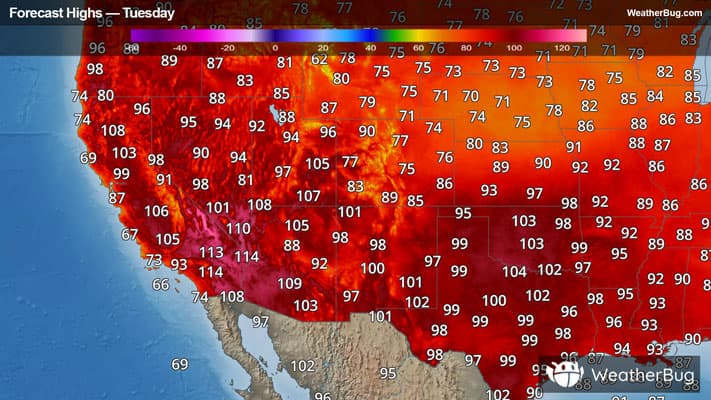
Out in the West, highs in the 60s and 70s are expected throughout the higher elevations of the Rockies and Cascades. The rest of the West will be very hot, with widespread temperatures in the 90s, while the Desert Southwest and California’s Central Valley will reach well into the triple digits, where some spots could approach 120 degrees!